Pakistan's proposed budget for fiscal year 2026-27 rests on ambitious tax collection targets, offers little relief to lower-income salaried workers and lacks a clear strategy to revive industry and attract investment, senior journalist Nadeem Malik said.
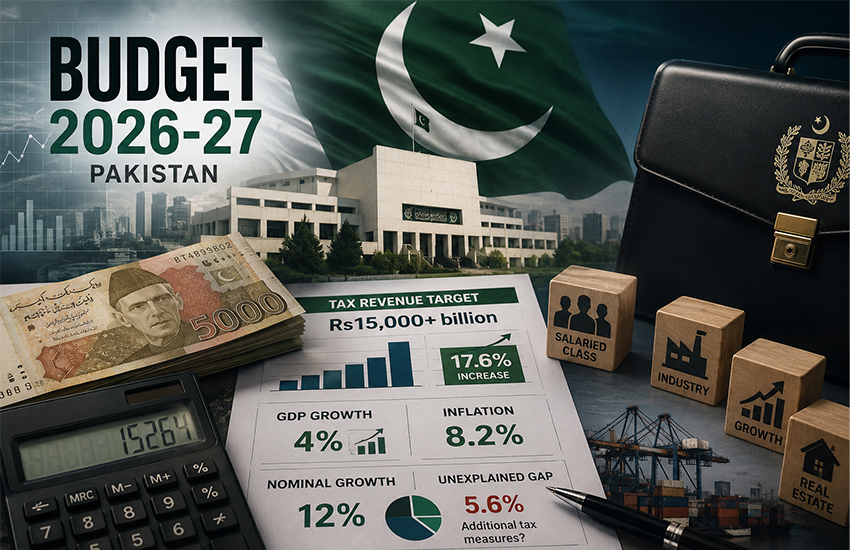
Speaking during a post-budget television transmission, Malik questioned how the government planned to achieve a 17.6% increase in tax revenues next fiscal year, arguing that the numbers presented in the budget were difficult to reconcile with the government's own economic projections.
The government has set a tax collection target of more than Rs15 trillion for the next fiscal year, compared with around Rs13 trillion in the outgoing year, implying an increase of roughly Rs2.264 trillion.
At the same time, the budget projects economic growth of 4% and inflation of 8.2%.
Malik said those two figures combine to produce nominal economic growth of about 12%, raising questions about how the government intends to bridge the gap between projected economic expansion and the much higher growth in tax revenues.
"How they are going to get the remaining 5.6% is by additional tax measures, which they have not announced yet," Malik said.
He said the government may eventually withdraw sales tax exemptions or introduce other revenue measures through statutory regulatory orders (SROs), a route often used to broaden the tax base without announcing headline tax increases during the budget speech itself. "Those details are yet to come, and I believe there will be many items under this head," he said.
Malik said it was also not guaranteed that the government's economic assumptions would materialise. While officials have projected nominal growth of around 12%, actual performance could fall short.
"When I talked about the nominal growth of 12%, it is not necessary that the target will be achieved. It could be 8 or 9%, no one knows," he said.
If growth undershoots projections, the government may be forced to adopt additional fiscal measures to meet revenue targets, he added.
"No such measure was visible in the finance minister's speech. Things will be clear when the SROs are issued step by step."
Growth Assumptions
According to Malik, the budget reflects a broader problem in economic policymaking: the expectation that tax revenues can continue rising rapidly even when economic activity remains subdued.
"There is a fundamental principle that when the economy is not growing, the growth of taxes comes down," he said. "A fast-moving economy has greater potential of generating more revenue."
He argued that the revenue projections contained in the budget raise concerns about the credibility of the government's growth assumptions. "The numbers they have presented are not genuine and have a lot of issues, especially where growth is shown," he said.
Industry’s Revival
Malik said the budget should have included measures aimed at reviving industrial activity, lowering production costs and attracting foreign direct investment, areas he described as critical for sustainable economic expansion.
"The budget should have reflected an out-of-the-box approach to revive Pakistan's industry and boost foreign direct investment, but not even a single step in that direction has been mentioned," he said.
Asked whether the budget outlined a strategy capable of delivering stronger growth, Malik said he had not seen evidence of one. "There is apparently no strategy through which growth could be achieved without reducing the cost of production," he said.
While budget documents primarily focus on government income and expenditures, he said economic planners should have simultaneously outlined measures capable of stimulating growth in the wider economy.
NFC Arrangement & ‘Gifted’ Funds
Malik also highlighted what he described as a major development in relations between the federal government and provinces, arguing that Islamabad's fiscal position has become so constrained that new arrangements were needed to support federal finances.
"The main issue is that the federal government does not have resources," he said.
According to Malik, authorities had previously attempted to persuade provinces to consider a new National Finance Commission (NFC) arrangement.
Another proposal under discussion involved provinces transferring part of their resources to the federal government in exchange for the devolution of the Benazir Income Support Programme (BISP), he said.
However, that proposal faced strong resistance, particularly from the Pakistan People’s Party.
Malik said Finance Minister Muhammad Aurangzeb revealed an important figure during his budget speech when he stated that provincial allocations would remain fixed at Rs13.35 trillion.
According to Malik's interpretation of the budget figures, revenues collected above that level and up to Rs15.264 trillion would effectively remain with the federal government.
"From here until Rs15.264 trillion, which is approximately Rs1.9 trillion, the provinces will grant that amount to the federal government," he said. He described the arrangement as a significant development given the state of federal finances.
At present, debt servicing alone costs around Rs8 trillion annually, consuming a substantial portion of federal resources.
According to Malik, the additional Rs1.9 trillion amounts to roughly 1.5% to 1.75% of gross domestic product.
"Basically, this will be gifted to the Centre from the divisible pool without even changing the NFC formula, while maintaining the same distribution ratio," he said.
He added that the arrangement appeared likely to remain in place not only during the upcoming fiscal year but also for the following two years. "It appears that the Centre and provinces have agreed to this new economic cooperative arrangement."
Impact on Salaried Class
Malik was equally critical of the budget's treatment of the salaried class, arguing that urban lower-income households continue to shoulder a disproportionate burden despite years of inflation and rising living costs.
"The impact of poverty and inflation is enormous in urban areas hosting low-income groups, especially the salaried class," he said.
"I believe the finance minister has absolutely failed in this area. The budget speech is disappointing."
He criticised the government's decision to maintain the minimum taxable income threshold at Rs600,000 annually instead of raising it to Rs1.2 million.
According to Malik, the government effectively chose to continue collecting roughly Rs1,000 per month from individuals earning between Rs600,000 and Rs1.2 million annually. The government has “preferred taking Rs1,000 per month from people earning Rs600,000 to Rs1.2 million instead of easily declaring the Rs1.2 million the basic threshold," he said.
Malik argued that a worker earning around Rs100,000 per month already faces significant financial pressures because of rent, utility bills and other household expenses.
"It must be considered that those earning Rs100,000 a month struggle to make both ends meet," he said. "Taking Rs1,000 from this is great unjust."
Maintaining the income threshold at Rs600,000 amounts to an oppressive measure, he added. "The government should have charged that amount from people in the Rs1.2 million-Rs1.8 million bracket."
A lower-income worker can barely provide for a family and should not be expected to make additional contributions to the national exchequer through income taxation, he said.
"The government took this step just to portray the number of income tax filers going up."
Supertax
On business taxation, Malik welcomed the reduction of supertax rates but argued that policymakers should have gone further.
"The abolition of supertax is a move in the right direction, but instead of decreasing the ratios on business, it should have been abolished completely," he said.
He argued that both salaried individuals and corporations remain excessively taxed. "The maximum tax on the salaried class is around 35%, which should have been 25% at best."
Similarly, he said, the supertax imposed on the corporate sector should have been eliminated while overall tax rates on businesses should have been reduced.
According to Malik, stronger economic activity can only emerge when households and businesses retain a greater share of their income.
"You will see greater economic activity when people are allowed to retain more so that their buying power can increase," he said. "Planners should have made an economic model where people have some kind of disposable income."
"There can be no economic activity within closed doors. I did not see that kind of vision."
Black Money in Real Estate
Malik did, however, identify one positive measure in the budget, which is lower taxes for the real estate sector.
He said the principal challenge facing the sector is not taxation itself but documentation, given the large volume of undeclared wealth traditionally associated with property transactions. "The real challenge in that sector is to document it, since a lot of black money is involved," he said.
Maintaining very low tax rates, potentially starting at around 1%, would reduce incentives for under-reporting and encourage market participants to bring assets into the formal economy, he argued. "That would help bring all assets into the tax net."
Beyond the real estate sector, however, Malik said he saw little in the budget capable of generating the level of economic activity required to accelerate growth, raise investment and sustainably increase government revenues.


.jpg)

.jpg)