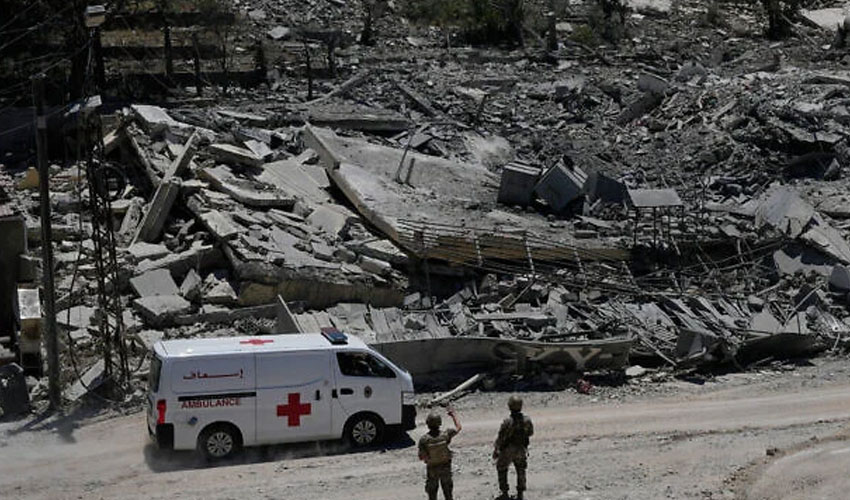
Israeli air and drone strikes across southern Lebanon have killed at least 12 people, including senior military officers.
The attacks come days after conditional ceasefire understandings brokered through US mediation.
Tensions remain high as both sides continue to exchange accusations and military action.
The Lebanese army confirmed that a brigadier general, a captain, and a soldier were killed when their military vehicle was struck on the Khardali–Nabatieh road.
The incident marks one of the most significant losses for the army since the escalation of cross-border violence.
Lebanon’s army said the attack targeted a clearly marked military vehicle during movement in the south.
Israeli response and ongoing operations
The Israeli military stated that the strike occurred in an “active combat zone,” adding that movement in such areas requires coordination with Israeli forces.
Officials said the incident is under investigation but maintained that operations continue against armed targets in southern Lebanon.
Separately, Israel claimed it has struck around 150 Hezbollah-linked targets over the past two days, including weapons storage sites and command centers.
Further Israeli air and drone strikes were reported in multiple locations:
- Six people killed in Saksakiyah in Sidon district
- One person killed in Deir al-Zahrani, Nabatieh district
- Another casualty reported on the Zifta–Nabatieh highway
- One additional death in Habboush municipality
Lebanon’s state media also reported several injuries and ongoing displacement in affected areas.
Lebanese leadership condemns attacks
Lebanese President Joseph Aoun condemned the strikes as a “flagrant violation” of sovereignty and international law.
Prime Minister Nawaf Salam described the attack as a “heinous crime” and extended condolences to the families of the slain soldiers, including Brigadier General Wassam Sabra, Captain Elie Khoury, and soldier Hussein Ghozal.
The Lebanese army said the attacks are undermining efforts to achieve stability and peace in the region.
Hezbollah called the strikes a “heinous crime,” accusing Lebanon’s government of failing to protect the country.
Iran’s Foreign Ministry also condemned the attacks, calling them a violation of Lebanese sovereignty.
Regional countries including Saudi Arabia, Jordan, and Qatar strongly denounced the strikes, calling for an immediate halt to hostilities.
The United Nations peacekeeping force in Lebanon (UNIFIL) warned that such attacks violate UN Security Council Resolution 1701 and threaten regional stability.
The violence comes amid fragile ceasefire arrangements that have repeatedly broken down between Israel and Hezbollah.
A US-mediated understanding announced recently has not held, with both sides accusing each other of violations.
The latest escalation follows months of cross-border strikes and retaliatory attacks linked to broader regional tensions involving Iran-backed groups.



.jpg)