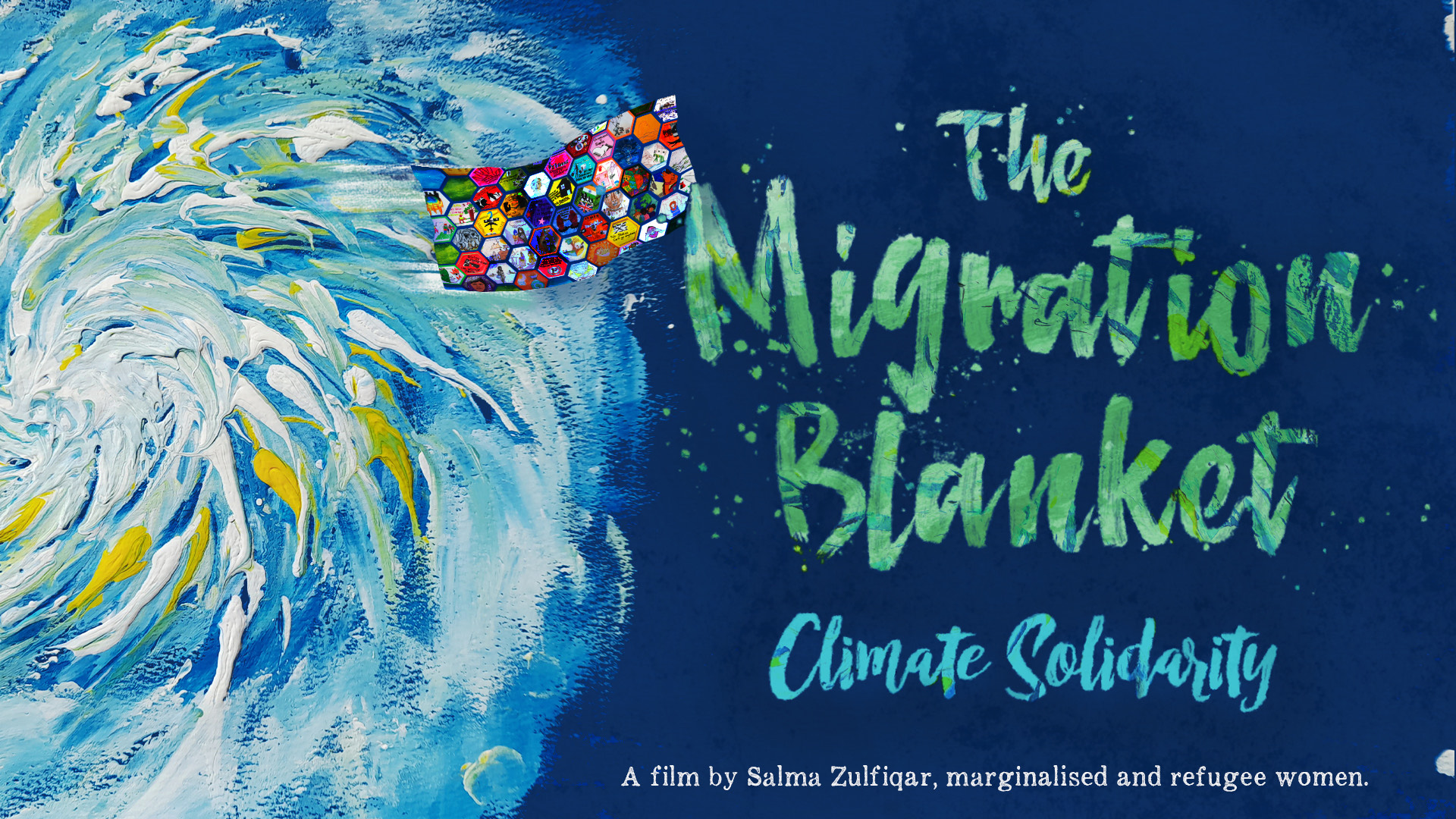
In an online workshop linking young women across 15 countries, far from any negotiating table, a girl from a fishing village explained why she believed the storms kept coming. She thought climate change was an act of God. When she said it aloud, many of the other young women in the workshop nodded. They had thought the same thing.
That moment, ordinary, quiet and devastating, sits at the heart of The Migration Blanket – Climate Solidarity, an award-winning art film that has travelled from displacement camps and classrooms to the Venice Biennale, and which its makers say is more urgent now than when it was first released in 2022.
The film is the work of British artist and human rights activist Salma Zulfiqar, who was awarded the British Empire Medal in King Charles III's 2023 Birthday Honours for services to the arts and education. It stitches together more than 400 pieces of handmade artwork created by 150 marginalised women in 15 countries, from Pakistan and Bangladesh to Kenya, Afghanistan, Jordan and the UK. The drawings were made in Salma's ARTconnects workshops, where women who had rarely been asked what they thought about anything were taught how, and why, the climate is changing around them.
What they revealed is a portrait of a crisis that falls hardest on the people least responsible for it.
When the farmland dies, the girls are married off
"No one was really talking about it," Salma says of the link between climate change and women's rights. "Women are more likely to be displaced. Many are in villages with children while husbands go to cities to find work. When they are displaced they become more vulnerable to abuse, violence, trafficking."
The pattern she describes is borne out by the data. According to UN Environment, an estimated 80 percent of people displaced by climate change are women and girls. UN Women's latest projections are starker still: by 2050, under a worst-case scenario, climate change could push up to 158 million more women and girls into extreme poverty, nearly half of them in sub-Saharan Africa. Already, 47.8 million more women than men face food insecurity and hunger.
Behind every figure is a decision made at a kitchen table. When a flood destroys farmland and a family loses its livelihood, Salma says, the response is often to marry off a daughter, sometimes as young as eight. "It is very concerning and unacceptable," she says. Among the film's participants, the stories repeated themselves: siblings married off, families surviving on a single meal a day, rice or bread, with vegetables once a week if they were lucky.
The voices from Balochistan, Swat
For audiences in Pakistan, the film's most resonant testimony comes from closer to home. Participants in Balochistan and Swat described not understanding why their lives were getting harder: the intensifying heat, the storms, the illnesses that followed when floodwater contaminated their drinking supply.
That was 2022. A year later, Salma says, the storms returned harder. Women she had worked with sent her images of collapsed homes. They had been displaced again, left without food or clean water.
READ ALSO: How Pakistan’s street workers see climate change as ‘God’s will’
It is a thread that runs from the catastrophic 2022 floods in Pakistan, which killed men working in the fields and left women widowed, to the rising grocery bills in London and the Gulf. "The impact of climate change in the Global South also affects the rest of the world," Salma argues. "Agriculture is hit, crops are destroyed, and prices rise. We have seen massive price hikes across the UK, Europe, the US and the Gulf. It is affecting all of us in different ways."
A seat at the table
Salma's central demand is about who gets to speak. "We need a seat at the table to make sure our voices are heard," she says, adding that she hopes to represent the women she worked with across South Asia, East Africa, the Middle East and Europe at future UN climate talks.
Her policy asks are concrete: boosted funding for grassroots community initiatives, expanded solar power and clean energy for vulnerable nations, and a firm, time-bound commitment to phase out fossil fuels, an outcome she felt recent negotiations failed to deliver.
The workshops behind the film, she says, did more than gather artwork. They gave young women knowledge that changed how they saw their own futures, inspiring some to study and work in climate solutions, and giving others a way to express themselves and speak up in their communities. A second phase was planned. A lack of funding has stalled it, Salma says, at exactly the moment it is needed most.
A film still in demand
Since its release, The Migration Blanket has been screened around 60 times, including at COP28, the Commonwealth Games festival sites, the Venice Biennale, Oxford University, and the Natural History Museum's Broken Planet exhibition, reaching hundreds of thousands of people. Organisations now use it as a teaching tool to promote climate action and prevent violence against women.
At a London screening held with Global Citizen, audience members described it as poignant, eye-opening and tangible. "It's so important to hear the voices of those directly impacted, to give them a space to share their experiences using art," one viewer, Alexandra, wrote. "Now, we need the decision-makers to listen."
Salma, a UNESCO affiliate artist whose work has featured on the BBC, The Guardian and Euronews, believes art can reach where statistics cannot. The girl in the workshop who once thought the storms were sent by God left understanding something different: that the climate crisis is human-made, and that her voice is part of the answer.
Institutions, broadcasters and educators wishing to screen or licence the film can contact ARTconnects at artconnectscf@gmail.com.


.jpg)