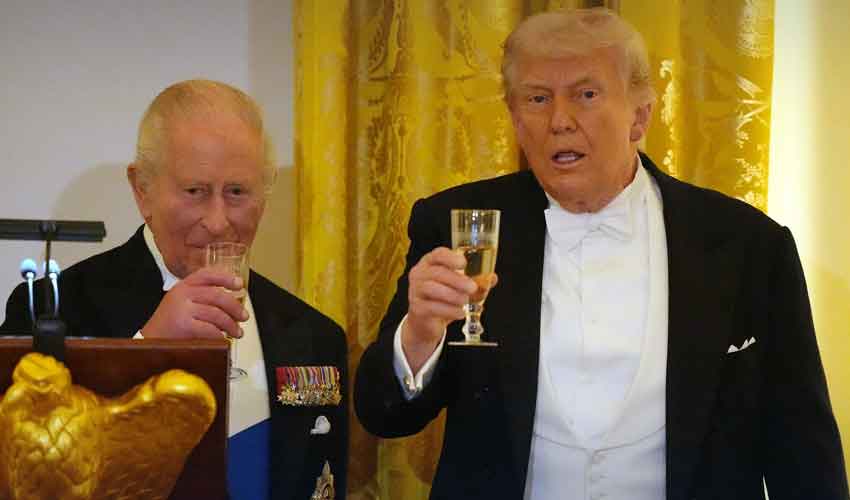
US President Donald Trump said on Tuesday that Britain’s King Charles III shared his view that Iran should not be allowed to acquire a nuclear weapon, raising the sensitive issue of the Middle East conflict during a White House state dinner for the visiting monarch.
The comments came on the second day of the king’s four-day state visit to the United States, at a tense moment in US-UK relations after Trump repeatedly criticized British Prime Minister Keir Starmer over what he called a lack of support in the Iran war.
Speaking at the dinner honouring King Charles and Queen Camilla, Trump said his administration was engaged in “a little Middle East work” and claimed the situation was going well.
“We’re doing a little Middle East work right now and we’re doing very well,” Trump said.
“We have militarily defeated that particular opponent, and we’re never going to let that opponent ever — Charles agrees with me even more than I do — we’re never going to let that opponent have a nuclear weapon,” he added.
Trump did not provide further details to support his claim that Iran had been “militarily defeated.”
King Charles avoids comment on Iran war
In his own remarks after Trump, King Charles did not mention Iran, the Iran war or Trump’s claim about his views.
The British monarch is not a spokesman for the UK government and traditionally avoids taking political positions in public.
Asked about Trump’s state dinner comments, the British Embassy in Washington referred Reuters to Buckingham Palace. Buckingham Palace did not immediately respond to a request for comment.
Trump’s remarks appeared to suggest that the issue had come up during private meetings with King Charles before the state banquet.
Iran war strains US-UK ties
The state visit is taking place during a difficult period in relations between Washington and London. Trump has repeatedly criticized Prime Minister Keir Starmer, saying Britain has not done enough to help prosecute the Iran war.
The US president’s comments are likely to be seen as a veiled criticism of Starmer, whose relationship with Trump has reportedly soured in recent months after he refused to join the war in Iran.
British officials had hoped the royal visit would help ease tensions between the two leaders.
Trump made similar remarks to The Telegraph in April, when he suggested the king would have “taken a very different stance” on the war from Starmer.
Charles avoided direct Iran mention in Congress
Earlier in the day, King Charles addressed the US Congress but made no direct mention of the Iran war.
However, his speech referred to several issues that have caused friction between Washington and London, including Trump’s criticism of NATO, the importance of continued US support for Ukraine in its war with Russia, the risks of isolationism and the need to protect the environment.
The king also reminded US lawmakers of Britain’s role in the alliance that defended America after the September 11 attacks. He noted that NATO’s collective defense clause has only been invoked once — after the 9/11 attacks on the United States.
King says NATO more important than ever
King Charles suggested that NATO was “more important than ever” in the current political climate. Trump previously told The Telegraph that he was strongly considering pulling the US out of NATO after the alliance failed to join his war on Iran.
Trump has also claimed that Britain stayed “off the front lines” in Afghanistan.
In his address to Congress, Charles described the US-UK alliance as unique and rooted in a long history of cooperation.
“The alliance that our two nations have built over the centuries — and for which we are profoundly grateful to the American people — is truly unique,” he said.
He referred to Henry Kissinger’s description of John F. Kennedy’s “soaring vision” of an Atlantic partnership based on two pillars: Europe and America.
“That partnership, I believe, Mr Speaker, is more important today than it has ever been,” the king said.
Trump praises king’s Congress speech
At the state dinner, Trump congratulated King Charles on what he called a “fantastic speech” before Congress.
“He got the Democrats to stand — I’ve never been able to do that. I couldn’t believe it!” Trump said.
“They liked him more than they’ve ever liked any Republican or Democrat, actually,” he added. Trump also praised what he called “a friendship unlike any other on Earth” between the United States and Britain.
“Ours is a treasured friendship, an eternal bond, and a true story of extraordinary heroism and skill,” Trump said. “History has known no more powerful force than the combination of American patriotism and British pride.”
Charles reflects on US-UK wartime bond
King Charles used his own state dinner remarks to reflect on the enduring relationship between Britain and the United States. “We have stood together through the best and worst of times,” he said.
He recalled how American leadership helped rebuild Europe after World War II and played a decisive role as a defender of freedom.
“American leadership helped rebuild a shattered continent, playing a decisive role as a defender of freedom in Europe,” the king said.
Charles also reaffirmed support for NATO and AUKUS, the trilateral security partnership between Australia, the United Kingdom and the United States.
He said he would “never forget that freedom is again under attack,” referring to Russia’s ongoing war against Ukraine.
“Today, our partnerships in NATO and AUKUS deepen our cooperation and ensure that together, we meet the challenges of an increasingly complex world,” he said.
In his congressional speech, Charles also voiced strong support for Ukraine.
“Today, Mr Speaker, that same unyielding resolve is needed for the defence of Ukraine and her most courageous people,” he said.
King references climate, Ukraine, Epstein scandal
In the East Room, Charles alluded to several subjects that have been points of contention during Trump’s leadership, including global warming, the war in Ukraine, the Epstein scandal and the wider UK-US alliance.
He again emphasized the importance of NATO, technological cooperation and military coordination.
“We and I shall never forget that, not least as freedom is again under attack following Russia’s invasion of Ukraine,” Charles said.
“Today, our partnerships in NATO deepen our technological and military co-operation and ensure that together we can meet the challenges of an increasingly complex and contested world.”
King Charles also offered support to victims of abuse after calls for him to address the Jeffrey Epstein scandal during his state visit.
The monarch did not mention Jeffrey Epstein by name. However, he praised British and American efforts to support “victims of some of the ills” that exist in both societies.
His remarks came after renewed scrutiny of Andrew Mountbatten-Windsor’s friendship with the late sex offender.
“In both of our countries, it is the very fact of our vibrant, diverse and free societies that gives us our collective strength, including to support victims of some of the ills that, so tragically, exist in both our societies today,” Charles told Congress.
King jokes about Trump’s Europe comment
Charles also used humor during the state dinner, joking about Trump’s past comments on European history.
“You recently commented, Mr. President, that if it were not for the United States, European countries would be speaking German,” the king said.
“Dare I say that if it wasn’t for us, you’d be speaking French,” he added.
The remarks drew attention as part of a visit aimed at projecting warmth between the US and UK despite recent diplomatic tensions.
Congress gives Charles several standing ovations
King Charles received several standing ovations during his congressional address. His speech was praised for combining “wit, honour, history and appreciation.”
Senator Lindsey Graham, a South Carolina Republican and one of Trump’s closest allies, said the king’s address gave Congress a “much-needed morale boost.”
Graham said the speech had united Republicans and Democrats, a rare moment of bipartisan approval in Washington.



.jpg)