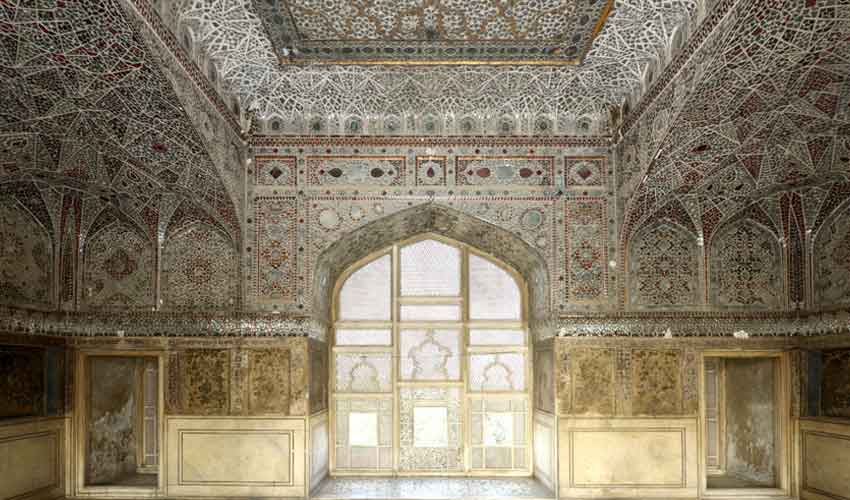
Key stakeholders at the helm of safeguarding Lahore's historic sites recently convened to review efforts and discuss strategies to revive the city's landmarks.
Aga Khan Cultural Service – Pakistan (AKCS-P), in partnership with the Walled City of Lahore Authority (WCLA), has been undertaking efforts to restore some of these structures, including the Lahore Fort, Wazir Khan Mosque, and the Shahi Hammam, through traditional techniques and international best practices.
The meeting was attended by AKCS-P Chairman Akbar Ali Pesnani, CEO Tausif Khawaja, AKCS-P Board members, and WCLA Director General Najmus Saqib.

Discussions focused on the progress, opportunities, and challenges related to joint conservation efforts at key heritage sites, including the Lahore Fort, Wazir Khan Mosque, and Akbari Mandi. Critical reflections were shared on strategies to further strengthen conservation practices while promoting sustainable development and community engagement in the Walled City.
A key topic of discussion was the conservation of the Wazir Khan Mosque. Work on the mosque has involved the structural consolidation of domes, walls, and foundations, as well as the restoration of floors, lime plaster, rooftops, and parapets. Beyond the mosque itself, conservation efforts have extended to the surrounding neighbourhood. The bustling yet deteriorated area has been rehabilitated, historic houses along the southern side of Chowk Wazir Khan have been restored, and smaller monuments and façades within the square have been conserved.
Planned interventions include the conservation of the north-west and south-west minarets, restoration of frescoes in the prayer chamber, and redevelopment of the southern neighbourhood, including façade improvements of selected properties such as the WCLA office. This roadmap aims to transform the mosque and Chowk Wazir Khan into a vibrant tourist hub and community space.
Projects funded by the Agence Française de Développement (AFD) at the Lahore Fort have supported the revival of some of the Fort’s most treasured sites, including the Sheesh Mahal and the Picture Wall. Work at the Sheesh Mahal is ongoing, with site assessments and emergency stabilisation already completed. Following laboratory testing, suitable conservation materials were identified, and skilled labour has been trained in traditional stucco techniques, which are now being applied to restore the palace of mirrors to its former glory.

Mimicking the mirror pieces originally used in the Sheesh Mahal was no small feat and required a major undertaking, including the reopening of a closed industrial unit in a remote part of Sindh. The factory in Shikarpur was revived to produce custom-made convex mirrors. Over time, the once-glimmering palace developed structural voids and cracks in its walls and ceilings. To address these, grouting is being applied, a process in which a fluid material is injected to fill gaps, strengthen the structure, and prevent water infiltration.
At the Picture Wall, renowned as one of the world’s largest murals, conservation work is nearing completion. Efforts have included tracing and reconstructing panel impressions, brick imitation, and the careful retracing and repainting of frescoes across its countless panels to match the original designs.
Participants also discussed the potential for joint initiatives involving WCLA, the Department of Archaeology, and AKCS-P to enhance heritage conservation efforts across Pakistan.




.jpg)