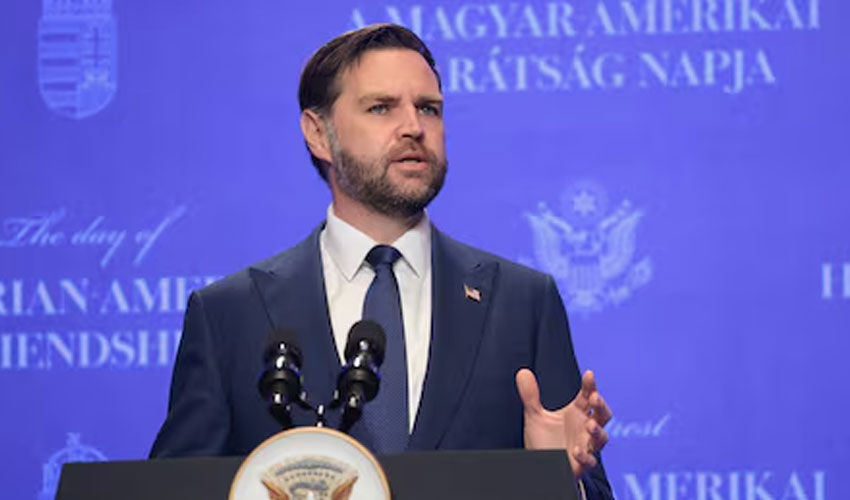
US Vice President JD Vance has confirmed that negotiations with Iran will begin this week, while cautioning Tehran against derailing the ceasefire over what he described as a “misunderstanding” regarding Lebanon.
Speaking to the media in Hungary, Vance revealed that the United States held talks with Iran through Pakistan, which played a key mediating role in securing the ceasefire. He said Iran has presented a 10-point proposal and promised to reopen the Strait of Hormuz, a crucial global trade route.
Vance confirmed that formal negotiations with Iran are set to begin this week, marking the next phase after the ceasefire.
The US vice president emphasized that the ceasefire was the result of coordinated teamwork.
“We worked as a team for the ceasefire,” Vance said, praising all members involved, including US Secretary of State Marco Rubio. He added that the ceasefire specifically relates to Iran and sets the stage for further diplomatic engagement.
Iran must negotiate seriously
Vance stressed that Iran must come to the negotiating table with seriousness and commitment.
“The next step after the ceasefire is for the Iranians to take,” he said, warning that President Donald Trump still has options to return to military action if necessary.
He reiterated Washington’s firm stance that Iran cannot be allowed to acquire nuclear weapons under any circumstances.
Despite the strong warnings, Vance indicated that there is room for diplomacy. He said the United States is open to discussing the easing of sanctions on Iran, provided progress is made in negotiations.
Lebanon’s inclusion in ceasefire
A key point of contention remains whether Lebanon is included in the US-Iran ceasefire. Vance said Iranian negotiators believed Lebanon was part of the agreement, but clarified that the US had not agreed to include it.
“I think this comes from a legitimate misunderstanding,” Vance told reporters, adding that the ceasefire focuses on Iran, Israel, and US allies in the Gulf.
The US position appears to contradict earlier statements by Prime Minister Shehbaz Sharif, who had said Lebanon was part of the truce. Iranian Foreign Minister Abbas Araghchi also echoed that view, highlighting Lebanon’s inclusion in the ceasefire terms.
Vance, however, dismissed the discrepancy as a misunderstanding, while also accusing some parties of engaging in “bad faith negotiation” and “propaganda.”
Israel’s stance and attacks in Lebanon
According to Vance, Israel has agreed to show some restraint in Lebanon to ensure the success of ongoing negotiations.
“The Israelis have offered to check themselves a little bit in Lebanon,” he said, without providing further details.
Vance warned that it would be “dumb” for Iran to jeopardize the ceasefire over Lebanon, which he said is not part of the agreement.
“If Iran wants to let this negotiation fall apart… over Lebanon, which has nothing to do with them… that’s their choice,” he said.
Iran signals possible retaliation
Iranian officials, however, have taken a firmer stance, insisting they will not abandon Hezbollah. The Islamic Revolutionary Guard Corps (IRGC) warned that fighting could resume if Israel continues attacks in Lebanon.
“If the aggressions against Lebanon are not stopped immediately, we will give a regretful response,” the IRGC said.


.jpg)