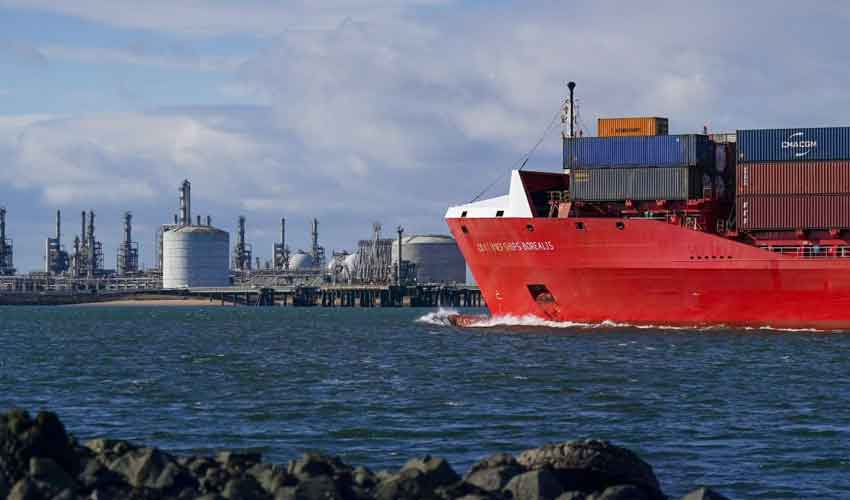
A two-week ceasefire agreement between Iran and the United States has introduced a significant change in global shipping, allowing Iran and Oman to charge transit fees in the Strait of Hormuz.
The move comes as part of a Pakistan-mediated deal aimed at easing regional tensions.
Under the agreement, both Iran and Oman will be permitted to charge fees on ships passing through the Strait of Hormuz.
A regional official directly involved in the negotiations, speaking anonymously, confirmed the development. The official said the arrangement is part of the broader ceasefire plan designed to stabilize the region.
Funds for reconstruction
According to the official, Iran intends to allocate the revenue generated from transit fees toward reconstruction efforts following the conflict. However, it remains unclear how Oman plans to utilize its share of the funds collected from vessels transiting the strait.
Iran’s semi-official Tasnim News Agency also reported that the collected funds would be earmarked for reconstruction.
Also Read: Trump agrees to ceasefire after 'talks with PM Shehbaz, Field Marshal'
The Strait of Hormuz — located at the narrow mouth of the Persian Gulf — lies within the territorial waters of both Iran and Oman.
Traditionally, the global community has treated the passage as an international waterway, with no tolls imposed on ships. The introduction of transit fees marks a major departure from longstanding maritime norms.
Shipping remains severely disrupted
Since the conflict began, the strait has been effectively closed, with maritime tracking data showing that only about 5% of pre-war shipping traffic is currently passing through.
Also Read: Iran-US talks to begin in Islamabad on April 10
Some tankers have managed to navigate the route. Countries like Pakistan and India have negotiated with Iran to secure guaranteed passage for certain flagged vessels.
High fees raise questions
Iran has reportedly been charging as much as $2 million per vessel for transit through the Strait of Hormuz. However, it remains unclear whether any ship operators have actually paid these fees so far.
The development is part of a ceasefire agreement brokered by Pakistan, according to reporting by The Associated Press. The unnamed official said they were not authorized to publicly discuss internal deliberations but confirmed key details of the arrangement.

.jpg)