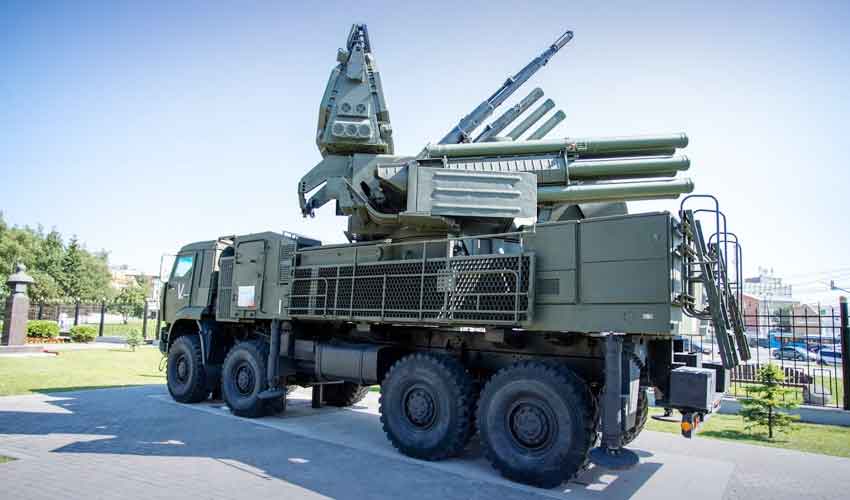
The United States has approved a potential $1.98 billion arms sale to Kuwait, including advanced counter-drone systems and related equipment, in a move aimed at strengthening the Gulf state's defenses against growing aerial threats.
The announcement comes days after Kuwait was hit by a deadly drone strike and amid heightened security concerns across the Gulf following months of conflict involving Iran, the United States and regional allies.
In a statement released on Friday, the US State Department said it had approved the possible sale of counter-unmanned aerial systems (C-UAS) platforms and related equipment to Kuwait.
The package, valued at approximately $1.98 billion, includes systems, equipment and support services designed to detect, track and neutralize unmanned aerial vehicles (UAVs).
According to the State Department, the proposed sale will help Kuwait improve its ability to counter drone-related threats and strengthen its overall air defense capabilities.
“The proposed sale will support the foreign policy and national security objectives of the United States by improving the security of a major non-NATO ally,” the department said.
The State Department identified defense technology company Anduril as the principal contractor for the proposed deal. Anduril, a US defense company known for developing advanced surveillance and counter-drone technologies, was founded by a supporter of President Donald Trump.
The sale remains subject to congressional review. Under US law, Congress has the authority to block major foreign military sales, although such objections are relatively uncommon.
Kuwait strike heightened security concerns
The approval comes shortly after Kuwaiti officials condemned what they described as Iranian aggression following a drone strike on Kuwait International Airport earlier this week.
The attack killed one person and injured 63 others, according to Kuwaiti authorities.
Iran denied any involvement in the incident, claiming the explosion resulted from “an error in the American Patriot systems,” referring to a US-made missile defense battery.
The strike occurred despite a ceasefire agreement reached on April 8 that paused the war triggered by the February 28 US-Israeli bombing campaign against Iran.
Although the ceasefire has largely held, sporadic exchanges of fire have continued across the region.
The proposed arms sale reflects growing concern among Gulf nations about the increasing use of drones in modern conflicts.
Military planners across the Middle East have identified unmanned aerial systems as one of the most significant emerging threats to critical infrastructure, military facilities and commercial shipping routes.
As a result, several Gulf states have accelerated investments in advanced air defense systems and counter-drone technologies.
Hormuz tensions underscore regional risks
The deal also comes amid renewed tensions around the Strait of Hormuz, one of the world’s most strategically important maritime chokepoints.
Recently, US Central Command said American forces shot down four Iranian attack drones and later carried out strikes against Iranian coastal radar installations after determining the aircraft posed a threat to maritime traffic.
The incidents highlighted growing concerns among Gulf allies regarding the risks posed by drones and missile systems operating near major shipping lanes.
Kuwait remains key US security partner
Kuwait hosts thousands of US military personnel and serves as one of Washington’s most important logistics and security partners in the Gulf region.
In recent years, the country has expanded defense cooperation with the United States through military training programs, security partnerships and major arms purchases.
The proposed counter-drone package is expected to further deepen those defense ties while enhancing Kuwait’s ability to respond to evolving security challenges.
$1.5bn helicopter sale for New Zealand
In a separate announcement, the US State Department approved the possible sale of five MH-60R Seahawk multi-mission helicopters and related equipment to New Zealand in a deal valued at approximately $1.5 billion.
The helicopters are manufactured by the Sikorsky division of Lockheed Martin and are designed for maritime security, anti-submarine warfare and multi-role military operations.
“The proposed sale will improve New Zealand’s capability to meet current and future warfare threats by providing greater security for its critical infrastructure,” the State Department said.
It added that New Zealand would use the enhanced capability to strengthen homeland defense.
New Zealand boosts military spending
The helicopter purchase forms part of New Zealand’s broader effort to strengthen its military capabilities amid a rapidly changing security environment in the Asia-Pacific region.
The administration of US President Donald Trump has repeatedly urged allies in Europe and the Indo-Pacific to increase defense spending and contribute more to regional security.
New Zealand, a close ally of neighboring Australia, has increasingly deployed forces across East Asia in support of Western militaries and partner nations amid China's growing military influence.
Under a 2025 defense strategy, New Zealand’s center-right government plans to increase defense spending by NZ$9 billion (approximately $5 billion) over four years and nearly double military spending to 2% of gross domestic product within eight years.
Last month, Wellington allocated NZ$1.58 billion (about $916 million) in new defense funding as part of a broader military modernization program.
Speaking from Queensland, Australia, where he was attending an annual bilateral meeting with Australian Prime Minister Anthony Albanese, New Zealand Prime Minister Christopher Luxon reaffirmed his government's commitment to boosting defense investment.
“We've moved from a benign environment to a much more globally strategically competitive environment,” Luxon said.
“It's entirely appropriate that we double our defence spending.”
Luxon argued that decades of underinvestment had left New Zealand’s armed forces needing significant modernization.
“The government remained committed to lifting defence spending after 30 years of underinvestment in defence forces in New Zealand,” he said.
The approvals for both Kuwait and New Zealand underscore Washington’s broader effort to strengthen allied defense capabilities as security challenges continue to grow across the Middle East and the Indo-Pacific.


.jpg)