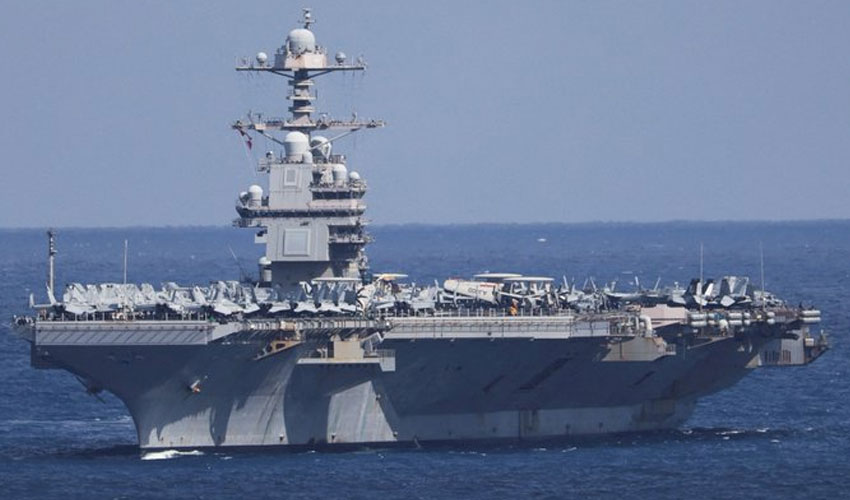
Fresh details reported by CNN have raised new questions about the scale of damage suffered by the USS Gerald R. Ford during a March fire in the Red Sea region, with new footage showing destruction far beyond what the US Navy initially acknowledged.
The aircraft carrier, the world’s largest and most advanced warship, was supporting US military operations during the joint US-Israeli war against Iran when the fire broke out.
According to CNN, newly obtained video from inside the USS Gerald R. Ford shows sailors’ sleeping areas completely destroyed.
The footage showed bunks reduced to charred and twisted metal, a ceiling apparently hollowed out by the fire, wires hanging overhead, and piles of ash scattered across the floor.
One sailor aboard the $13 billion vessel told CNN the situation felt life-threatening.
“I seriously thought we were going to lose the ship,” the sailor said. “It’s either fight or die.”
Navy accused of downplaying impact
After the fire, US officials said two sailors had been treated for non-life-threatening injuries and stated that the blaze had been contained.
The US Central Command also said in March that the fire caused no damage to the ship’s propulsion plant and that the aircraft carrier remained fully operational.
However, CNN’s latest report, citing a US official, said the Navy’s public statement downplayed the impact of the incident. The official said the fire did affect the Ford’s capabilities while it was operating in the Red Sea in support of US operations against Iran.
CNN also reported that sources said the ship’s fire-suppression system failed to work properly.
According to military officials and crew members, it took about 30 hours to extinguish the fire, clean up the damage and prevent it from reigniting. One sailor said the built-in fire suppression system was supposed to contain the blaze automatically.
“It shouldn’t have come to this. The fire suppression system built into the ship was supposed to put it out,” the sailor said.
Roughly 600 sailors lost access to their bunks after the fire, CNN previously reported. The New York Times also reported that more than 600 service members were left without beds.
Some sailors were forced to sleep on floors and tables. Because the fire began in the main laundry area, crew members also lost access to facilities needed to wash their clothes.
Dozens of service members reportedly suffered smoke inhalation, in addition to the two sailors officially treated for non-life-threatening injuries.
Carrier faced missile and drone threats
A sailor interviewed by CNN recalled seeing an orange streak in the sky while the Ford was operating in the Red Sea. The sailor said Iranian munitions appeared on the horizon during the carrier’s deployment.
According to the sailor, whenever Iranian missiles or drones came within a certain range, the ship would sound an alert warning the crew to expect a hit and prepare for damage control.
CNN said the ship was under constant threat of potential missile and drone attacks during operations in the region.
Despite the damage, Navy officials said in March that the USS Gerald R. Ford continued flight operations around the clock. However, a senior US official cited by CNN said the incident temporarily affected the carrier’s combat capabilities.
After the fire, the carrier remained at sea for some time before later calling at a port in Greece for partial repairs. Crew members also reported that the plumbing system serving around 650 toilets aboard the ship frequently broke down.
Ford is symbol of US naval power
Commissioned in 2017, the USS Gerald R. Ford is the newest and most technologically advanced of the US Navy’s 11 nuclear-powered aircraft carriers. The ship carries around 4,500 sailors and fighter pilots and is widely seen as a symbol of American naval strength.
Its advanced electromagnetic aircraft launch system allows it to launch a wide range of aircraft, including drones and fighter jets, giving commanders greater operational flexibility.
Brent Sadler, a former Navy officer, previously told CNN that the Ford has capabilities that distinguish it from other US aircraft carriers.
The Ford’s deployment ended when it returned to Norfolk, Virginia, in May. Before moving to the Middle East, the carrier had been ordered from the Mediterranean to the Caribbean on October 24 last year by Defense Secretary Pete Hegseth.
It was part of a broader US military buildup aimed at increasing pressure on then-Venezuelan President Nicolás Maduro before his capture in early January.
The vessel later departed for the Middle East to support the ongoing US-Israeli war against Iran. The Ford’s deployment also included participation in the US operation to kidnap Maduro, according to the report.
Trump’s Iran strategy faces scrutiny
The latest revelations have fueled criticism of President Donald Trump’s decision to join Israel in launching the war against Iran on February 28.
The report argues that Trump appeared to believe Washington could replicate in Iran the kind of regime-change scenario it had pursued in Venezuela.
Influenced by Israeli pressure and strategic miscalculations, Trump joined the conflict expecting the United States and Israel to destroy Iran’s military capabilities and shape a political outcome favorable to Washington.
But after 39 days of fighting, Trump accepted a ceasefire on April 8.
Iran’s response challenged US assumptions
Iran’s military response against Israel and US installations across the region exposed the limits of Washington’s approach, according to the report.
Rather than demonstrating overwhelming American power, the war showed the difficulty of using military pressure against a country capable of sustaining a prolonged confrontation and imposing costs on its adversaries.
Several previous US media reports have also questioned claims that Iran’s missile and drone capabilities were effectively neutralized. Those reports have highlighted damage caused by Iranian strikes on US military facilities in the Persian Gulf region.
Taken together, the reports challenge the long-standing image of US military invincibility, despite Washington possessing the world’s most advanced and expensive military apparatus.
The USS Gerald R. Ford remains a powerful symbol of US military technology, but CNN’s footage suggests that even America’s most advanced carrier faced serious vulnerabilities during the Iran war.
The latest revelations serve as another reminder that technological superiority does not always translate into strategic success.
They also deepen questions about Trump’s assumptions, the true cost of the war on Iran and the challenges faced by US forces during the conflict.

.jpg)