The Artemis 2 astronauts have glimpsed parts of the Moon never before seen by human eyes, the crew reported Sunday as their spacecraft passed the two-thirds mark of its 10-day mission toward a highly anticipated lunar flyby.
As the crew went to sleep early Sunday, they were nearly 200,000 miles (321,869 kilometers) from Earth and about 82,000 miles from the Moon, according to NASA’s online dashboard.
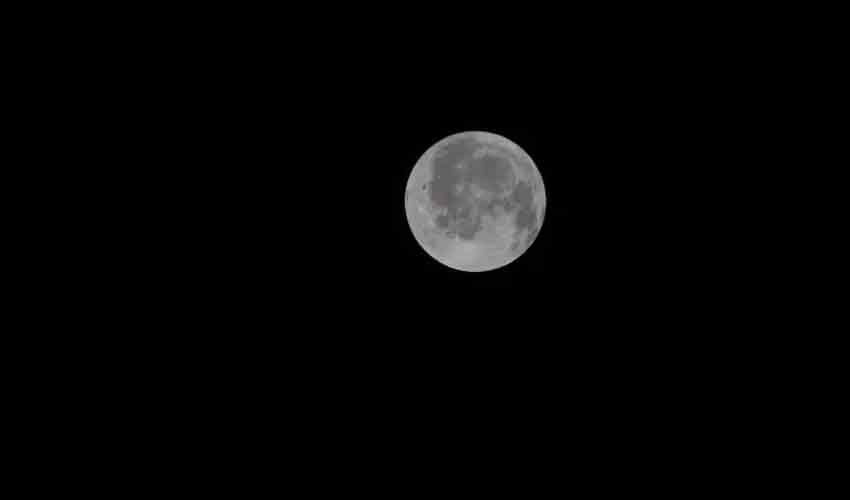
NASA released an image captured by the crew showing the Moon in the distance, with the Orientale basin clearly visible. “This mission marks the first time the entire basin has been seen with human eyes,” NASA said. While orbiting spacecraft had photographed the massive crater before, no humans had observed it directly.
During a live session with Canadian schoolchildren, astronaut Christina Koch described the Orientale basin, sometimes called the Moon’s “Grand Canyon,” as the highlight of their journey so far. “It’s very distinctive, and no human eyes had ever seen this crater until today,” she said.
The next milestone is expected late Sunday into Monday, when the astronauts will enter the Moon’s “sphere of influence,” where its gravitational pull exceeds that of Earth. If all goes according to plan, the Orion spacecraft will swing around the Moon, potentially taking the crew—Americans Koch, Reid Wiseman, and Victor Glover, along with Canadian Jeremy Hansen—farther from Earth than any humans in history.
NASA confirmed that the crew has completed a manual piloting demonstration and reviewed their flyby plan, including which lunar features to photograph and study during their orbit.
Earlier, the astronauts began the day with scrambled eggs and coffee, waking to Chappell Roan’s “Pink Pony Club.” Commander Reid Wiseman shared a personal highlight: speaking with his two daughters from space. “We’re so far away, and for a moment, I was reunited with my little family,” he said. “It was the greatest moment of my life.”
The crew has undergone geology training to accurately document lunar features, from ancient lava flows to impact craters. Unlike Apollo missions that orbited just 70 miles above the lunar surface, Artemis 2 will pass over 4,000 miles above, allowing astronauts to view the Moon’s entire circular surface, including the polar regions.
Already, the crew has seen unprecedented perspectives. Koch described their first view of the Moon’s far side as “absolutely spectacular.” NASA’s John Honeycutt highlighted images showing features that had only been captured by robotic probes before.
The astronauts have been actively photographing the Moon, even using smartphones recently cleared for spaceflight. Earlier images from Orion included striking portraits of Earth, showing deep blue oceans and swirling clouds.
Artemis 2 is part of NASA’s long-term plan to return humans to the Moon regularly, ultimately establishing a permanent lunar base as a platform for deeper space exploration. The mission combines precise technical execution with the astronauts’ lifelong dream of exploring space.








.jpg)