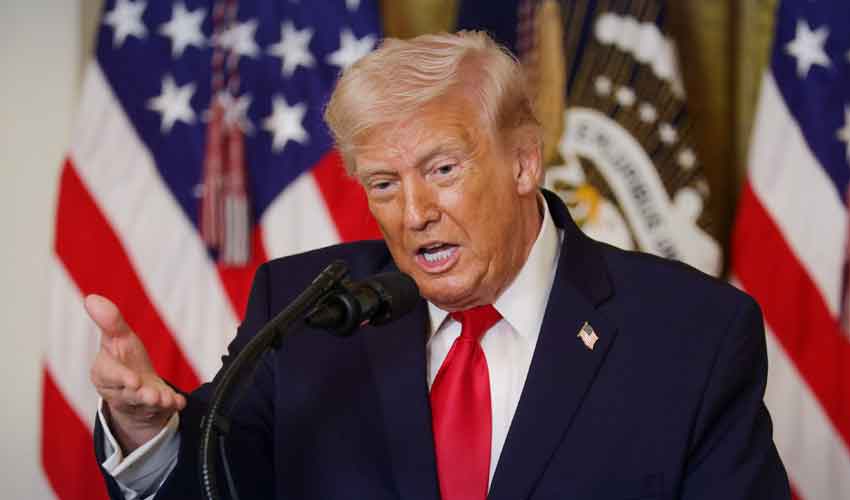
Donald Trump has signaled a potential breakthrough in tensions with Iran, claiming that both sides have agreed on “many major points.”
Speaking in a series of media interactions, the US president expressed hope for a deal while warning of the risks if negotiations fail.
In his media interview, Trump said the United States has held extensive talks with Iran and that there is a “real possibility” of reaching an agreement. He stated that both sides have agreed on many points and described recent discussions as “very strong” and serious.
Trump added that Iran “wants to make a deal” and that ongoing negotiations could soon lead to a resolution.
Five-day pause in strikes
The US president confirmed that he had ordered a five-day postponement of planned military strikes on Iranian power plants.
This decision came after what he described as “very good and productive” conversations with Tehran aimed at achieving a “complete and total resolution of hostilities.”
He also noted that special envoy Steve Witkoff and Jared Kushner had been engaged in talks with Iranian officials. He did not name who in Iran the US had spoken to but described him as "the man who I believe is the most respected and the leader."
Trump said the US had not heard from Supreme Leader Mojtaba Khamenei. He said he did not know if Khamenei was alive, adding that he did not wish for him to be killed.
"The discussions took place yesterday. They went into yesterday's evening," Trump said. He then said that Iran was very keen for a deal and the US was willing to make one.
"We're going to get together today by probably phone ... but we'll, at some point, very, very soon, meet," he said.
"We're doing a five-day period. We'll see how that goes, and if it goes well, we're going to end up with settling this. Otherwise we just keep bombing our little hearts out."
Demand for enriched uranium handover
Trump emphasized that Iran should hand over its enriched uranium and never attempt to acquire it again. He said that if a deal is reached, the US could easily secure enriched uranium itself, adding that such an agreement would prevent Iran from developing nuclear weapons.
The US president said he had spoken to what he described as a “respected” Iranian leader, though he did not specify the individual.
"They will never have a nuclear weapon," Trump said, referring to Iran. "They've agreed to that."
He said Iran had initiated contact because it did not want the US to strike its energy infrastructure, as Trump had threatened would happen unless the Strait of Hormuz was reopened.
Also Read: Iran-US war: Pakistan acts as lead mediator, as Asim Munir calls Trump
"I think this is something that's going to happen, and why wouldn't it happen?" referring to a deal with Iran.
"So tomorrow morning, sometime their time, we were expected to blow up their largest electric generating plant that cost over $10 billion to build. It's a very good one....Why would they want that. So they called, I didn't call. They called," he added.
Trump reiterated that his goal is peace in the Middle East and that he does not want Iran to possess nuclear weapons.
He warned that if Iran had nuclear capabilities, it could dominate the region, but added that a deal would be beneficial not only for Iran but for the wider Middle East and Gulf countries.
Communication with Israel
Trump said he had also spoken with Israel, noting that it was “happy with the latest progress.” He indicated that regional coordination remains ongoing and that developments in negotiations are being closely monitored by allies.
Despite expressing optimism, Trump acknowledged that he cannot guarantee a deal with Iran. At the same time, Iranian officials have denied holding talks with the United States, reflecting ongoing contradictions in public messaging.
Also Read: Shehbaz calls Iranian president; stresses dialogue, de-escalation
Trump claimed that US actions had significantly weakened Iran’s military capabilities, including its navy, air force, and defense systems. He also stated that much of Iran’s leadership had been eliminated, though these claims remain contested.
The president warned that without US intervention, Iran could have developed a nuclear bomb.
Strait of Hormuz
Trump suggested that control of the strategic Strait of Hormuz could potentially be shared between the US and Iran. The waterway is critical for global energy supplies, handling a significant portion of the world’s oil and gas shipments.
Asked about who would control the Strait of Hormuz after any deal with Iran, Trump responded that it would be jointly controlled.
When the reporter asked "By who?", Trump said: "Maybe me. Maybe me, me and the Ayatollah ... whoever the next Ayatollah is."
He said he did not consider Mojtaba Khamenei as Iran's leader. Khamenei was chosen as Iran's new supreme leader after his father Ayatollah Ali Khamenei was killed on the first day of the war.
"There's automatically a regime change," he said. "But we're dealing with some people that I find to be very reasonable, very solid. The people within know who they are. They're very respected, and maybe one of them will be exactly what we're looking for."
The US president said he is prepared to deploy the National Guard wherever needed within the country. He also emphasized that while the conflict is ongoing, diplomatic engagement remains the preferred path forward.
Hope for deal
Trump concluded by saying there are “very good chances” of reaching a deal with Iran, which he believes would make the world safer.
He stressed that both sides are negotiating and that a successful agreement would ensure Iran does not develop nuclear weapons while stabilizing the region.
.jpg)