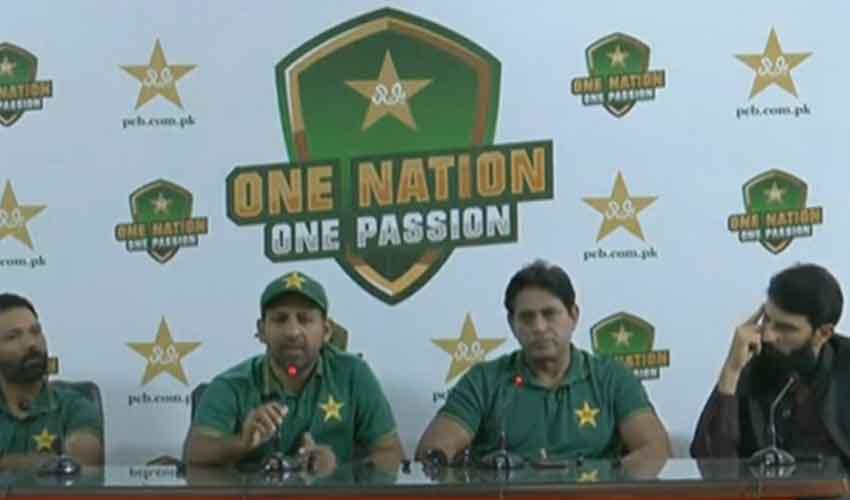
Pakistan cricket’s national selection committee addressed the media in Lahore on Saturday, discussing the team’s recent performances, player fitness concerns, and future selection plans following a disappointing World Cup campaign.
Former captain Misbah-ul-Haq, Sarfaraz Ahmed, Asad Shafiq, and Aqib Javed spoke at the press conference, stressing that player selection is based on performance and that the team will continue to introduce young talent.
Committee defends World Cup performance
Selection Committee member Aqib Javed defended Pakistan’s performance in the World Cup.
He said that failing to reach the semi-final was not a major issue, explaining that the team lost only one match in the Super Eight stage, while another match was washed out due to rain. He added that Pakistan missed the semi-final mainly because of net run rate.
During the briefing, Aqib also confirmed that Babar Azam will not play in the Bangladesh series or the National T20 tournament due to lack of fitness.
He said the injuries of Babar Azam and Fakhar Zaman came to light after the World Cup ended. The selection committee will conduct an inquiry to determine whether their fitness was properly monitored during the World Cup.
Aqib Javed added that questions regarding why Fakhar Zaman did not play the initial matches of the tournament should be answered by the team’s coach.
Committee denies interference in playing XI
Aqib Javed emphasized that he had no interference in the playing XI at all, explaining that the team lineup is decided jointly by the coach and the captain. He said the selection committee forms the squad, but decisions about the final playing XI remain with the team management.
“We want to give the coach and captain the freedom to make decisions,” he said.
He also noted that six members of the selection committee collectively decide whether a player like Babar Azam should be included in the squad.
According to him, no single person has the authority to select or drop a player alone, and Pakistan currently does not have a chief selector.
Performance, not personalities, determines selection
Sarfaraz Ahmed said players become part of the team based on performance, adding that Pakistan currently has two to three wicketkeeper options available. He also said young players will be given opportunities in the next season.
Sarfaraz mentioned that four to three wicketkeepers are in contention, and that Ghazi Ghauri is being considered as a promising wicketkeeper who could replace Mohammad Rizwan.
He added that Hasibullah has also been part of the Pakistan team, and more young players will be called up in the future.
The selectors highlighted the importance of domestic cricket performances in earning national selection. Sarfaraz said Shamyl Hussain has impressed with his performances in the Quaid-e-Azam Trophy and other domestic tournaments.
“He is a young boy and should be given a chance,” Sarfaraz said.
Misbah added that players who perform in domestic cricket must be carefully evaluated, and the aim is to provide the team with the best available options based on role and performance.
World Cup disappointment
Aqib Javed admitted that Pakistan’s performance in the World Cup was below expectations. “The team should have at least reached the semi-finals,” he said.
He added that the team had shown promise earlier, including winning a Test series against England, defeating South Africa, and winning an ODI series against Australia after 28 years.
Pakistan had also won the Champions Trophy, raising hopes for better results in the World Cup.
The selectors said they are investigating whether player fitness was properly monitored during the tournament. Aqib Javed acknowledged that selectors should have been aware of the players’ fitness issues, adding that the head coach and team physio also had responsibility for monitoring injuries.
He confirmed again that Babar Azam and Fakhar Zaman are currently not fit to play.
Cricket demands patience and stability
Aqib defended the need for stability in team selection, saying cricket teams cannot be rebuilt every season. He pointed out that teams like India and Bangladesh have largely retained similar squads over the past few years.
He further said that Pakistan makes more changes to its team than most other countries, adding that demanding major changes after every failure is excessive.
“You can’t fire someone on a single performance,” he said, adding that the winning team will always include some changes but not a complete overhaul.
Emotional pressure in India–Pakistan matches
The former fast bowler also noted that Pakistan often becomes overly emotional during matches against India, which can affect performance.
“The India–Pakistan match is very important, and we become very depressed after losing it,” he said. He added that modern cricket is very different from the game played in the 1990s, with new techniques and shot-making styles.
“Only Jasprit Bumrah looked like a different bowler in the entire World Cup,” Aqib Javed remarked.
Aqib also responded to criticism from former players appearing on television. He said many former cricketers frequently criticize the team on TV, while ignoring the complexities involved in team selection and management.
He stressed that the Pakistan team is not built around personal egos and is not against any individual player.
Accountability and future planning
The selection committee acknowledged that mistakes had been made from top management to lower levels. However, Aqib said Pakistan must move forward instead of simply labeling individuals as responsible and discarding them.
He also highlighted the development gap caused by years of limited cricket in Pakistan after the attack on the Sri Lankan team, saying it would take time to bridge that gap.
Despite challenges, the selectors pointed to positive results from Pakistan’s youth and development programs. The Under-19 team and Pakistan Shaheens squad have been performing well, Aqib said.
He added that Pakistan’s recent series victories against England, Australia and South Africa showed the team’s potential.
Amir Mir dismissed reports of players being fined, saying he did see reports about fines in the media. A proper accountability formula will be developed, he stated, adding that players were earning millions of rupees.
Modern scouting and data-driven selection
Aqib Javed explained that selectors no longer need to be physically present at every match, as modern technology allows games to be reviewed ball-by-ball through recorded footage.
“Every match is recorded now, and you can watch it by rewinding on television,” he said. He added that selection decisions are increasingly supported by data and video analysis.
Misbah said he is currently working as a batting consultant, helping improve the team’s technical standards. He acknowledged that decisions in cricket are not always correct, but emphasized that teams learn from mistakes over time.
“Even captains who lead teams for ten years make mistakes,” Misbah said.


.jpg)