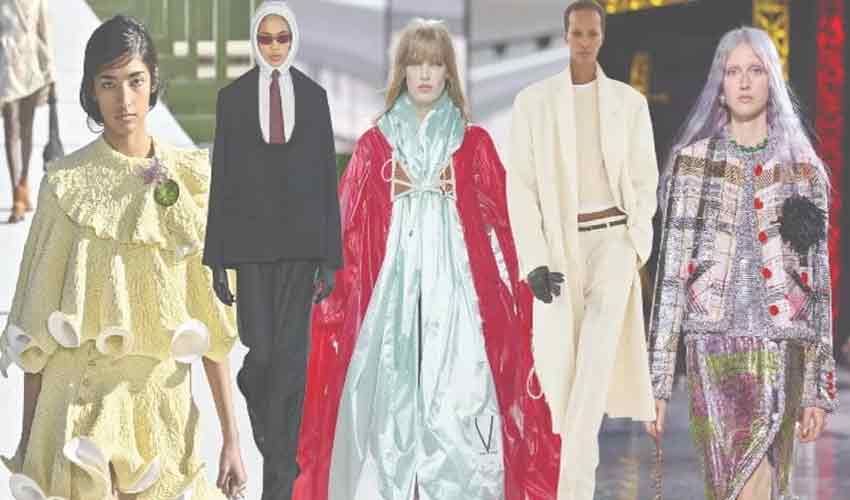
Sustainable fashion took center stage this season as young designer Max Alexander unveiled a 15-piece collection driven by creativity, recycling and environmental awareness.
Speaking to CBS News, the prodigy said sustainability played a central role in his design process. His collection featured 15 distinct dresses, nearly all created with eco-friendly materials.
“My collection consists of 15 dresses and around 90% of the show is biodegradable, recyclable and sustainable, made from dead stock and surplus fabrics,” Alexander said.
Among the standout pieces was a striking high-low gown crafted from an upcycled Indian saree, demonstrating how traditional textiles can be transformed into modern couture.
Alexander has previously drawn attention for his achievements in fashion at a young age. In 2023, shortly after earning a Guinness World Record as the youngest runway fashion designer, he told PEOPLE magazine he believed he might have been Gucci founder Guccio Gucci in a past life.
His advocacy for sustainability has also reached global platforms. In 2024, he was invited to address the United Nations, where he spoke about reducing fashion waste and limiting excessive fabric consumption in the industry.
“I am happy I got to show the world my designs and maybe encourage people to think about reuse and not buying so much fast fashion,” he said.
In a message shared on Instagram, Alexander thanked the supporters who believed in him from the start of his journey.
Meanwhile, Paris Fashion Week concluded with a dramatic back-to-nature showcase by Louis Vuitton. The show, staged in the main courtyard of the Louvre, featured models dressed in mountain capes and shepherd-style hats while carrying bell-adorned bags.
Celebrities Zendaya and Ana de Armas were among the guests watching the finale presentation by the brand’s artistic director Nicolas Ghesquière.
Ghesquière said the collection was designed to reconnect audiences with the roots of Louis Vuitton, who left the Jura mountains as a teenager and moved to Paris in 1837 to begin his career.
“For this show, I wanted to highlight the idea that nature is the greatest creator,” Ghesquière told journalists. “It wasn’t about imitating it, but rather about elevating nature.”
The designer incorporated hemp-based faux fur coats, patchwork dresses and wide rattan hats resembling inverted baskets to evoke a sense of global nomadism. The show also featured artwork by Ukrainian painter Nazar Strelyaev-Nazarko, whose pieces appeared on jackets and skirts worn by the models.
Paris Fashion Week also welcomed Ukrainian designer Lilia Litkovska, who debuted her first show on the official calendar this year.
Her collection featured deconstructed garments and biker-boot ensembles, with models walking the runway wearing headlamps. Litkovska said the designs were inspired by the experience of walking home from her studio in Kyiv during power outages caused by the ongoing war.
“I had a flashlight, and there were people across the street with lights as well,” she said. “It’s hard to explain, but you feel you’re not alone. Our beams crossed like a silent dialogue in the darkness.”
Fashion Week itself has a long history. While the first official fashion week took place in New York, the tradition originated in Paris through “salon shows,” known in French as défilés de mode, meaning fashion parades.
As early as the 1700s, Paris designers presented clothing to clients using mannequins. However, these displays limited how garments could be viewed since mannequins lacked movement. By the 19th century, fashion presentations began evolving into more dynamic showcases.
British-born designer Charles Frederick Worth, widely regarded as the father of haute couture, began presenting multiple designs together to attract buyers’ attention. French designer Jeanne Paquin later became the first to make fashion shows open to the public, while Paul Poiret introduced the concept of hosting lavish parties after runway presentations.
Worth’s rise to prominence was aided by influential clients, including Austrian princess Pauline von Metternich, who commissioned him to create a gown after seeing one of his sketches. His growing reputation led him to open his own couture house in Paris in 1858, catering to elite clientele.
In 1945, the Chambre Syndicale de la Haute Couture established strict rules governing haute couture houses. Among the requirements, fashion houses must present at least 35 designs each season — including both daytime and evening wear — to the Paris press in order to qualify as official haute couture.
Today, fashion weeks remain one of the industry’s most important platforms, where designers showcase new collections while shaping the future of global style.



.jpg)