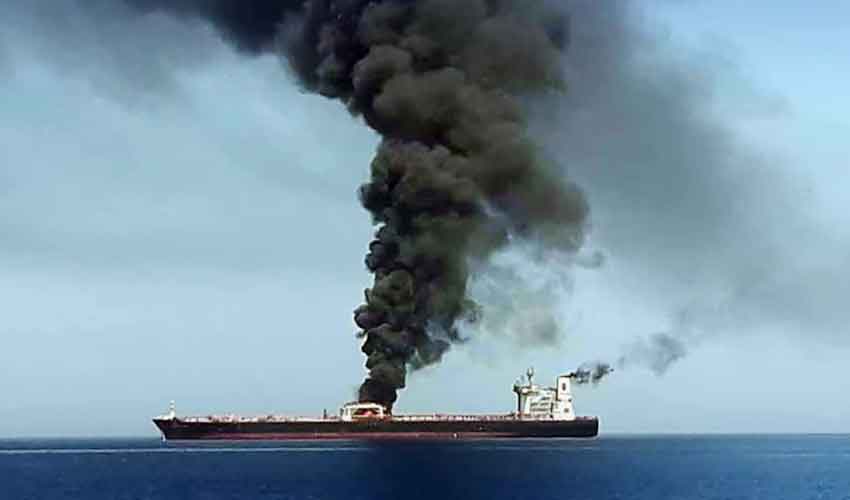
The United States has launched a full-scale military campaign against Iran, with officials warning the conflict will not end quickly.
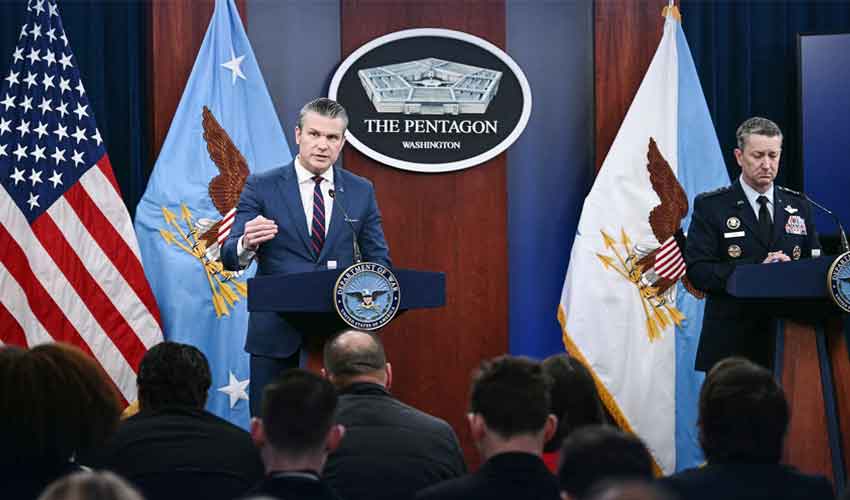
Speaking at a Pentagon press briefing, US Defense Secretary Pete Hegseth and Joint Chiefs of Staff Chairman General Dan Caine confirmed the war effort is ongoing — and more casualties are expected.
Operation Epic Fury
Defense Secretary Pete Hegseth revealed that Operation Epic Fury was launched two days ago on the orders of President Donald Trump. He described the campaign as a decisive military move aimed at crippling Iran’s missile program and naval capabilities while preventing Tehran from acquiring nuclear weapons.
“Our mission is to destroy Iran's missile program and navy,” Hegseth said. “We fight to win.”
More than 100 aircraft participated in the attack on Iran, according to General Dan Caine. The operation also targeted communication networks through space and cyber operations.
US forces have destroyed hundreds of Iranian missiles and drones, Caine added.
Full-scale war, not one-night strike
Officials made it clear that the campaign is not limited in scope.
“This is not a one-night operation. It is a full-scale war that is ongoing,” General Caine said.
Hegseth echoed that sentiment, stressing that this “will not happen overnight” and describing the battlefield as vast and complex.
“The military objectives at CENTCOM and the Joint Force have been tasked with will take some time to achieve and in some cases will be difficult and gritty work,” Caine explained.
Also Read: US-Israel strikes: Iran death toll reaches 555; US loses 4 soldiers
He said additional US casualties are expected but assured efforts would be made to minimize losses.
“We expect to take additional losses and as always, we will work to minimize US losses,” Caine stated.
Casualties and attacks on US forces
During the briefing, Hegseth confirmed that Iran targeted a Tactical Operations Center, resulting in casualties. However, he did not specify the extent of the losses.
US officials are also investigating reports of aircraft destruction in Kuwait. The Joint Chiefs of Staff clarified that those aircraft were not destroyed by enemy fire.
Also Read: Iran claims missile strike on Netanyahu’s office, Israeli Air Force
Hegseth emphasized that while there are currently no US forces on Iranian soil, “no option can be ruled out” in pursuit of victory.
Not Iraq, not endless
The US defense secretary sought to distinguish the current war from previous long-term conflicts.
“This is not Iraq. This is not endless,” Hegseth said.
He added that under the “America First” policy, the United States intends to end the war soon. However, he declined to provide a timeline, saying such decisions rest with President Trump.
“As far as time frame, I would never hang a time frame,” he said. “President Trump has all the latitude in the world to talk about how long it may or may not take — four weeks, two weeks, six weeks. It could move up. It could move back.”
Regime change and broader message
In a striking remark, Hegseth stated, “This is not a so-called ‘regime change’ war, but the regime sure did change. And the world is better off for it.”
He also accused Iran of having unilaterally declared war on the United States for 47 years, citing rocket attacks on US personnel in Beirut, Iraq, and Afghanistan.
Also Read: US confirms 4 troops killed, 4 seriously injured in Iran strikes
“If you target Americans, we will find and kill you,” he warned.
Iran’s military capabilities
General Caine noted that Iran possesses dual-purpose missile capabilities, raising concerns about the scale of the conflict. He said the US had prepared for this target “for months and years,” calling the operation a strong demonstration of America’s war readiness and military power.
Additional US forces are being deployed to the region as part of the ongoing campaign. Officials also stressed continued commitment to counter-drone operations.
When pressed repeatedly for a timeframe, both officials declined to offer specifics.
“We cannot give a timeframe for the operation,” Caine said.
Hegseth reiterated that the duration of the US-Israeli assault on Iran ultimately depends on presidential decisions and battlefield developments.

.jpg)