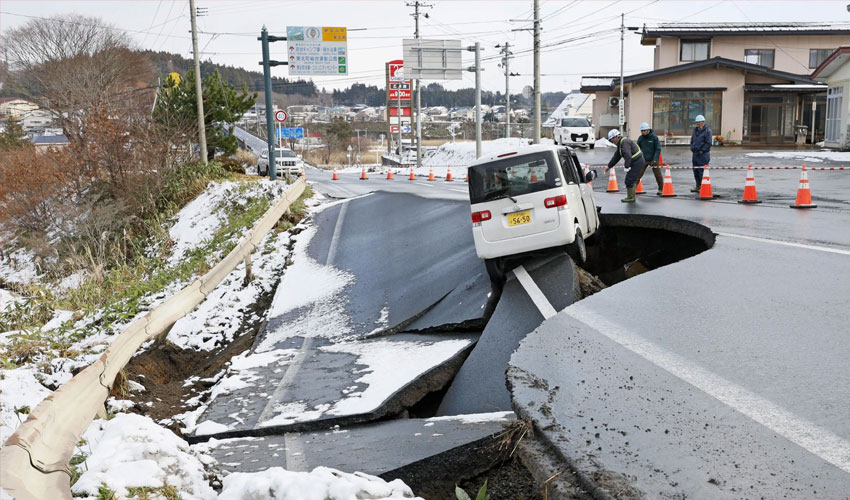
Japan’s northeastern region was shaken by a magnitude 6.7 earthquake on Friday, prompting the Japan Meteorological Agency to issue a tsunami warning.
The quake, striking near Aomori Prefecture, comes just days after another strong tremor rattled the same area.
The earthquake hit at 11:44 a.m. local time (02:44 GMT) at a depth of 20 km (12.4 miles), according to the Japan Meteorological Agency. The United States Geological Survey confirmed the magnitude at 6.7.
While the tremor was strong enough to trigger a tsunami advisory, national broadcaster NHK noted that the shaking was less intense than a magnitude 7.5 quake that struck earlier this week, damaging roads, breaking windows, and generating tsunami waves of up to 70 centimeters (2.3 feet).
Nuclear safety status
Japan’s Nuclear Regulation Authority reported no immediate signs of abnormalities at regional nuclear facilities, easing fears of a potential radiation hazard.
Residents brace for possible aftershocks
The northeast region remains on high alert following Monday’s earthquake, which injured at least 50 people. The JMA had issued a special advisory warning residents across a broad area—from Hokkaido to Chiba—to prepare for increased seismic activity over the week.
Amid lingering fears, people are stocking up on disaster essentials. In Hakodate City, Hokkaido, sales of bottled water and disaster kits tripled. “We decided to prepare, so I bought disaster kits for everyone,” a local resident told NHK.
Northeast Japan carries the memory of the 2011 magnitude 9.0 undersea earthquake that triggered a devastating tsunami, killing around 18,500 people.
The government has also warned of potential megaquakes along the Nankai Trough, which could kill as many as 298,000 people and cause up to $2 trillion in damages. Japan’s location atop four major tectonic plates along the Pacific “Ring of Fire” makes it one of the world’s most seismically active countries.







.jpg)