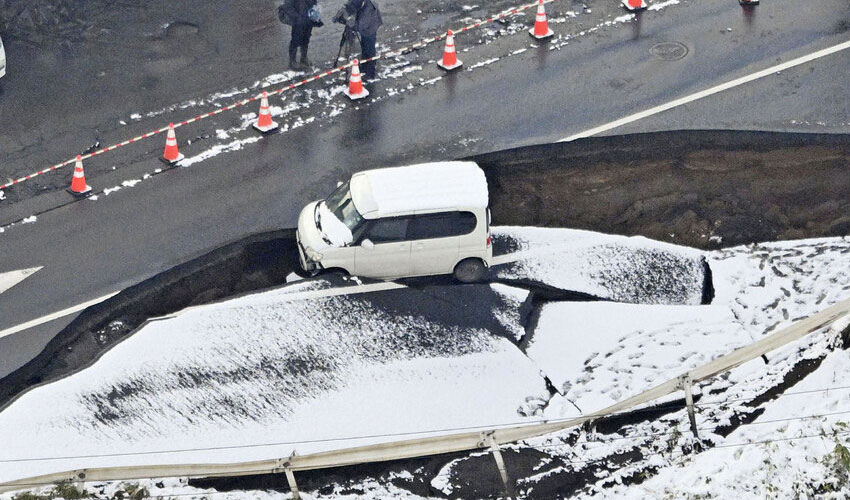
Japan lifted its tsunami warnings on Tuesday, just hours after a powerful 7.5-magnitude earthquake struck the country’s northeastern coast, injuring dozens and prompting nearly 90,000 residents to evacuate.
The late-night tremor triggered widespread alerts, disrupted power, and raised concerns of a potential “mega-quake” in the coming days.
Japanese authorities initially warned that tsunami waves up to 3 metres could hit parts of Hokkaido, Aomori, and Iwate prefectures. Waves between 20 and 70 cm were observed at several ports, but no major destruction was reported.
By early Tuesday morning, the Japan Meteorological Agency (JMA) downgraded the warnings to advisories and later lifted them entirely.
Officials, however, cautioned that the possibility of another powerful quake remains high for at least a week.
“There is a possibility that further powerful and stronger earthquakes could occur over the next several days,” a JMA official said.
Epicentre near Aomori
The earthquake struck at 11:15 p.m. on Monday, with its epicentre located 80 km off the coast of Aomori at a depth of 54 km.
On Japan’s seismic intensity scale of 1 to 7, the tremor registered an “upper 6” in Hachinohe city—strong enough to make standing or walking nearly impossible.
Prime Minister Sanae Takaichi confirmed that at least 30 people were injured, and one fire was reported following the quake.
Transport disruptions and power outages
East Japan Railway suspended some train services in the affected regions, while other routes faced delays.
Thousands of households temporarily lost power, but electricity was restored by Tuesday morning. Notably, nuclear plants operated by Tohoku Electric Power and Hokkaido Electric Power reported no irregularities, easing fears of a repeat of past disasters.
Japan has maintained a strict post-2011 earthquake protocol. Based on lessons from the devastating 9.0-magnitude Sendai quake, the government now issues a one-week “mega-quake advisory” whenever a significant earthquake hits the region.
The 2011 disaster, followed by massive tsunami waves, killed nearly 20,000 people and led to meltdowns at the Fukushima Daiichi nuclear plant—the worst nuclear incident in 25 years.
Financial markets briefly reacted to the tremor. The yen weakened against major currencies, with both the U.S. dollar and the euro touching session highs shortly after the quake’s announcement.







.jpg)