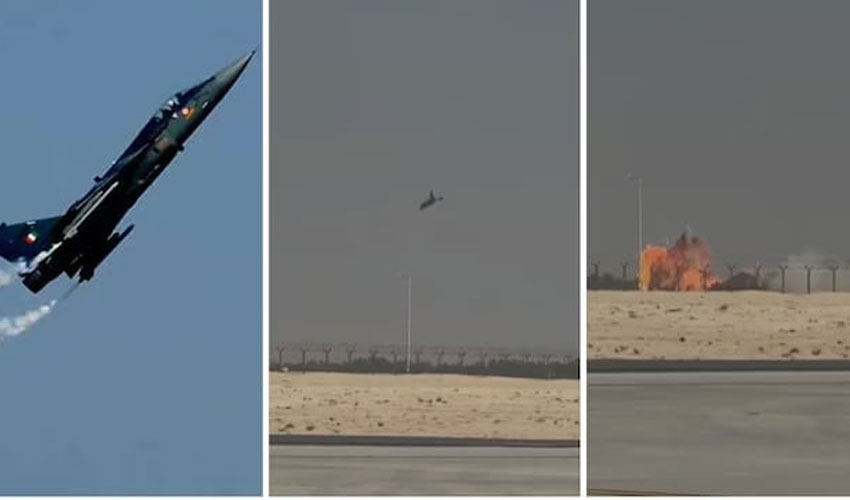
India faced a setback at the Dubai Airshow as its Tejas fighter jet crashed in front of global arms buyers, raising questions about the jet’s export potential.
The accident occurred amid heightened regional rivalry, with Pakistan showcasing its JF-17 Thunder Block III.
The Tejas fighter’s crash on Friday was a dramatic moment at one of the world’s largest air shows. Experts caution that while the cause is still unclear, the incident dents India’s efforts to market the home-built jet internationally.
Douglas A. Birkey, executive director at the Mitchell Institute for Aerospace Studies, said, “A crash sends quite the opposite signal: a dramatic failure.” Despite the setback, he added that the jet’s momentum could recover, as fighter sales are often influenced by political considerations beyond one-off accidents.
Tejas’ role in India’s military modernisation
The Tejas program, which began in the 1980s to replace aging MiG-21s, remains central to India’s push for self-reliance in defense technology. Hindustan Aeronautics Ltd (HAL) has 180 Mk-1A variants on order, but deliveries are delayed due to GE Aerospace engine supply issues.
RELATED: Who was Wing Commander Namansh Syal? Tejas crash pilot
An Indian Air Force officer noted the jet was meant to fill gaps in shrinking fighter squadrons, now reduced to 29 from the approved 42. As a result, India is considering off-the-shelf purchases, including more Rafales, F-35s, and Su-57s to meet short-term needs.
Export potential takes hit
Industry insiders say the crash rules out immediate export plans for Tejas, which had targeted markets in Asia, Africa, and Latin America. HAL had even opened an office in Malaysia in 2023 to support international sales. Analysts now expect India to prioritise domestic production and orders before pursuing overseas markets.

The Dubai Airshow also highlighted ongoing tensions with Pakistan. The rival nation signed a provisional agreement to supply its JF-17 Thunder Block III fighter to a “friendly country,” promoting the jet as “battle-tested” after its deployment in May. Meanwhile, India’s Tejas, which was not used in the recent aerial conflict, remained a symbol of technological promise rather than battlefield experience.
Walter Ladwig of the Royal United Services Institute said the Tejas’ significance lies more in building India’s industrial and technological base for future combat aircraft than in immediate sales abroad.




.jpg)