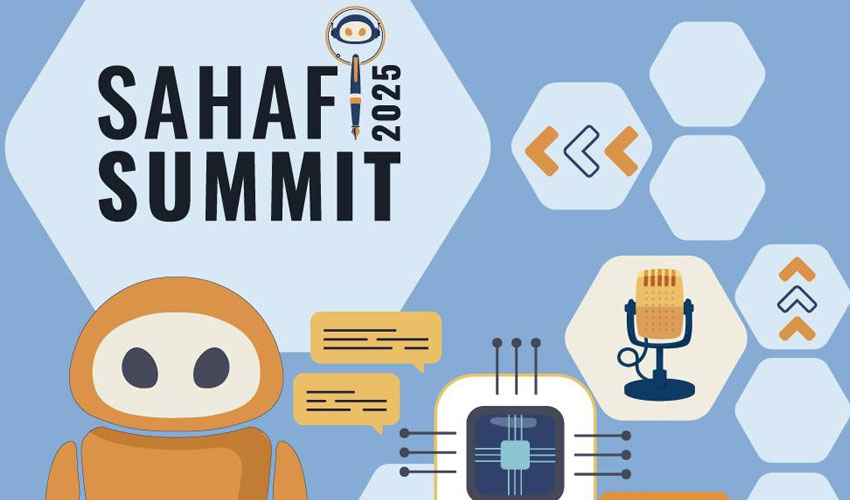
Media Matters for Democracy (MMfD) unveiled the standards for AI in Journalism during the closing ceremony of Sahafi Summit 2025.
The standards were introduced at the end of Sahafi Summit 2025 - a three-day event focused on the future of AI in journalism - organised in collaboration with the Department of Media and Development Communication, University of the Punjab, with support from the European Union in Pakistan and UNESCO’s Information for All Programme.
Developed through a co-creation process involving newsroom leaders and media professionals, the standards aim to uphold accountability, transparency, and human oversight in AI integration. These pillars form a comprehensive framework for safe, transparent, and ethical AI adoption in news production and editorial workflows.
“We hope that these principles will provide a grounding and a pathway for integrating AI tools in a way that strengthens, rather than replaces, journalistic practice,” said Asad Baig, Founder of Media Matters for Democracy.

Baig added that AI should not be viewed merely as a content tool but as a transformative technology reshaping newsroom sustainability, labour structures, and editorial cultures.

Emphasizing practical implementation, Baig noted,
“For any standards to be meaningful, they must reflect the realities of the local media environment. These standards draw on the collective experiences of editors from national and international newsrooms.”
AI-powered newsroom
One of the most engaging sessions at the summit was led by Dr. Asim Siddique, General Manager of Samaa Digital, who shared practical insights into how Pakistani newsrooms are evolving with artificial intelligence.
Dr. Siddique presented Pakistan’s first AI-assisted newsroom model, explaining how Samaa Digital has integrated AI-generated voiceovers, automated news summaries, and virtual anchors into its workflow.
He emphasised that every use of AI within the newsroom strictly adheres to the editorial policy, ensuring that human oversight and editorial integrity remain central to the process.

He demonstrated how AI tools can assist journalists in data-driven storytelling, technical SEO, and real-time news monitoring, enabling faster yet more accurate content production. However, he cautioned that such integration must always remain human-led, with journalists responsible for editorial decisions, fact-checking, and ethical compliance.
During an interactive Q&A session, Dr. Siddique addressed a wide range of questions from students and professionals about AI ethics, bias, and misinformation, as well as concerns over job security in the digital era. He encouraged young journalists to view AI not as a threat but as a collaborative tool that can enhance creativity and newsroom efficiency.

The Samaa Digital head also shared detailed insights into digital monetization strategies—including earning models across YouTube, Facebook, TikTok, and independent websites, and explained how journalists can leverage AI tools to optimize content reach and revenue generation.
He discussed new platform policies and upcoming guidelines for monetization, providing practical advice on how media startups and individual creators can benefit from AI-powered analytics and automation.
“AI is already shaping how audiences consume news. The question is not whether we should use it—but how we can use it responsibly,” said Dr. Siddique. “At Samaa Digital, our goal is to ensure that technology serves journalism, not the other way around.”
Dr. Ayesha Ashfaq, Chairperson of the Department of Media and Development Communication, emphasized the importance of preparing media students for a rapidly changing digital world.
“Our media students will define the future of journalism in Pakistan,” she said. “It is essential for them to engage in these critical discussions about AI, ethics, and innovation.”






.jpeg)