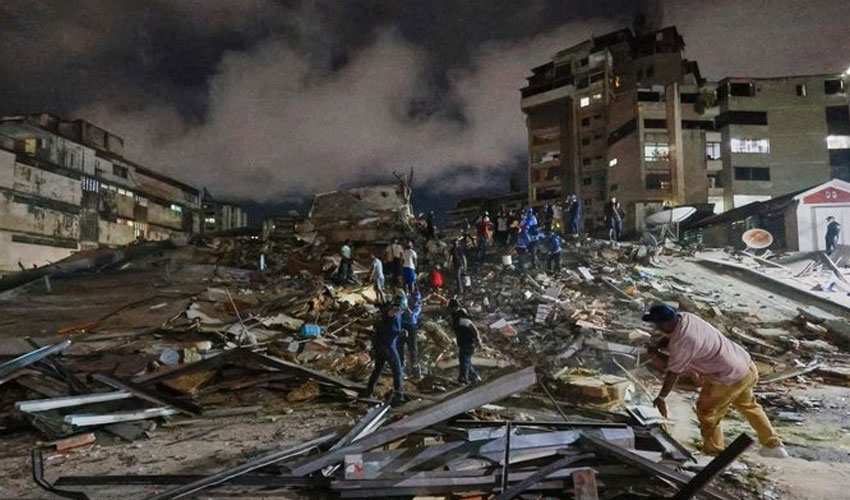
Venezuelan rescue teams and volunteers are racing against time to find survivors after twin earthquakes devastated the country's northern coast, leaving at least 1,430 people dead and more than 51,000 still missing.
The powerful earthquakes, measuring 7.2 and 7.5 in magnitude, struck on Wednesday and caused widespread destruction in the coastal region of La Guaira, with authorities warning that hopes of finding more survivors are rapidly fading.
Thousands of rescuers, volunteers and residents continued searching through collapsed buildings on Saturday as the crucial 72-hour survival window neared its end.
With limited government rescue teams available in the worst-hit areas, many desperate residents have been digging through rubble with their bare hands in search of loved ones.
Aid agencies warned that every passing hour significantly reduces the chances of finding survivors trapped beneath the debris.
Authorities restrict access to disaster zone
On Friday night, Venezuelan authorities restricted access to the affected areas around La Guaira, saying traffic congestion was disrupting rescue operations.
Officials announced that anyone entering the disaster zone would require official permission, although they did not provide details about who would qualify for entry.
Despite government assurances of a large-scale emergency response, residents reported seeing few official rescue teams in the hardest-hit communities.
"Each person saved is a miracle," National Assembly President Jorge Rodriguez said.
"We are not going to hide absolutely anything about the magnitude of this tragedy," he added.
Government forces distributed food and drinking water to survivors in La Guaira as Acting President Delcy Rodriguez said authorities were carrying out a full-scale emergency response during the critical rescue period.
She welcomed the arrival of international search-and-rescue teams and humanitarian assistance, adding that La Guaira had been militarised to facilitate relief operations.
Residents, however, said the assistance reaching affected communities remained far below what was needed.
Rodriguez assumed office in January after former President Nicolas Maduro was removed following his capture by the United States.
Billions in damage expected
The United Nations Development Programme (UNDP) estimated that direct physical damage caused by the earthquakes could range between $4.7 billion and $8.7 billion.
Meanwhile, a magnitude 4.8 aftershock struck off Venezuela's Aragua state on Saturday, according to the European-Mediterranean Seismological Centre, although no significant additional damage was immediately reported.
Authorities said the number of fatalities is expected to rise as rescue operations continue.
While more than 51,000 people have been reported missing, officials cautioned that the figure may include duplicate reports and people who remain unreachable because of widespread telecommunications outages.
More than 3,300 people have been injured, while rescue teams have pulled 243 survivors from the rubble so far.
The International Organization for Migration (IOM) estimated that up to 6.76 million people could be affected by the disaster, including nearly two million residents of Caracas.
"It is already clear that displacement will increase, as people seek safety," IOM Director-General Amy Pope said, stressing the need for a rapid humanitarian response.
International rescue teams arrive
Venezuelan authorities said approximately 1,600 foreign rescue personnel had arrived to assist local emergency services.
However, Nicole Kast, Venezuela director for the International Rescue Committee, said search teams were already entering the final hours of the rescue phase.
"Seventy-two hours is the window in which we hope to find people still alive," she said.
Kast noted that Venezuela was already facing humanitarian challenges before the earthquakes, leaving civil protection services with limited resources despite growing international support.
Reporting from Chacao in Caracas, Al Jazeera's Noris Soto said rescue crews continued clearing debris using heavy machinery and specialised equipment.
She said rescuers now believe the chances of finding additional survivors are "nearly zero."
Soto added that widespread mobile and internet outages, particularly in La Guaira, have made it extremely difficult for families to locate missing relatives.
Residents have also complained about poor coordination, saying many families still do not know where survivors have been taken or where recovered bodies are being transferred.



.jpeg)