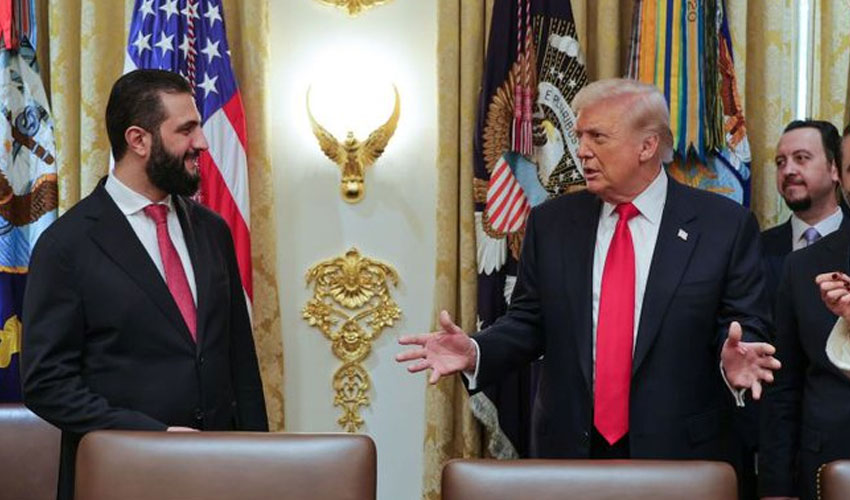
US President Donald Trump welcomed Syrian President Ahmed al-Sharaa to the White House on Monday, coinciding with Washington’s decision to extend sanctions relief for Damascus.
The visit marked a stunning diplomatic shift just a year after al-Sharaa overthrew longtime ruler Bashar al-Assad.
Al-Sharaa, 43, became the first Syrian leader to set foot in the White House since the country’s independence in 1946. Once a high-ranking member of al-Qaeda, al-Sharaa has rebranded himself as a reformist leader seeking to rebuild Syria and restore its international standing after years of war and isolation.
According to a statement from the Syrian presidency, the two leaders discussed ways to “strengthen and develop” U.S.-Syria relations, along with “regional and international issues of common interest.”
Trump praised al-Sharaa during the meeting, saying, “He comes from a very tough place, and he’s a tough guy. I like him.” The president added, “We’ll do everything we can to make Syria successful because that’s part of the Middle East. We have peace now in the Middle East – the first time that anyone can remember that ever happening.”
From rebel commander to head of state
Al-Sharaa’s rise has been nothing short of extraordinary. A former al-Qaeda commander once known as Abu Mohammed al-Julani, he led Hayat Tahrir al-Sham (HTS) before breaking ties with the militant network in 2016. Captured by U.S. forces during the Iraq War, al-Sharaa resurfaced as the political face of Syria’s post-Assad order after leading a coalition that toppled the former regime last December.
Since then, he has sought to portray himself as a unifying and moderate leader. At the UN General Assembly earlier this year, he declared that Syria is “reclaiming its rightful place among the nations of the world,” while advocating for renewed engagement with the U.S. and European Union.
Muted welcome, quiet diplomacy
Despite the symbolism of the visit, al-Sharaa’s arrival was deliberately understated. He entered the White House through a side entrance, and there was no joint press conference or photo-op with Trump — an unusual omission for such a landmark event.
A senior U.S. official told AP and AFP that Syria would join the global coalition against ISIL (ISIS) as its 90th member, and Washington would allow Syria’s embassy in D.C. to resume operations. The official added that both sides aim to improve coordination on counterterrorism, security, and trade.
No official statement was immediately issued by Damascus.
Foiled ISIL plots and security crackdown
Just hours before the talks, reports emerged of two foiled ISIL assassination plots targeting al-Sharaa in recent months. Syrian state media later confirmed that more than 70 suspected ISIL operatives were arrested in a nationwide crackdown ahead of the visit.
The renewed focus on counterterrorism, combined with U.S. engagement, underscores Washington’s shifting strategy toward a pragmatic partnership with Damascus against remaining extremist networks.
Sanctions relief and political divisions
In a parallel move, the U.S. Treasury Department announced the extension of sanctions relief for another six months, suspending punitive measures under the Caesar Act. The law had previously banned U.S. business dealings with Syria’s government and military.
“Removing U.S. sanctions will support Syria’s efforts to rebuild its economy and combat terrorism,” the department said in a statement. It added that Trump was “delivering on his commitment to give Syria ‘a chance at greatness.’”
However, the decision drew mixed reactions in Washington. A permanent repeal of the Caesar Act would require congressional approval. Senator Jeanne Shaheen has proposed ending sanctions without conditions, while Senator Lindsey Graham favors a conditional review every six months — a move critics argue could discourage international investors from re-entering Syria.


.jpg)