Federal Finance Minister Muhammad Aurangzeb engaged in a series of high-profile meetings during his ongoing visit to the United States this week, underscoring Pakistan’s economic reforms, stability measures, and growing investment potential.
During his Washington engagements, the finance minister met with Nobumitsu Hayashi, governor of the Japan Bank for International Cooperation (JBIC), delivered an address at the JP Morgan Investment Seminar, and participated in the World Economic Forum (WEF) meeting focused on “Promoting Inclusive and Sustainable Development through Innovation.”
Meeting with Japan Bank governor: Boosting bilateral investment
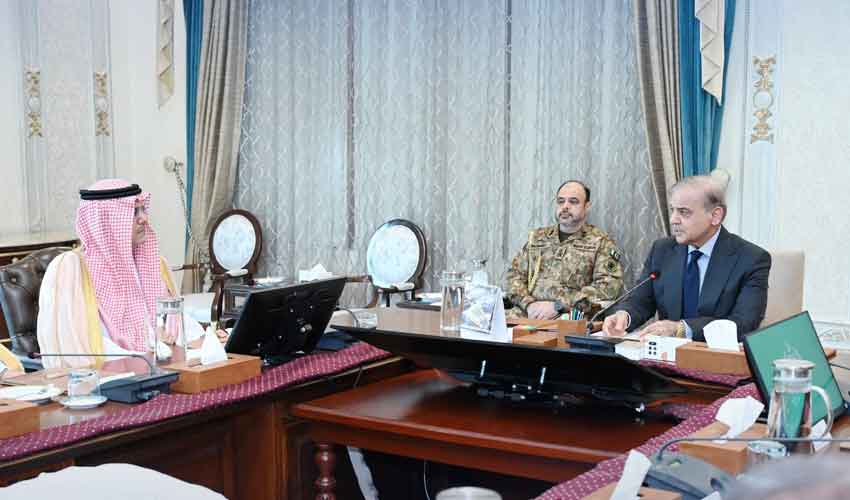
In his meeting with JBIC Governor Nobumitsu Hayashi, Minister Aurangzeb appreciated the bank’s official inclusion in the lending group for the Reko Diq project, describing it as a positive step in strengthening economic ties between Pakistan and Japan.
He stated that the move would send “a strong and positive message” to Japanese business circles, highlighting Pakistan as an increasingly attractive destination for investment.
Federal Minister for Finance and Revenue, Senator Muhammad Aurangzeb, met with Mr. Nobumitsu Hayashi, Governor of the Japan Bank for International Cooperation (JBIC), in Washington D.C.
— Ministry of Finance, Government of Pakistan (@Financegovpk) October 17, 2025
The Minister appreciated JBIC’s formal commitment to join the Reko Diq lender group, noting… pic.twitter.com/ZJ5ClapMvu
Aurangzeb reaffirmed the government’s commitment to ensuring trust and security for foreign investors and emphasized the importance of exploring additional areas of cooperation between the two countries.
JP Morgan seminar: Pakistan’s economic and financial policy in focus
At the JP Morgan Investment Seminar in Washington DC, the minister presented an in-depth overview of Pakistan’s economic and financial policies, recent achievements, and reform progress.
He highlighted improvements in economic governance, fiscal discipline, and external sector stability, attributing these gains to the government’s effective reform measures.
Federal Minister for Finance and Revenue, Senator Muhammad Aurangzeb, addressed the JP Morgan Investment Seminar on Pakistan’s Economic and Monetary Policy Outlook in Washington D.C.
— Ministry of Finance, Government of Pakistan (@Financegovpk) October 17, 2025
The Minister briefed participants on recent developments in Pakistan’s fiscal, monetary, and… pic.twitter.com/2URiNyvLcA
Aurangzeb also briefed investors on the Staff-Level Agreement (SLA) recently signed with the International Monetary Fund (IMF). The agreement pertains to the second review of the Extended Fund Facility (EFF) and the first review of the Resilience and Sustainability Facility (RSF).
He noted that the upgrade in Pakistan’s credit rating by global agencies reflects renewed international confidence in the government’s reform agenda and macroeconomic management.
World Economic Forum: Linking technology with sustainable development
During his participation in the World Economic Forum (WEF) meeting, Finance Minister Aurangzeb discussed the role of technology and innovation in promoting inclusive and sustainable growth.
He emphasized that Pakistan’s development strategy is anchored in technological advancement, with ongoing initiatives designed to strengthen the country’s innovation-driven economy.
Federal Minister for Finance and Revenue, Senator Muhammad Aurangzeb, participated in the World Economic Forum’s (WEF) Future of Growth Initiative dialogue on “Leveraging Innovation for Inclusive and Sustainable Growth.”
— Ministry of Finance, Government of Pakistan (@Financegovpk) October 17, 2025
In his remarks, the Minister emphasized that technological… pic.twitter.com/CV1dgHv0yE
Aurangzeb also drew attention to the Federal Board of Revenue (FBR) reforms, under which artificial intelligence-based monitoring systems have been introduced to improve transparency and efficiency.
“These AI-driven reforms have significantly boosted productivity,” he noted, adding that the use of artificial intelligence has also increased the income of small farmers in developing regions and improved service delivery quality across multiple sectors.