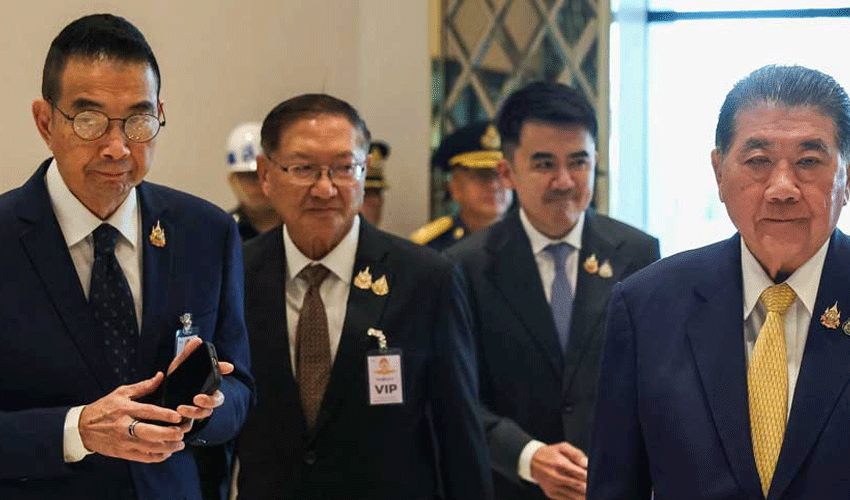
The leaders of Thailand and Cambodia are due to meet in Malaysia on Monday for high-stakes talks aimed at securing an urgent ceasefire in their escalating border conflict, which has left over 30 people dead and forced more than 200,000 civilians from their homes.
The talks, brokered by Malaysia in its capacity as the current chair of the ASEAN bloc, are being co-organised with the United States and include the participation of China. Malaysian Prime Minister Anwar Ibrahim is expected to chair the meeting.
U.S. Secretary of State Marco Rubio confirmed late Sunday that American diplomats were already in Kuala Lumpur to facilitate the process. “We want this conflict to end as soon as possible,” Rubio said in a statement. “State Department officials are on the ground in Malaysia to assist these peace efforts.”
Tensions between the two Southeast Asian neighbours have been rising steadily since the killing of a Cambodian soldier in late May during a border skirmish. The situation rapidly deteriorated into full-scale hostilities last Thursday, resulting in the most intense fighting between the two countries in over a decade.
The clashes have so far claimed more than 30 lives — including at least 20 civilians — while both countries have reinforced their border troops. Thailand has declared martial law in eight districts and Cambodia has accused its neighbour of using cluster munitions, which are banned under international conventions.
The mounting violence has triggered a mass exodus from affected areas, with Thai officials reporting the evacuation of over 138,000 people and Cambodian authorities relocating nearly 70,000 from the northern Preah Vihear province.
According to Bernama, Anwar Ibrahim said he had been approached by both sides to mediate and was currently working out the conditions for negotiations. “What is important is an immediate ceasefire,” Anwar said on Sunday night. “I'm discussing the parameters, the conditions.”
Thailand initially expressed a preference for bilateral talks, while Cambodia had insisted on international mediation. The presence of both US and Chinese representatives in Kuala Lumpur indicates broader geopolitical interest in containing the conflict, which risks destabilising the wider region.
Both Bangkok and Phnom Penh have so far refrained from announcing concrete confidence-building measures, although officials in both capitals have expressed cautious optimism about the outcome of the Malaysia-hosted talks.
Observers say the presence of major powers may help ease tensions, but warn that deep-seated mistrust and unresolved territorial issues — particularly around the historic Preah Vihear temple — continue to complicate prospects for a long-term settlement.
The United Nations Security Council held an emergency closed-door meeting on Friday but has yet to issue a public statement. ASEAN, which has often been criticised for its non-interference policy, now finds itself under renewed pressure to take decisive action as the crisis unfolds.



.jpg)