More than 70 Palestinians were killed in Israeli strikes across Gaza on Saturday, including dozens reportedly waiting for humanitarian aid, as the death toll from enforced starvation continues to mount amid a deepening humanitarian catastrophe.
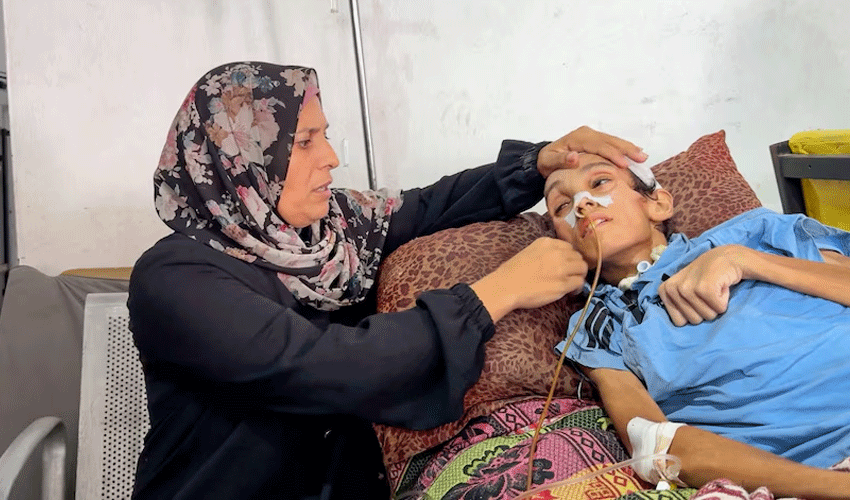
Medical sources told Al Jazeera that at least 71 Palestinians lost their lives in the latest wave of Israeli bombardments, 42 of whom were reportedly trying to access aid. Meanwhile, Gaza’s Ministry of Health confirmed five additional deaths from malnutrition, pushing the total number of hunger-related fatalities to 127 since October — including 85 children.
In a late-night statement on Saturday, the Israeli military announced it would initiate a “humanitarian pause” in certain civilian areas and corridors from Sunday to facilitate the distribution of aid. However, it did not specify which regions would be affected or the duration of the pauses.
The announcement comes as global outrage grows over the worsening conditions in Gaza, where aid organisations have warned that civilians are being pushed past the brink of survival.
The Israeli Foreign Ministry, while announcing the pause, again blamed the United Nations for the ineffective distribution of aid inside Gaza — a claim dismissed by both UN officials and independent rights groups. The UN and humanitarian actors have repeatedly said that aid delivery has been hampered by Israel’s refusal to ensure safe passage and consistent access.
Airdrops deemed 'ineffective'
The Israeli military claimed it had begun conducting airdrops of aid over Gaza, a method also adopted by the United Arab Emirates. However, aid experts have warned that such measures are largely symbolic and insufficient to address the humanitarian scale of need.
Philippe Lazzarini, head of the United Nations Relief and Works Agency for Palestine Refugees (UNRWA), described airdrops as an “expensive distraction” and urged Israel to open land crossings instead.
“These do not reverse the deepening starvation,” Lazzarini said, calling on Israel to lift the blockade and guarantee the safe movement of supplies and personnel.
Al Jazeera’s Hani Mahmoud, reporting from Gaza City, criticised the limited impact of the airdrops, stating that the aid delivered amounted to “only seven pallets” — the equivalent of half a truckload. “This will have no impact on the starvation crisis,” he said, citing medical professionals who warned that Gaza had already passed the “tipping point” and mass-scale starvation mortality was imminent.
Safe zones under attack
Despite designating certain areas as “safe zones,” Israel’s military continued its assaults. At least six people were killed in a drone strike on a tent camp in al-Mawasi near Khan Younis, an area previously identified by Israeli forces as a humanitarian shelter.
The Civil Defence authority in Gaza warned that it is on the brink of collapse, stating that nearly all its vehicles are out of service due to lack of spare parts and fuel.
“We stress the need for an urgent intervention to pressure the Israeli occupation authorities to allow fuel and repair parts for vehicles to enter,” the agency said.
Aid ship intercepted in international waters
In a separate development, Israeli naval forces intercepted the Handala, a humanitarian vessel organised by the Freedom Flotilla Coalition carrying baby formula, food, and medical supplies toward Gaza.
The ship, which had 19 international activists onboard, was reportedly seized in international waters. A livestream showed Israeli soldiers boarding the vessel, which the coalition described as a “violent seizure” in breach of international maritime law.
“The unarmed boat was carrying life-saving supplies when it was boarded by Israeli forces, its passengers abducted, and its cargo seized,” read a statement from the organisers.
The seizure of the vessel has further fuelled calls for accountability. While some Western governments have issued strong condemnations of Israeli conduct in Gaza, human rights advocates say concrete action is needed.
“The time for statements has passed,” said one rights campaigner. “We need targeted sanctions and international pressure to prevent further atrocities.”



.jpg)