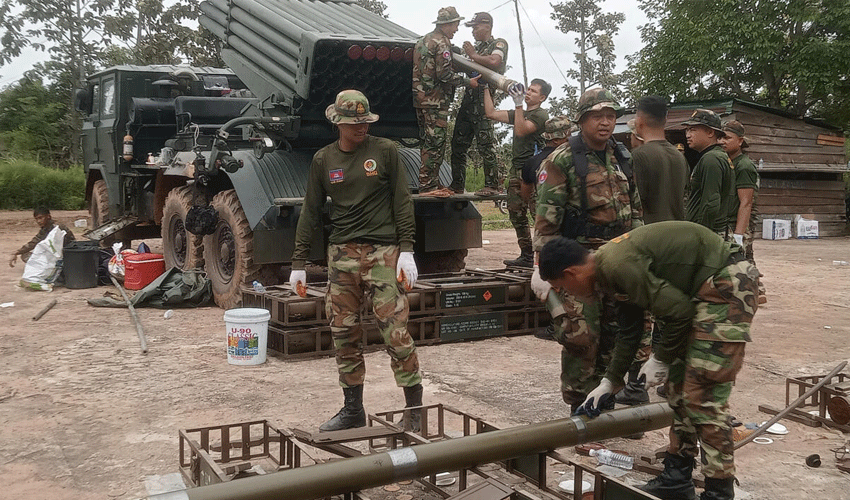
The death toll from ongoing clashes along the Thailand-Cambodia border has climbed to 32, with more than 130 people injured, as hostilities between the Southeast Asian neighbours escalate, sparking concerns of a broader conflict in the region.
Cambodian officials confirmed the deaths of 12 more individuals on Saturday — seven civilians and five soldiers — bringing the country’s total casualties to 18. A spokesperson from the Cambodian Ministry of National Defence, Maly Socheata, said an earlier casualty was a civilian who died when a Thai rocket struck a Buddhist pagoda in which he had taken refuge.
“In total, over 70 Cambodians, including 20 soldiers, have been injured since the violence began,” the spokesperson said.
On the Thai side, authorities have reported the deaths of 19 people — including 13 civilians and six soldiers — over the past two days. Among the civilian casualties are children, according to Thai officials. An additional 59 individuals — 30 civilians and 29 soldiers — have been wounded in retaliatory attacks attributed to Cambodian forces.
The renewed violence began on Thursday, when both sides exchanged direct fire, blaming each other for the initial provocation. Thailand accused Cambodian forces of launching long-range rockets at civilian infrastructure, including a petrol station, which resulted in the deaths of six people.
In response, the Royal Thai Air Force dispatched an F-16 fighter jet, which reportedly bombed several targets inside Cambodian territory. One of the strikes hit a Buddhist pagoda, killing a Cambodian civilian, according to local reports.
Cambodia has further alleged that Thailand used cluster munitions — internationally condemned for their indiscriminate effects — during the offensive, labelling the act a violation of international law.
“The use of cluster bombs is not only unacceptable but constitutes a breach of humanitarian conventions,” Cambodian foreign ministry officials stated.
In a sharp rebuttal, Thailand’s acting Prime Minister Phumtham Wechayachai accused Cambodia of war crimes, citing attacks on civilian areas and damage to medical facilities. “We are reviewing all legal options,” he said during a press briefing on Friday.
As the situation deteriorates, both countries have moved to secure their respective border populations. According to Cambodian provincial authorities in Preah Vihear, nearly 20,000 residents have been evacuated from border villages. Thai officials have confirmed the evacuation of over 138,000 people from the border region, establishing nearly 300 temporary shelters.
Thailand has also declared martial law in eight districts bordering Cambodia, heightening military presence and restricting civilian movement in the affected areas.
The United Nations Security Council convened an emergency closed-door session in New York on Friday evening to discuss the unfolding crisis. However, the meeting concluded without a public statement, reflecting divisions within the council over the next course of action.
Despite repeated calls for restraint from the international community, neither Bangkok nor Phnom Penh has shown a willingness to de-escalate. Analysts warn that if the fighting continues unchecked, the border skirmishes could spiral into a prolonged and destabilising conflict for the region.
The disputed border area, long a source of friction between the two nations, includes the site of the historic Preah Vihear temple. Although the International Court of Justice ruled in Cambodia’s favour in 2013, nationalist sentiments and unresolved demarcation issues have kept tensions simmering.

.jpg)