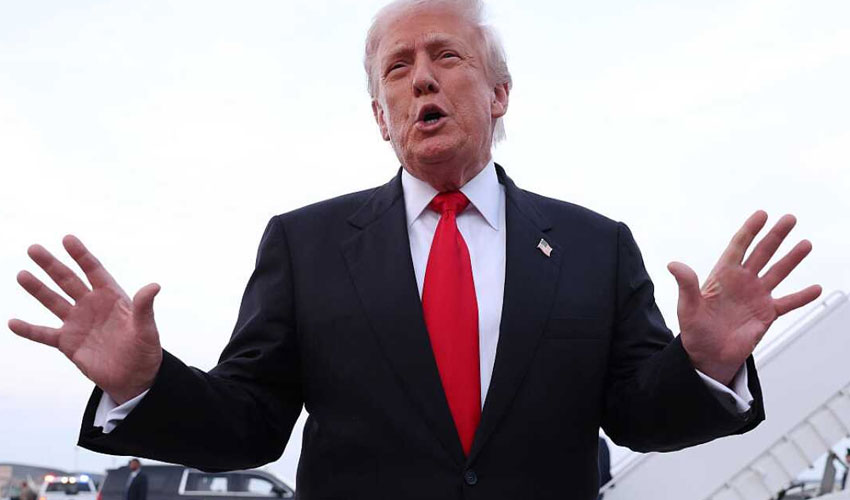
US president Donald Trump has filed a $10 billion defamation lawsuit against media tycoon Rupert Murdoch and The Wall Street Journal, alleging the publication falsely linked him to convicted sex offender Jeffrey Epstein through a controversial birthday letter.
The legal action was initiated in a federal court in Miami days after WSJ reported that Trump, then a real estate magnate, allegedly sent Epstein a suggestive birthday greeting in 2003. The report claimed the note contained a hand-drawn sketch of a naked woman and included a reference to a shared “secret,” along with Trump’s stylised signature.
Trump, 79, who is seeking a return to the White House in the upcoming election, has vehemently denied the claims. He labelled the article a “scam” and the birthday note “completely fabricated,” asserting that he neither authored the note nor drew the image described.
Writing on his social media platform, Truth Social, Trump accused the Journal and its editor-in-chief Emma Tucker of publishing false information despite being informed that the letter was inauthentic.
“I never wrote a picture in my life. I don’t draw pictures of women,” he said. “It’s not my language. It’s not my words.”
The lawsuit adds to mounting political pressure on the president, who continues to face scrutiny over past associations with Epstein. Although the two were photographed together at events in the early 2000s, no direct link has ever been established implicating Trump in Epstein’s criminal activities.
The timing of the Journal article, published late Thursday, raised eyebrows among Trump’s supporters, with many viewing it as a calculated attempt to damage his re-election bid. The report further fuelled conspiracy theories within his "Make America Great Again" (MAGA) base — many of whom believe a government cover-up shrouds the Epstein case.
In what appears to be an attempt to ease public outrage and reclaim control of the narrative, Trump has directed Attorney General Pam Bondi to seek the unsealing of grand jury testimony related to Epstein's federal prosecution. Such testimonies are typically kept confidential, but Bondi argued in her New York court filing that the "extensive public interest" surrounding the case warrants transparency.
It remains unclear whether the court will allow the release of the grand jury material. Even if unsealed, legal experts have suggested that the testimony may not contain any definitive evidence about the so-called "Epstein client list" — a term that has gained traction among right-wing media outlets and online communities.
The president’s push for the documents coincides with increased frustration within Republican circles, where some have accused the Justice Department of shielding high-profile individuals allegedly connected to Epstein.
Epstein, a financier with ties to several powerful men including Bill Clinton and Britain’s Prince Andrew, died in 2019 in a Manhattan jail cell while awaiting trial on charges of sex trafficking underage girls. His death was ruled a suicide, though conspiracy theories persist that he was murdered to prevent damaging revelations.
In July, Bondi issued a memo stating that no "client list" exists, in an apparent effort to put the matter to rest. However, the recent WSJ article appears to have reignited public interest, with critics accusing Murdoch’s publication of engaging in politically charged journalism.
Legal observers say Trump’s defamation suit faces a high bar for success, given the burden of proof required to show actual malice under US defamation law. However, they also acknowledge the lawsuit's political utility in rallying Trump’s supporters and pushing back against narratives that threaten his credibility.





.jpg)