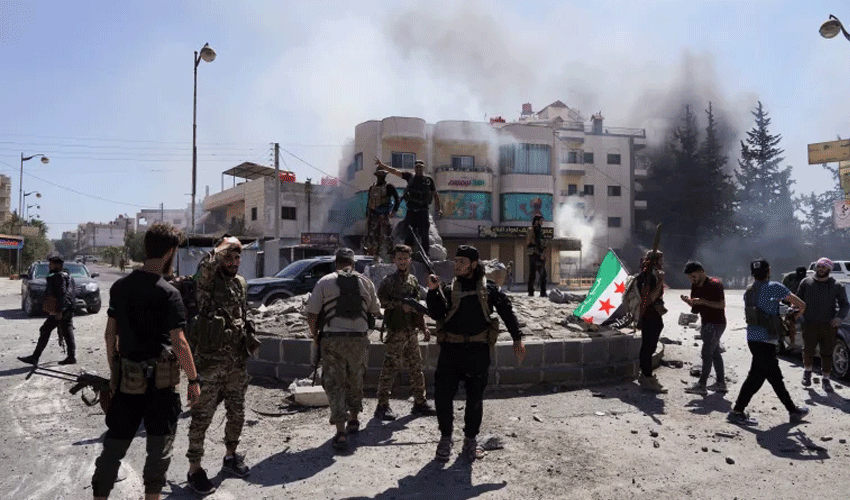
The United States on Wednesday announced that “specific steps” had been agreed upon to end the escalating violence in southern Syria, shortly after Israeli forces launched multiple strikes on Damascus and Suweida, targeting the Syrian defence ministry and government positions.
The development comes amid a deadly flare-up of sectarian violence in the predominantly Druze province of Suweida, where fighting between Druze militias and Bedouin tribes has reportedly left more than 300 people dead since Sunday.
US Secretary of State Marco Rubio, speaking on X (formerly Twitter), said Washington was “very worried” about the situation but was hopeful that calm would return soon.
“We have agreed on specific steps that will bring this troubling and horrifying situation to an end tonight,” Rubio posted late Wednesday, without disclosing further details. Syrian state media later welcomed the US and Arab mediation efforts aimed at resolving the crisis peacefully.
Meanwhile, the Syrian state news agency Sana reported that government forces had begun withdrawing from Suweida following an agreement with local Druze religious leaders. The army’s withdrawal was described as a move taken after “the completion of the army’s pursuit of outlaw groups.”
Israeli strikes target defense ministry
The Israeli military on Wednesday confirmed carrying out airstrikes on what it described as Syrian military targets in both Damascus and Suweida. One of the strikes reportedly hit near the entrance of the defence ministry in Umayyad Square, a central and symbolic location in Damascus.
Israeli Prime Minister Benjamin Netanyahu said the operations were aimed at "saving our Druze brothers and eliminating the regime's gangs". Defence Minister Israel Katz, in a post on X, said the Israeli military would continue its campaign “vigorously in Suweida” until hostile forces were completely removed.
Katz also shared footage showing a Syrian TV presenter diving under her desk as explosions were heard during a live broadcast—reportedly from a nearby Israeli airstrike.
Israel said it had also targeted armoured vehicles, weapons convoys en route to Suweida, and a military installation near the presidential palace. However, the Syrian foreign ministry condemned the strikes as a “flagrant assault” and “blatant violation of international law”, accusing Israel of attempting to sow chaos and destabilise the country.
Sectarian tensions and humanitarian fallout
The recent fighting in Suweida is believed to have been triggered by the abduction of a Druze merchant last Friday on the highway to Damascus. On Sunday, Druze fighters reportedly encircled and later took control of a Bedouin-majority neighbourhood in Suweida city, igniting retaliatory attacks by tribal groups.
According to the UK-based Syrian Observatory for Human Rights (SOHR), at least 300 people have been killed, including 69 Druze fighters, 40 civilians, and over 160 members of government forces. The BBC, however, noted it could not independently verify the figures.
Eyewitnesses from Suweida described scenes of panic and devastation. One resident, Hosam, told the BBC that snipers had been targeting civilians in the city centre. “I lost my neighbour today. A sniper shot him. We tried to call an ambulance, but we couldn’t get him to the hospital,” he said.
SOHR also reported that tanks shelled the national hospital in Suweida, causing widespread panic among patients and medical workers. The Syrian health ministry later claimed that government forces had entered the hospital and discovered "dozens of bodies" after armed groups fled the facility.
Severe shortages of water, electricity, and medical supplies have been reported across the province, with aid organisations warning of a deepening humanitarian crisis.
Political reactions
Interim Syrian President Ahmed al-Sharaa, in a televised address on Thursday, vowed to hold accountable those who “abused our Druze people.” He said the government would not allow external actors to exploit the unrest.
“We are not among those who fear war. We have put the interests of Syrians before chaos and destruction,” he said.
Despite the president’s assurances, trust remains low among Syria’s Druze community, who have historically maintained a cautious distance from both the government and opposition forces. Their concerns have been further heightened by recent outbreaks of sectarian clashes and the presence of Hayat Tahrir al-Sham (HTS)—a Sunni Islamist group formerly linked to al-Qaeda—in southern Syria.
Israel has expressed concerns over HTS’s activities in the region. Netanyahu recently reiterated his demand for the demilitarisation of Suweida and two adjoining provinces, citing the threat posed by Islamist factions near Israel’s northern frontier.
Regional implications
Israel has carried out hundreds of airstrikes in Syria since the collapse of Bashar al-Assad’s regime in December, often targeting Iranian-backed militias and Syrian military assets. The latest strikes, however, mark a significant escalation by directly hitting Syrian government institutions in central Damascus.
The Israeli military has also deployed troops into the UN-monitored buffer zone between Syria and the Israeli-occupied Golan Heights, raising alarms about potential regional spillover.
While the exact terms of the reported ceasefire remain unclear, the situation in Suweida and wider southern Syria remains volatile. Analysts say much will depend on how far the involved parties are willing to de-escalate and whether international mediation can enforce lasting calm in a region fractured by sectarian distrust and foreign interests.




.jpg)