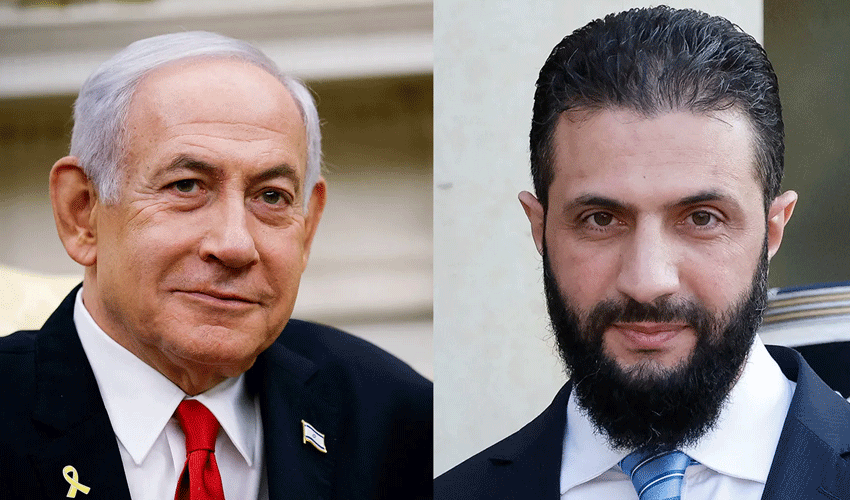
Syrian interim President Ahmad al-Sharaa is said to have attended at least one high-level meeting with Israeli officials in Azerbaijan, despite official denials from Damascus.
The covert meeting, reportedly part of a broader series of diplomatic engagements, involved discussions on a proposed security agreement between Israel and Syria, the growing threat posed by Iran, Hezbollah’s weapons arsenal, and the future of Palestinian militant groups operating out of Lebanon.
According to a Syrian source close to the presidency, Al-Sharaa’s presence at one of the meetings was confirmed, alongside that of Syrian Foreign Minister Asaad al-Shaibani and Ahmed Al-Dalati, the Syrian government’s liaison for security talks with Israel.
The Israeli delegation is believed to include a special envoy from Prime Minister Benjamin Netanyahu’s office, as well as senior military and intelligence officials.
The meetings, which are said to be taking place in Baku, the capital of Azerbaijan, are part of what insiders describe as a two or three-round engagement. While Syrian state channels and diplomatic circles in Damascus have denied Al-Sharaa’s involvement, the source told Israeli broadcaster i24NEWS that his participation is “definite” for at least one session.
“The decision to hold these talks in Azerbaijan was made jointly by Israel and the United States,” the source said, suggesting the choice of venue was intended as a geopolitical signal to Tehran. Azerbaijan has maintained cordial ties with both Israel and Syria and has previously played a mediating role in regional diplomacy.
The talks reportedly address several sensitive issues, including:
-
Details of a proposed Israel-Syria security agreement
-
Iran’s strategic influence in Syria and Lebanon
-
Hezbollah’s weaponisation and cross-border activity
-
The arming of Palestinian militias
-
The future of Palestinian refugee camps in Lebanon
-
Resettlement of displaced Gazan Palestinians in the region
One point under discussion is the potential establishment of an Israeli coordination office in Damascus. While the office would not carry formal diplomatic status, its creation would mark a significant step in Israeli-Syrian relations, currently strained but showing signs of a backchannel thaw.
In a separate but related development, Syrian President Al-Sharaa met Azerbaijani President Ilham Aliyev on Saturday in Baku — his first official visit to the country. Baku has in recent months also hosted indirect talks between Israeli and Turkish officials on the situation in post-conflict Syria.
A diplomatic source in Damascus, speaking on condition of anonymity due to the sensitivity of the matter, told Agence France-Presse (AFP) that a meeting “between a Syrian official and an Israeli official” was expected to take place on the sidelines of Al-Sharaa’s visit. However, the same source claimed Al-Sharaa would not personally attend that meeting.
Reports earlier this week alleged that Israeli National Security Adviser Tzachi Hanegbi had met Al-Sharaa in Abu Dhabi. However, Hanegbi was in Washington at the time and later denied any such encounter. This has led to speculation that another senior Israeli official may have quietly engaged with the Syrian leader.
The talks come at a delicate time for the region, following the fall of long-time Syrian President Bashar al-Assad in December. Israel is believed to have established a military presence in parts of Syria during the final stages of Assad’s rule, and the future of that presence is said to be a key subject in the ongoing discussions.
While the full outcome of these clandestine meetings remains unclear, diplomatic observers say the involvement of both top-level Syrian and Israeli figures signals a significant shift in regional dynamics, with Baku emerging as an unlikely but pivotal venue for conflict de-escalation.
Officials from Israel and Syria have so far declined to comment publicly on the matter.


.jpg)