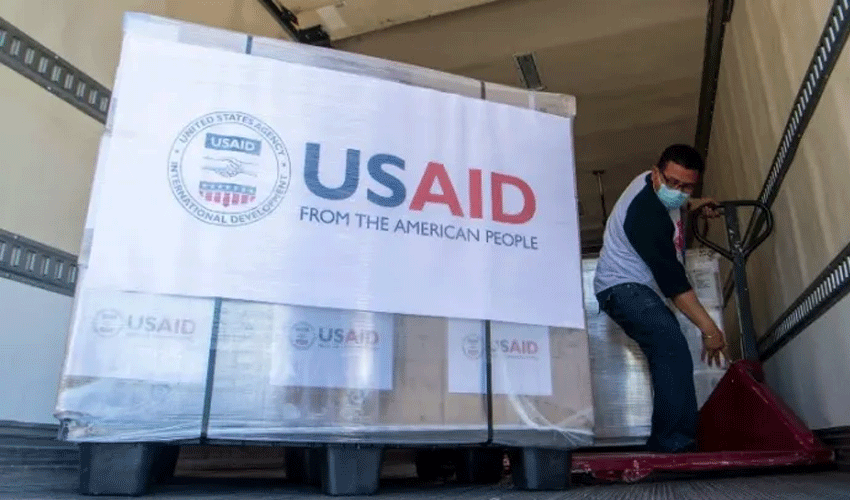
A federal judge on Friday temporarily blocked former US President Donald Trump’s attempt to place thousands of employees of the US Agency for International Development (USAID) on leave.
US District Judge Carl Nichols, who was appointed by Trump, ruled in favor of two federal employee associations, halting the plan that sought to put 2,200 USAID employees on paid leave by midnight Friday.
The decision does not roll back the broader restructuring efforts but delays immediate action against the agency’s workforce.
The lawsuit was filed by the American Foreign Service Association and the American Federation of Government Employees, arguing that the administration lacks the authority to shut down the six-decade-old agency without congressional approval. Democratic lawmakers have echoed similar concerns.
Targeting USAID
The Trump administration, alongside billionaire Elon Musk, who is heading the newly established Department of Government Efficiency, has made USAID its primary target in an unprecedented move to restructure federal agencies.
The administration has already halted nearly all aid programs, furloughed staff, and locked employees out of official systems. Reports suggest that USAID’s computer servers were also removed from its premises.

Trump had expressed his stance on social media before the court ruling, writing, “CLOSE IT DOWN.”
Following the move, workers were seen removing the agency’s name from its Washington headquarters. USAID flags were taken down, and signs bearing the agency’s name were covered with duct tape. Outside the entrance, someone placed a bouquet of flowers in what appeared to be a symbolic farewell.
Disruptions in global aid
The administration had ordered nearly all overseas USAID employees to return to the US within 30 days, with the government covering travel expenses. However, a notice posted on the agency’s website clarified that staffers who chose to stay longer would have to bear their own costs unless granted a hardship waiver.
Officials familiar with USAID’s operations have warned that essential humanitarian assistance has been disrupted. Programs affected include a $450 million food aid initiative, sufficient to feed 36 million people, and critical water supplies for 1.6 million displaced individuals in Sudan’s Darfur region.

Despite claims by Secretary of State Marco Rubio that essential programs were receiving waivers, USAID officials speaking on condition of anonymity refuted the assertions, stating that no waivers had been issued.
Rubio, while on a visit to the Dominican Republic, defended the administration’s actions, stating that the government would “continue providing foreign aid, but it is going to be foreign aid that makes sense and is aligned with our national interest.”
Court battle ahead
The legal dispute over USAID’s future adds to a series of judicial setbacks for the Trump administration. Recent court rulings have temporarily blocked policies offering financial incentives for federal workers to resign and ending birthright citizenship for children of undocumented immigrants.
Within the State Department, employees fear substantial job cuts as the administration moves to consolidate aid programs under its purview. A separate court hearing is scheduled for Monday to address the legality of incentives offered to federal employees for voluntary resignation.


.jpg)