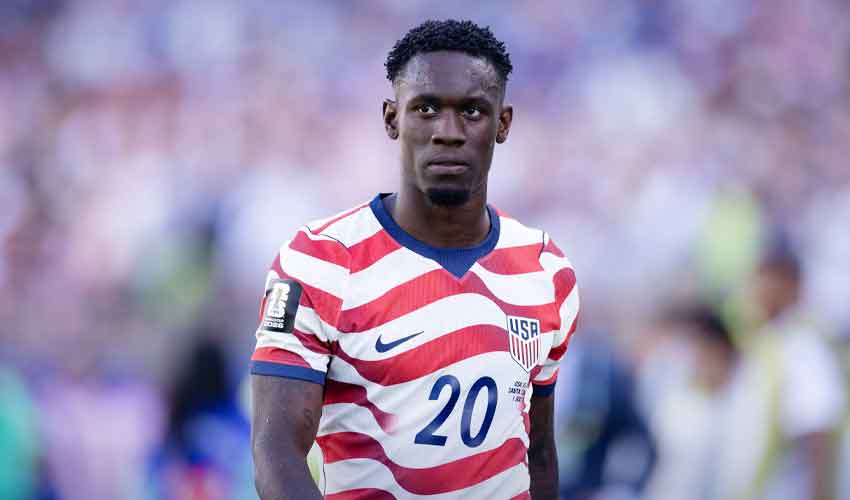
The United States crashed out of the World Cup on Monday after a heavy 4-1 defeat to Belgium in Seattle. But the match was overshadowed by allegations of political interference after FIFA suspended Folarin Balogun’s red-card ban.
Belgium advanced to the World Cup quarter-finals with a dominant 4-1 win over the United States.
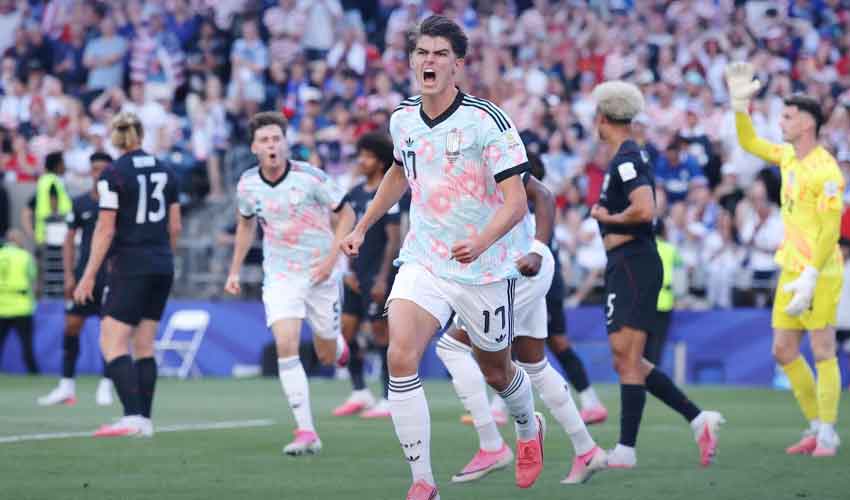
Charles De Ketelaere scored twice for Belgium, including an early goal inside the first 10 minutes, silencing the loud “U-S-A!” chants from the home crowd.
Despite strong support in a stadium filled with red, white and blue, the US could not recover and were emphatically knocked out of the tournament.
Trump intervention sparks uproar
The controversy began after US striker Folarin Balogun was allowed to play despite receiving a red card in the previous round.
Balogun had been sent off after a VAR review for dragging his studs down the back of Bosnia and Herzegovina defender Tarik Muharemovic’s leg and onto his foot during the round-of-32 match.
The red card carried an automatic one-match ban, which would have ruled him out of the Belgium match.
Also Read: Trump intervention sparks World Cup storm as FIFA clears Balogun
However, President Donald Trump said he asked FIFA President Gianni Infantino to review the case. FIFA later suspended the ban, allowing Balogun to play.
Trump called it a “brilliant decision,” saying Balogun was the team’s best player and that the World Cup would have had “a big stain” if he had been barred from playing.
FIFA defends decision on Balogun
FIFA said its disciplinary committee had the authority to suspend Balogun’s one-match ban under Article 27. The committee suspended the ban for a one-year probationary period but did not rescind the red card itself.
Balogun was also fined $40,000 for coming onto the pitch after his dismissal to celebrate with teammates.
FIFA said Belgium’s appeal against Balogun’s eligibility was rejected because the Royal Belgian Football Association was not a party to the proceedings and had no standing to appeal.
Infantino confirmed he had spoken to Trump but insisted FIFA’s judicial bodies acted independently and autonomously.
He said he told Trump that the matter was part of an ongoing legal process and would be decided by the competent FIFA bodies.
The decision drew sharp criticism from UEFA, the Royal Belgian Football Association and several national federations.
UEFA called the ruling “unprecedented, incomprehensible and unjustifiable,” warning that it undermined the integrity of the game.
“When the certainty of rules is no longer guaranteed by its guardians, the credibility of a competition is undermined,” UEFA said.
The Swiss Football Association also criticised the decision, saying it raised questions about the authority of referees and VAR decisions.
Referee criticism rejected by Brazil
Trump also questioned the performance of Brazilian referee Raphael Claus, who had sent Balogun off, describing him as “a little bit suspect” without elaborating.
The Brazilian Football Association rejected any suggestion against the referee’s integrity. It said Claus was an exemplary professional whose career was supported by technical assessments, consistent performance and the trust of major competitions.
FIFA said Claus was not available for comment, in line with its policy of not allowing referees to speak to the media during the tournament.
Also Read: Belgium end US World Cup dreams with 4-1 rout
Former Liverpool manager Jurgen Klopp, who is in talks to become Germany’s new coach, strongly criticised the controversy.
“This is our sport, not theirs,” Klopp said, adding that if Trump and Infantino had “sorted this out between themselves,” it would call everything into question.
Former FIFA President Sepp Blatter also criticised the development, saying red cards should be overturned by rules, evidence and independent bodies — not political phone calls.
“Football must never become a playground for political power,” Blatter said.
England considers Quansah appeal after Balogun case
The Balogun decision has now affected England’s World Cup campaign.
England defender Jarell Quansah was sent off during Sunday’s 3-2 win over Mexico at the Azteca Stadium and faces an automatic one-match suspension.
A source familiar with the matter said the English FA is considering its options regarding a possible appeal in light of the Balogun case.
England are scheduled to face Norway in the quarter-finals in Miami on Saturday.
British lawmakers demand consistency
British MPs also entered the debate, urging FIFA to apply the same standard to Quansah.
Labour MPs Noah Law and Melanie Onn wrote separate letters to Infantino asking FIFA to defer Quansah’s suspension until after the World Cup, citing Balogun’s case as a precedent.
Law said he believed Quansah deserved the red card but argued the ban should be delayed for consistency.
Onn said it would be difficult to justify one player receiving a delayed suspension while another in similar circumstances did not.
Caroline Dinenage, chair of the House of Commons Culture, Media and Sport Committee, called on FIFA to urgently explain its ruling.
She said the controversy risked casting a shadow over a tournament that should be a worldwide celebration of football.
England manager Thomas Tuchel also questioned the decision after Quansah’s red card against Mexico.
“Who overturns this decision then and when? And on what grounds?” Tuchel asked.
He said the situation was strange and raised wider questions about how far FIFA’s disciplinary flexibility could now go.
Political neutrality under scrutiny
The controversy has renewed questions over FIFA’s political neutrality. Infantino had already faced criticism earlier this year after attending President Trump’s Board of Peace meeting in February.
Now, the Balogun decision has become the tournament’s biggest controversy, with critics arguing it has damaged trust in FIFA’s disciplinary system.
For the United States, the ruling did not change the outcome on the pitch. Balogun started against Belgium but made little impact as the co-hosts were eliminated in a heavy defeat.