China has test-fired a long-range ballistic missile from a nuclear-powered submarine into the Pacific Ocean, triggering concern among regional allies and the United States. While Beijing described the launch as a routine military exercise, several countries warned the test could undermine regional stability.
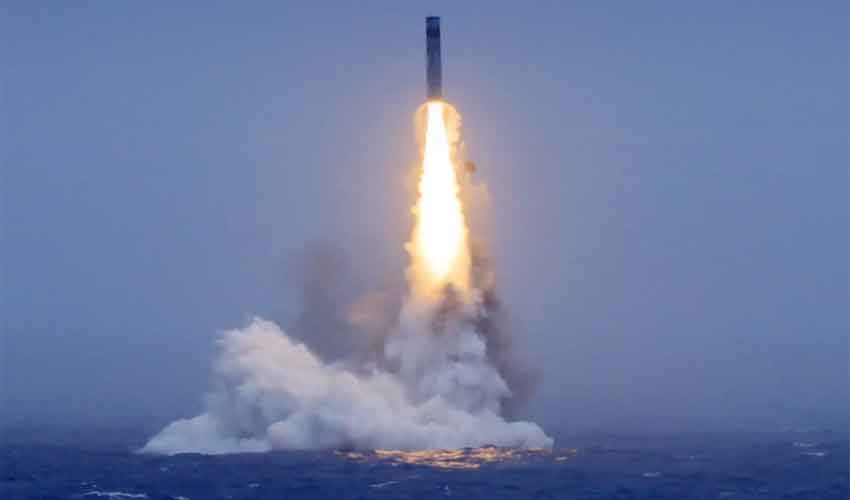
China’s military launched a missile carrying a dummy warhead from one of the People’s Liberation Army (PLA) Navy’s nuclear-powered submarines at 12:01pm local time (0401 GMT) on Monday.
According to state news agency Xinhua, the missile was fired toward international waters in the Pacific Ocean and landed precisely within designated waters.
Chinese state broadcaster CCTV described the launch as a routine part of the country’s annual military exercises and insisted it was not directed at any specific country or target.
Foreign Ministry spokesperson Mao Ning also defended the launch, saying it was conducted “safely, in a standardised and professional manner” and complied with international law and practice.
She added that relevant countries had been notified in advance and urged them “not to over-interpret” the exercise.
China’s latest submarine-launched missile
Although Chinese authorities did not officially identify the missile, the state-run Global Times, citing a military expert, said it was likely the JL-3, China’s most advanced submarine-launched ballistic missile.
The JL-3 was publicly displayed for the first time during a military parade last year.
According to a US Department of Defense report, the JL-3 has the capability to strike the continental United States from Chinese coastal waters, highlighting its long-range strategic reach.
US urges China to improve transparency
The United States confirmed it monitored the launch of the unarmed intercontinental-range ballistic missile.
US State Department spokesperson Tommy Pigott urged Beijing to engage in meaningful arms control discussions and establish a regular notification mechanism for all intercontinental ballistic missile and space launches.
Pigott also said China’s rapid and opaque expansion of its nuclear arsenal remains a major concern for both the region and the wider international community.
Also Read: China test fires missile into Pacific, alarming regional powers
Security analyst Meia Nouwens of the International Institute for Strategic Studies said the United States and its allies would closely examine the launch for insights into China’s military capabilities.
Australia calls launch destabilising
Australia said it had been informed in advance of China’s plans but criticised the missile test as destabilising.
Foreign Minister Penny Wong said the launch came against the backdrop of China’s rapid military buildup, which lacks the transparency and reassurance expected by countries across the Indo-Pacific.
Australian Prime Minister Anthony Albanese also expressed concern, saying the launch of a nuclear-capable intercontinental ballistic missile from a nuclear-powered submarine risked fuelling dangerous nuclear proliferation.
“The fact that this was a test of a nuclear-capable intercontinental ballistic missile fired from a nuclear-powered submarine is of real concern,” Albanese said.
He warned that such weapons have the potential to cause “considerable damage” if ever weaponised and stressed that the world needs fewer nuclear weapons, not more.
Australian Defence Minister Richard Marles said the missile was not launched particularly close to Australia but noted that it demonstrated China’s expanding ability to deploy nuclear weapons over much greater distances.
Pacific leaders voice strong objections
The missile test came as Australia and Fiji signed the “Ocean of Peace” mutual defence alliance, committing both nations to assist each other if attacked.
Some analysts suggested the timing of China’s notification was notable, although they also said such missile tests are typically planned well in advance.
Speaking in Honiara during a visit to the Solomon Islands, Albanese reiterated Australia's concerns over any move that could destabilise the Pacific.
Solomon Islands Prime Minister Matthew Wale, who also chairs the Pacific Islands Forum, said he had lodged a strong protest with China’s ambassador.
“China is a good friend of Solomon Islands. But this is not something a friend does,” Wale said.
He added that Pacific nations do not want any country—including China or the United States—using the region as a testing ground for intercontinental ballistic missiles.
Japan, New Zealand express concern
Japan said it had received prior notification of the launch but urged China to reconsider the test. Tokyo said it had expressed grave concern over increased Chinese military activity and noted that Chinese authorities had also warned Japan’s coastguard about possible falling space debris within Japan’s exclusive economic zone.
New Zealand Foreign Minister Winston Peters described the launch as “an unwelcome and concerning development.”
He said Pacific nations have no interest in seeing the South Pacific used as a missile testing site.
Taiwan calls launch act of intimidation
Taiwan strongly criticised the missile test, describing it as an attempt by Beijing to intimidate the international community.
Joseph Wu, secretary-general of Taiwan’s National Security Council, shared what he said was the missile’s flight path, showing it travelled southeast of China, passed over the Philippines, Micronesia and Palau, and landed south of Nauru.
“It’s a provocation that destabilises the Indo-Pacific. China just proved itself again to be a bully on the block,” Wu wrote on social media.
Taiwan’s presidential office echoed those concerns, while a senior Taiwanese security official said the island was closely monitoring increased Chinese naval activity during the peak military exercise season, including joint drills with Russia.
The missile launch coincided with intensifying strategic competition between China and Western allies across the Pacific.
Beijing and countries led by the United States and Australia have competed for influence among Pacific island nations for years, making the latest missile test particularly significant.
China last conducted an intercontinental ballistic missile test in 2024, a move that also underscored the country's rapidly advancing military capabilities.