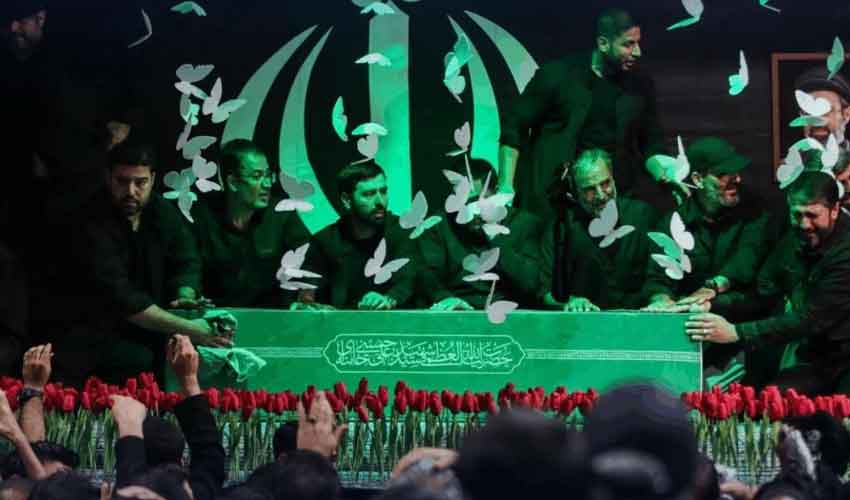
The coffin of former Iranian Supreme Leader Ayatollah Ali Khamenei has been laid out for final viewing in Tehran, Iranian media reported, as Iran prepares for days of state-led mourning and mass funeral ceremonies.
The coffin was draped in the red flag of the Imam Reza Shrine, while Iran’s political and military leadership attended a condolence ceremony in the capital.
According to Iran’s state news agency IRNA, Khamenei’s body was brought Thursday night to a farewell ceremony in Tehran.
Thousands of family members of those killed in US-Israeli attacks gathered near the site where Khamenei was killed, mourning alongside senior officials and religious figures.
Khamenei was killed in a joint US-Israeli attack on Iran on February 28, an event that triggered weeks of war and sharply heightened regional tensions.
Funeral schedule released by Iranian media
Iranian media said the official schedule of condolence ceremonies has been released, with six days of mourning beginning in Tehran from July 4.
An official memorial ceremony is scheduled for Friday, July 3, with heads of state, senior officials and religious leaders expected to attend. Farewell ceremonies will continue in Tehran on July 4 and July 5.
A central funeral procession will take place on the streets of Tehran on July 6, before the body is transferred to the holy city of Qom on July 7.
On July 8, condolence ceremonies will be held in Iraq, including Najaf and Karbala, where the body will be received by religious and political figures and taken to major Shia shrines.
Khamenei’s body will be brought back to Iran on July 9 for the final funeral and burial ceremony at the Imam Ali Reza Shrine in Mashhad, one of Shia Islam’s holiest sites.
Iranian media reported that heads or representatives of 30 countries and around 90 religious figures from different countries are expected to participate.
Iran prepares mass funeral as show of unity
Iran’s ruling clerics are preparing the funeral rites as a major display of public devotion to the Islamic Republic after the war with the United States and Israel.
Qom Friday prayer leader Ayatollah Mohammad Saidi told state media that the large public turnout at the funeral of the “martyred leader” would serve as another referendum for the Islamic Republic.
Authorities are hoping to mobilize millions of supporters by arranging transport, accommodation and food for mourners arriving from across the country.
Vahidi appears in public after months
The head of the Revolutionary Guards, Brigadier General Ahmad Vahidi, appeared in public for the first time in months, Iranian media reported.
Images distributed by state media showed Vahidi attending a preparatory meeting for the funeral and later sitting beside the coffin during a small ceremony near what had been Khamenei’s home before he was killed.
Tehran under tight security
Security has been tightened across Tehran and other cities ahead of the funeral events, with temporary airspace restrictions also reported.
Hotels are offering 50% discounts, while schools, mosques and sports halls have been prepared to house mourners. Bus and rail networks are also being diverted to support the main funeral gatherings.
Iranian state TV reported that more than 20 million people could travel to Tehran for the funeral, a number that would more than double the capital’s population of roughly 10 million.
Public mood remains divided
While supporters describe Khamenei’s death as martyrdom, analysts say public support for the Islamic Republic has weakened after years of sanctions, economic hardship and political repression.
Recent protests over inflation had seen demonstrators chanting against Khamenei before authorities crushed the unrest. After news of his killing spread, some Tehran residents reported hearing cheers from homes and apartments in parts of the city.
Still, supporters of the Islamic Republic say the funeral will be a moment of national mourning and defiance.
Khamenei’s death and the succession of his son Mojtaba as Iran’s third supreme leader mark a defining moment in the Islamic Republic’s 47-year history.
Mojtaba was reportedly wounded in the same strike that killed his father and has not appeared in any new image since the war began.
State media also reported that the bodies of Khamenei’s daughter, son-in-law, granddaughter and the widow of Mojtaba Khamenei, who were killed in the same strike, will be carried alongside during the funeral events.
Mass processions planned across several cities
The Musalla complex in Tehran, used for Friday prayers and official religious gatherings, will remain open day and night until Monday.
After the Tehran procession, the funeral will move to Qom, followed by ceremonies in Najaf and Karbala in Iraq. The final burial will take place in Mashhad near the tomb of Imam Reza.
Officials and foreign dignitaries, including representatives from Russia and China, are expected to offer condolences during the events.


.jpg)