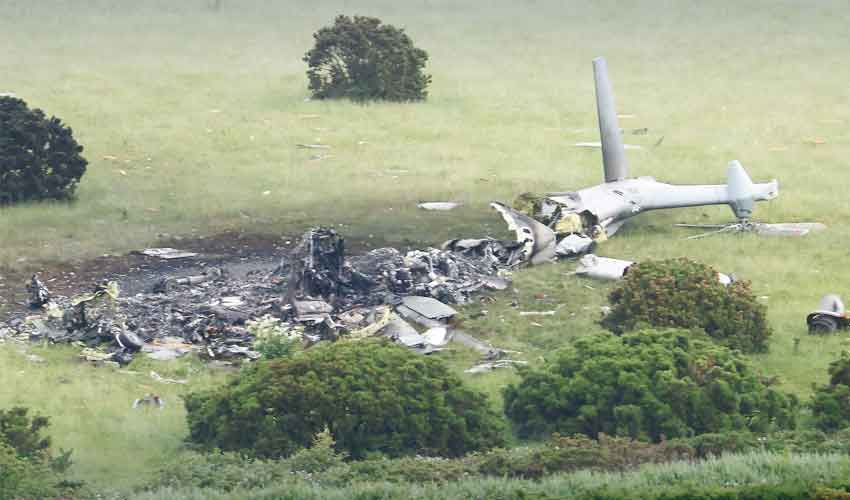
A US Navy helicopter operating from the aircraft carrier USS George H.W. Bush crashed in the Arabian Sea, leaving one crew member missing and triggering a major search and rescue operation, US military officials said.
The MH-60S Sea Hawk helicopter went down at about 3:30am Eastern Time on July 1, late morning in the region, with four crew members on board.
According to the US Navy’s 5th Fleet, three crew members were quickly rescued and are now aboard the USS George H.W. Bush in stable condition.
Search operations are continuing for the fourth crew member, with US Navy assets in the region involved in the rescue effort.
On July 1 at 3:30 a.m. ET, the aircrew of an MH-60S Sea Hawk helicopter assigned to USS George H.W. Bush (CVN 77) conducted an emergency water landing in the Arabian Sea. There is no indication the emergency was caused by hostile action. Three of the helicopter’s four crew…
— U.S. Naval Forces Central Command/U.S. 5th Fleet (@US5thFleet) July 1, 2026
No hostile action indicated
US Naval Forces Central Command said there was no indication that the emergency water landing was caused by hostile activity.
The Navy has not yet provided further details about the exact cause of the crash, the identities of the crew members or the precise location of the incident in the Arabian Sea.
Officials said the cause of the incident remains under investigation.
The helicopter was assigned to the USS George H.W. Bush, a Nimitz-class aircraft carrier currently deployed in the Arabian Sea. The carrier is operating as part of the US mission to deter Iranian attacks on shipping in the region.
US Central Command said on June 24 that the USS George H.W. Bush was one of two US aircraft carriers continuing operations in the Middle East.
Dangerous water landing
Helicopter water landings can be dangerous even for experienced pilots, as top-heavy aircraft can flip upside down during submersion.
The Navy described the incident as an emergency water landing, while rescue teams continued efforts to locate the missing aircrew member.
US-Iran tensions
The crash occurred as American forces in the region remain on high alert during a fragile ceasefire between the US and Iran.
The US and Iran have agreed to stand down from strikes and allow vessels to move freely in the region after signing a memorandum of understanding aimed at ending the war.
The talks include arrangements around the Strait of Hormuz, the removal of a US blockade on Iranian ports, sanctions on Iran and the future of Iran’s stockpile of highly enriched uranium.
Both sides have 60 days from the signing of the memorandum earlier this month to work out the details.
Recent aircraft incidents in region
The incident is the latest in a series of recent US military aircraft emergencies during operations in the Middle East.
Last month, US President Donald Trump confirmed that a US Army AH-64 Apache attack helicopter went down near the Strait of Hormuz after being hit by Iranian fire.
The Iranian anti-aircraft missile that struck the Apache reportedly failed to detonate, and both pilots survived a water landing and escaped the cockpit.
A US Navy drone boat was deployed in the rescue mission, recovering the pilots after they remained at the crash site for up to two hours. The incident later prompted a major round of retaliatory US strikes.
In April, US forces also carried out a rescue operation after two aviators ejected from an F-15E Strike Eagle fighter jet after being shot by Iranian fire.
One airman hid in a mountain crevice while US forces worked to rescue him, while the second was recovered from behind enemy lines under cover of darkness.
Carrier’s safety record
The USS George H.W. Bush has had a relatively positive safety record.
In 2018, a crew member was killed after being struck by a propeller blade during routine deck operations, but the carrier has reported few major incidents since.



.jpg)