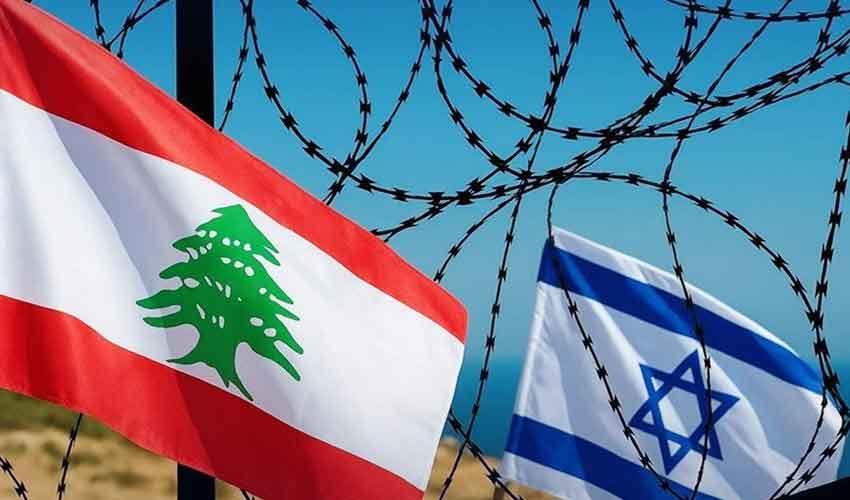
Israel and Lebanon have launched a new round of direct negotiations in Washington after US President Donald Trump said he had secured commitments from both Israel and Hezbollah aimed at reducing tensions and preventing further escalation.
The talks come as fighting continues at a lower intensity, with both sides exchanging fire despite US-backed ceasefire efforts and growing international pressure to end the conflict.
Representatives from Israel and Lebanon met at the US State Department on Tuesday for the first session of a two-day round of negotiations.
The meeting marks the fourth round of direct talks between the two countries, which do not have diplomatic relations and have technically remained in a state of war since 1948.
The US State Department said there had been “progress” following Tuesday’s discussions.
A senior Lebanese official told Reuters that negotiators were exploring ways to strengthen the fragile ceasefire through phased measures that could gradually expand into a broader peace arrangement.
Pilot zones proposed to reinforce ceasefire
According to the Lebanese official, discussions could include the creation of “pilot zones” in specific geographic areas.
Under the proposal, hostilities would stop in designated locations, Israeli troops would withdraw and Lebanese soldiers would deploy to maintain security.
Officials hope such measures could gradually build confidence and eventually lead to a wider ceasefire across Lebanon.
Trump says he secured commitments from both sides
The latest negotiations follow comments by President Donald Trump, who said he had received commitments of de-escalation from both Israel and Hezbollah.
Trump announced Monday that he had spoken with Israeli Prime Minister Benjamin Netanyahu and representatives connected to Hezbollah.
According to Trump, Israel agreed not to send troops into Beirut, while Hezbollah agreed to stop attacks against Israel.
“There will be no troops going to Beirut, and any troops that are on their way have already been turned back,” Trump wrote on Truth Social.
He later said both sides had agreed to halt attacks and expressed hope the arrangement would last permanently.
Lebanese officials confirm ceasefire proposal
Lebanese authorities confirmed that Hezbollah had agreed to a US proposal for a “mutual cessation of attacks” with Israel.
The Lebanese Embassy in Washington said the initial arrangement would involve Israel refraining from attacks on Beirut’s southern suburbs in exchange for Hezbollah halting attacks on Israeli territory.
According to the embassy, the ceasefire would later expand to cover all Lebanese territory.
The embassy also said Trump personally informed Lebanon’s ambassador to the United States that Netanyahu had agreed to the proposal.
Fighting continues despite truce efforts
Although the latest US-brokered truce appeared to be partially holding, violence continued on both sides. Israel and Hezbollah exchanged fire on Tuesday, though attacks were less intense than in previous days.
Lebanon’s state-run National News Agency reported Israeli strikes on approximately 30 locations across southern Lebanon, including several deadly attacks.
Lebanese state media also reported at least four people were killed in airstrikes and artillery attacks on two towns in southern Lebanon.
Hezbollah said it had attacked Israeli troops operating in occupied areas of southern Lebanon but did not claim attacks inside Israel.
The Israeli military said it intercepted two projectiles fired from Lebanon and reported no injuries.
Hezbollah rejects partial ceasefire
Despite diplomatic efforts, Hezbollah has not publicly endorsed Trump’s proposed arrangement. Youssef al-Zein, head of Hezbollah’s press office, said the group would not publicly support any ceasefire proposal unless Israel formally committed to ending all military operations across Lebanon.
“Hezbollah will monitor developments both on the battlefield and in diplomatic channels in the coming days,” Zein said.
Senior Hezbollah official Mahmoud Qomati also rejected the idea of a limited ceasefire. “We will not accept a partial ceasefire,” Qomati told AFP in a written statement.
“The Zionist enemy should know that any aggression against the suburbs could lead to a deeper and stronger response,” he added, referring to Dahiyeh, Hezbollah’s stronghold in Beirut’s southern suburbs.
Israel’s Channel 12 reported, citing unnamed sources, that Hezbollah had threatened to strike Tel Aviv and Haifa if Israel bombed Beirut. The report could not be independently verified.
Meanwhile, Hezbollah has remained deeply opposed to the Washington negotiations.
Israeli military operations continue
Israel has scaled back threats to strike Beirut’s southern suburbs for now following Trump’s phone conversation with Netanyahu. However, military operations in southern Lebanon have continued.
Netanyahu later stated that Israel would resume strikes on Beirut if Hezbollah attacks continued.
“I spoke this evening with President Trump and told him that if Hezbollah does not stop attacking our cities and civilians, Israel will strike terrorist targets in Beirut,” Netanyahu wrote on X.
“At the same time, the IDF will continue operating as planned in southern Lebanon.”
Israeli soldiers injured in drone attack
The Israeli military said one reservist was moderately wounded and three other soldiers suffered light injuries after a Hezbollah explosive drone attack in southern Lebanon earlier Tuesday.
The soldiers were evacuated to a hospital, and their families were informed, the military said.
As the latest ceasefire showed signs of partially holding, Israel’s Home Front Command announced it would ease security restrictions in communities near the northern border.
The decision reflected cautious optimism that violence could be reduced despite ongoing hostilities.
What both sides want from the talks
Lebanon’s government continues to push for a complete ceasefire and a full Israeli withdrawal from southern Lebanese territory.
Officials say such a withdrawal would allow more than 1.2 million displaced people to return home and enable the Lebanese state to focus on rebuilding damaged areas and addressing the future of Hezbollah’s weapons.
Lebanon also hopes to revive discussions based on principles closer to the 1949 armistice agreement between the two countries.
Israel and the United States, meanwhile, want Hezbollah to be disarmed.
That objective is shared by the Lebanese government but firmly rejected by the Iran-backed group.
Analysts say Israel is aware that disarming Hezbollah remains difficult while military operations continue and Israeli forces maintain positions in parts of southern Lebanon.
Some observers argue Israel is attempting to increase pressure on Lebanon internally, potentially fueling sectarian tensions and political instability.
Previous talks and points of disagreement
The first meeting between the two countries’ ambassadors to the United States took place in April. A second round followed in May with larger delegations, while military representatives from both sides also met on Friday.
Hezbollah has not participated directly in the talks. Israeli officials previously suggested there could eventually be trade agreements and tourism exchanges between the two countries if progress is made.
Lebanese officials, however, have emphasized that their priority remains a ceasefire and a framework based on previous agreements rather than normalization.
During the last round of talks, Lebanese negotiators reportedly presented detailed maps showing damage caused by Israeli military operations since the 2024 ceasefire agreement.
The maps documented homes and infrastructure destroyed during the conflict.
Rubio says Hezbollah remains main obstacle
US Secretary of State Marco Rubio voiced support for the diplomatic effort while blaming Hezbollah for preventing a broader peace agreement.
“Israel and Lebanon can do a peace deal tomorrow,” Rubio told a hearing of the Senate Foreign Relations Committee.
“Israel has no territorial claims in Lebanon. Hezbollah is the impediment,” he added.
Lebanese Prime Minister Nawaf Salam defended the negotiations despite Hezbollah’s opposition.
He described the Washington talks as “the least costly choice for Lebanon.”


.jpg)