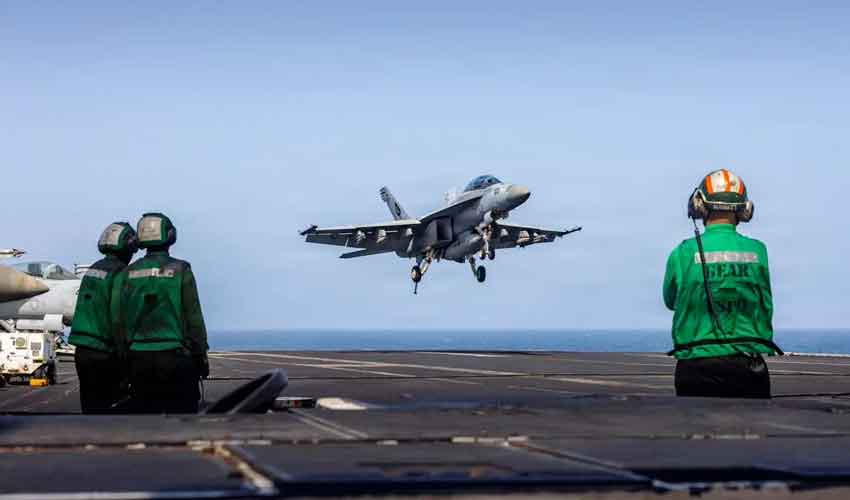
The fragile ceasefire between the United States and Iran came under renewed strain after the US military carried out fresh strikes on an Iranian drone operation near the Strait of Hormuz, prompting Iran’s Revolutionary Guard to target a US airbase in response.
The escalation came hours after President Donald Trump rejected reports that Washington was close to a compromise deal with Tehran over restoring shipping through the strategic waterway.
A US official told Reuters that American forces shot down four Iranian one-way attack drones that posed a threat around the Strait of Hormuz.
The official, speaking anonymously, said the US also struck a ground control station in the strategic port city of Bandar Abbas as it was preparing to launch a fifth drone.
“These actions were measured, purely defensive and intended to maintain the ceasefire,” the official said.
US Central Command also said the drones threatened US forces and commercial shipping in the strait. Iranian media reported explosions east of Bandar Abbas.
IRGC says it targeted US airbase
Iran’s Islamic Revolutionary Guard Corps said it targeted a US airbase on Thursday after what it called a US attack near Bandar Abbas airport.
Tasnim news agency reported that the IRGC targeted the airbase from which it said the attack on the Bandar Abbas control station had been launched.
The Revolutionary Guard did not identify the base, but the announcement came after Kuwait said its air defenses were responding to hostile missile and drone threats.
Kuwait, which hosts a large US military base, did not say where the attacks were coming from. The IRGC warned that any repeat of what it called aggression would receive a “more decisive” response, adding that responsibility for the consequences lay with the “aggressor.”
Second US strike in three days
The latest US action marked the second time in three days that Washington struck targets in Iran.
Earlier in the week, US forces carried out strikes in southern Iran on Monday, saying they targeted Iranian missile sites and boats attempting to lay mines in the Strait of Hormuz. Centcom said those earlier strikes were designed “to protect our troops from threats posed by Iranian forces.”
Iran condemned the strikes as “a grave violation of the ceasefire” and said it would not leave any act of hostility unanswered.
Iranian state-linked reports offered a different version of events. Tasnim cited a military source as saying the IRGC Navy fired toward a US oil tanker attempting to transit the strait, forcing it to turn back.
The source claimed the US military then struck open ground around Bandar Abbas, causing no casualties or damage.
Iranian media later reported that a military official said four vessels attempted to pass through the strait early Thursday but were turned back by warning shots.
Oil prices rebound as markets react
The escalation rattled global markets and pushed oil prices higher.
US crude futures rose more than 3% after falling over 5% on Wednesday. Stocks declined and the dollar strengthened as investors reacted to renewed tensions near the world’s most important energy corridor.
Before the war, the Strait of Hormuz handled around one-fifth of the world’s oil and liquefied natural gas traffic.
Trump rejects reported Strait deal
The latest confrontation came after Trump dismissed an Iranian state TV report claiming an unofficial draft deal had been reached to restore commercial shipping through the Strait of Hormuz to prewar levels within a month.
The reported framework said Iran and Oman would jointly manage traffic through the waterway.
Trump rejected the claim during a White House cabinet meeting.
“Nobody’s going to control the strait,” Trump said. “It’s international waters and Oman will behave just like everybody else or we’ll have to blow them up. They understand that, they’ll be fine.”
The White House and Oman’s embassy in Washington did not immediately respond to requests for comment. Iran’s permanent mission to the United Nations was also not immediately available for comment.
US says sanctions relief not under discussion
Trump said he was not satisfied with the state of talks with Iran and added that Washington was not discussing easing sanctions.
The Iranian TV report claimed the draft agreement included the lifting of a US blockade on Iranian ports and the withdrawal of US military forces from Iran’s vicinity. The White House dismissed the report as a “complete fabrication.”
The Iranian report did not mention Iran’s nuclear program, which remains a major sticking point in negotiations.
Iran insists on uranium enrichment and Strait authority
Ebrahim Azizi, head of Iran’s parliamentary national security committee, said Trump’s rhetoric would not force Tehran to retreat from its demands. He said Iran would continue to insist on uranium enrichment, authority over the strait and the lifting of sanctions.
“It is obvious Trump, seeking a way out of this strategic deadlock, alternates between issuing threats and appealing for an agreement,” Azizi wrote on X.
Iranian sources have said nuclear talks may come in a second round of negotiations, a proposal that may face resistance among Trump’s closest supporters.
Iran maintains that its nuclear program is peaceful. “The bottom line is Iran’s never going to have a nuclear weapon,” US Secretary of State Marco Rubio said at the cabinet meeting.
US sanctions Iranian Strait authority
The US Treasury Department also imposed sanctions on the Persian Gulf Strait Authority, the Iranian body tasked with managing passage and collecting payments from ships traveling through the Strait of Hormuz.
The Treasury said any ships paying the authority could face sanctions risk.
US Treasury Secretary Scott Bessent described the body as the “Iranian military’s latest attempt to extort global maritime trade” and said it showed Iran was “desperate for cash.”
Iranian foreign ministry spokesman Esmaeil Baqaei said earlier that Tehran was collecting fees for “navigational services” and would continue to manage traffic through the waterway.
International law guarantees foreign vessels the right to pass through the strait.
Israel, Hezbollah front adds to regional tensions
The escalation near Hormuz came as Israel reported sirens over hostile aircraft activity in northern Israel. Israel has been fighting Iran-backed Hezbollah militants in southern Lebanon, adding another layer of tension to the wider regional conflict.
The war began on February 28 with US and Israeli strikes on Iran. It has killed thousands, choked traffic through the Strait of Hormuz and sent global energy prices sharply higher.
Trump warns Iran over negotiations
Trump has repeatedly said a deal with Iran is close, but his tone shifted during Wednesday’s cabinet meeting. He said Iran was “negotiating on fumes” and warned that his approach would not be influenced by November’s US midterm elections.
“They thought they were going to outwait me,” Trump said. “You know, ‘We’ll outwait him. He’s got the midterms.’ I don’t care about the midterms.”
Trump also said the US may resume major military action if Iran does not agree to his terms. “Maybe we have to go back and finish it, maybe we don’t,” he said.
During the meeting, Trump also urged Gulf nations to join the Abraham Accords and normalize relations with Israel.

.jpg)