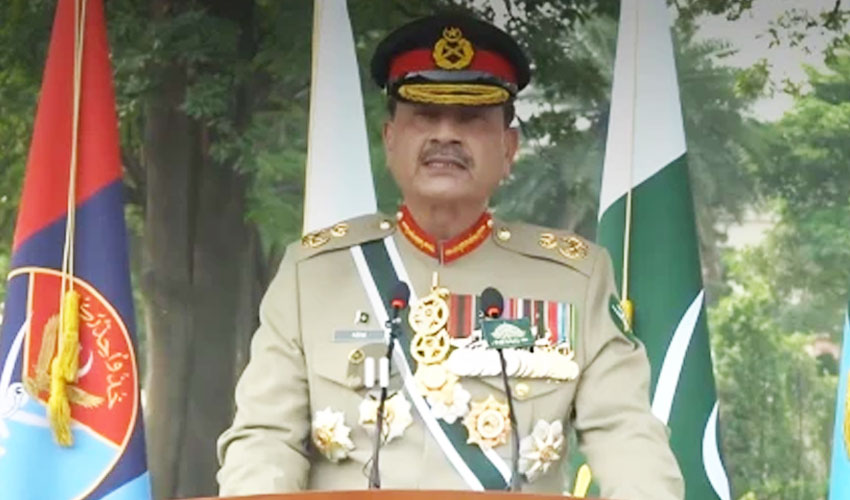
Chief of Army Staff Field Marshal Syed Asim Munir has warned that any future military adventurism by India against Pakistan would face “extremely dangerous, far-reaching and painful consequences.”
The remarks came during a high-profile ceremony at the General Headquarters (GHQ) in Rawalpindi marking one year since the “Marka-e-Haq.”
GHQ Ceremony marks anniversary of ‘Marka-e-Haq’
A dignified ceremony was held at GHQ Rawalpindi to commemorate the completion of one year since what the military termed the “Marka-e-Haq” and Operation “Bunyan-um-Marsoos.”
Senior military leadership, including the Chief of Air Staff Air Chief Marshal Zaheer Ahmed Babar Sidhu and Chief of Naval Staff Admiral Naveed Ashraf, attended the event alongside Field Marshal Syed Asim Munir.
During the ceremony, wreaths were laid at the Martyrs’ Monument and fateha was offered for the fallen soldiers.
‘Battle between two ideologies,’ says COAS
In his address, the army chief described the “Marka-e-Haq” not as a conventional military confrontation, but as a decisive clash between two ideologies.
He said Pakistan emerged victorious with the support of Allah, while “falsehood faced humiliation and defeat.”
He added that the events of May 2025 were not isolated, but part of a long pattern of what he described as Indian hostility and propaganda against Pakistan.
Warning to India over future conflict
Field Marshal Munir warned that India’s perceived ambition to isolate Pakistan militarily and diplomatically, and alter the regional balance of power, would never succeed.
He said Pakistan’s armed forces and people had never been intimidated in the past and would not be in the future.
Most notably, he cautioned that any future military misadventure would be met with consequences that would be “extremely dangerous, far-reaching and painful.”
Modern warfare and defence preparedness
The army chief highlighted that future wars would be multi-domain in nature, involving long-range precision weapons, drones, cyber warfare, and artificial intelligence.
He said Pakistan had already taken steps to adapt to modern warfare challenges, including establishing a Defence Forces Headquarters to enhance coordination among services.
Munir credited Pakistan’s success to national unity, professional excellence of the armed forces, and contributions from political leadership.
He also praised diplomatic efforts, saying Pakistan’s global engagement had improved its international standing.
The army chief specifically mentioned Pakistan-Saudi Arabia strategic defence cooperation as a milestone in foreign relations.
According to statements made during the ceremony, Pakistan’s armed forces successfully targeted more than two dozen military objectives during the conflict period.
The leadership reiterated that the military response had forced the adversary into retreat and demonstrated Pakistan’s operational readiness across land, air, and sea domains.
Field Marshal Syed Asim Munir stated that countries which once objected to Pakistan are now becoming its close partners. He said global confidence in Pakistan’s military capability and defence technology has significantly improved, which has also contributed to a rise in defence exports.
He noted that Pakistan’s evolving international image reflects growing trust in its strategic, military and technological strengths.
Saudi Arabia defence pact
The Field Marshal described the Pakistan–Saudi Arabia strategic defence agreement as a major diplomatic breakthrough. He called it a historic milestone in mutual defence cooperation and regional security.
He said the agreement reflects deepening trust between Pakistan and its “brotherly Islamic country,” strengthening long-term strategic ties.
Pakistan’s role in global peace
Asim Munir highlighted that Pakistan is currently hosting important international peace talks through what he described as responsible, effective and impartial diplomacy.
He said the international community has acknowledged Pakistan’s efforts in promoting ceasefire and negotiations, helping prevent wider regional instability.
According to him, this diplomatic role has positioned Pakistan as an active peace-building state on the global stage.
Engagement with global leadership
The Field Marshal said Pakistan maintained constructive diplomatic engagement with global leadership, including contacts with the United States and Iran.
He also referred to former US President Donald Trump, stating that Pakistan was trusted in facilitating negotiation efforts.
He emphasized that Pakistan’s diplomatic outreach continues to contribute positively to international dialogue.
India accused of sponsoring terrorism
Asim Munir stated that after failing in conventional warfare, India has reverted to what he termed its “old policy” of sponsoring terrorism.
He alleged that efforts to destabilize the region are being carried out not only from Indian territory but also through Afghan soil.
He urged Afghanistan to ensure that its territory is not used by terrorist groups, particularly elements referred to as “Fitna Khawarij” and “Fitna Bharat,” and to dismantle all terror networks.
Tribute to Security Forces and Martyrs
The Field Marshal paid tribute to the sacrifices of the people of Khyber Pakhtunkhwa and Balochistan, along with Pakistan’s armed forces and law enforcement agencies.
He said these institutions have been fighting terrorism with courage for over two decades.
He emphasized that just as Pakistan achieved success in conventional conflict, it would also defeat terrorism with national unity and institutional resolve.
He said that even after what he termed the historic victory of the “struggle for truth,” Pakistan remains committed to continuing its broader struggle for justice and stability in the region.
He added that this mission would continue until complete peace is achieved.
Kashmir stance reaffirmed
The Field Marshal said Pakistan could never forget its Kashmiri brothers and sisters, adding that every national narrative remains incomplete without Kashmir.
He reiterated that the Kashmir dispute must be resolved in line with UN resolutions and the aspirations of the Kashmiri people.
He rejected any demographic or social changes in occupied Jammu and Kashmir, calling them unacceptable and a distortion of ground realities.
Pakistan, he said, will continue to raise the Kashmir issue at all international forums.
Diplomatic efforts in Lebanon and Palestine
Asim Munir highlighted Pakistan’s role in facilitating ceasefire efforts in Lebanon through diplomatic channels.
He also reaffirmed Pakistan’s continued support for peace in Palestine, stating that efforts will continue until the establishment of an independent Palestinian state.
He stressed that Pakistan must further strengthen national defence and internal unity.
He said unity remains the driving force behind national resilience and success, adding that it is essential for both defence and national development.
He described the national flag as a symbol of hope, sacrifice and determination, and said the armed forces remain fully prepared to defend the country at all times.




.jpg)