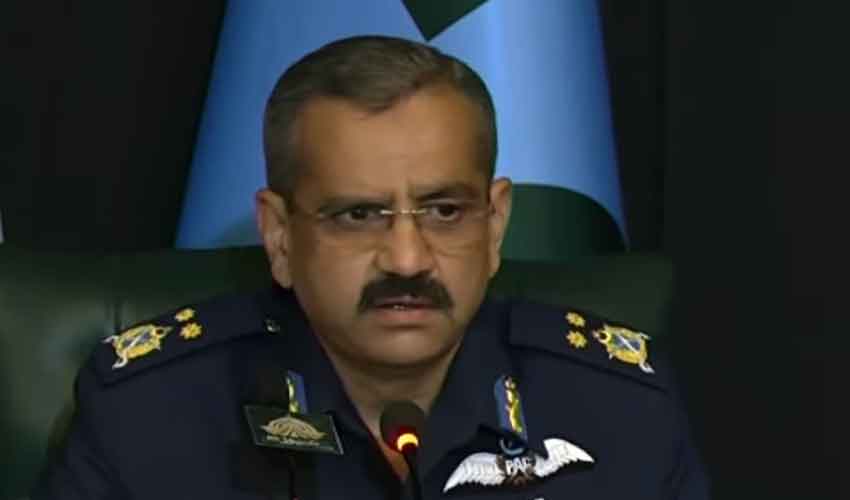
The deputy chief of air staff, speaking during a press conference with the ISPR DG on Thursday, said the Pakistan Air Force gave a powerful and unexpected response to Indian actions during Marka-e-Haq.
He said Pakistan had strong safeguards on its borders, monitored every enemy activity and quickly shifted from a defensive posture to an offensive one.
The deputy chief of air staff said guidance for tri-service plans had been fixed as part of the operational strategy. He added that Pakistan had to do two key things, including ensuring a strong defence.
According to him, the armed forces remained aligned in their planning and response.
The air force official maintained that the Pakistan Air Force integrated multi-domain operations for the first time, adding that the PAF was noting every activity of the enemy on the other side.
According to him, this constant monitoring forced India to realign its forces.
Strong safeguards maintained on borders
The deputy air chief said Pakistan had a strong safeguard on its borders, adding that the enemy did not dare to come close to Pakistan’s border.
According to him, Indian aircraft did not enter Pakistani territory and remained within their own range.
Rafale aircraft incident in Kashmir
The deputy air chief said that on April 29 last year, four Rafale aircraft flew and tried to turn in the Kashmir region. He said the Pakistan Air Force gave those aircraft a “small welcome note.”
According to him, the Rafale aircraft lost their datalinks, image, communication and guidance, adding that the four Rafale aircraft were forced into emergency recovery in Srinagar.
He said the PAF continued offensive and aggressive flights after the incident. According to him, Pakistan’s air operations remained active and effective throughout the situation.
The deputy air chief said cyberattacks continued during the conflict, adding that Pakistan kept targeting India’s communication system and other targets. He added that the Pakistan Air Force also targeted India’s data centre.
Satellite and advanced weapons
The deputy air chief said Pakistan shot down an Indian satellite. He said India did not enter Pakistan’s territory, and instead, according to him, Indian aircraft launched state-of-the-art weapons from within their own range.
The deputy air chief said what happened after India launched advanced weapons came as a major surprise for the enemy. The defensive posture of the Pakistan Air Force changed into an offensive posture within seconds, he added.
According to him, Pakistan’s response was unbelievable for the enemy.
PAF claims 8-0 victory score
The air official said India had top-line fighters, but Pakistan’s performance changed the outcome.
“Now it must be said that we are at 8-0,” he said. He explained that four Rafales, one Sukhoi-30, one MiG-29, one Mirage 2000 and one expensive aircraft were shot down. He added that many Indian aircraft were not recovered.
The official said India should have taken pre-emptive action on May 10, adding that Pakistan targeted 16 Indian air bases. He also said the air force destroyed a BrahMos site and two expensive S-400 batteries.
PAF performance called unbelievable for enemy
The deputy air chief said Pakistan’s response was a big surprise for the enemy. He repeated that the PAF’s defensive posture changed to an offensive posture within seconds.
According to him, the Pakistan Air Force’s performance in the conflict was unbelievable for India and reflected the force’s readiness, coordination and operational capability.




.jpg)