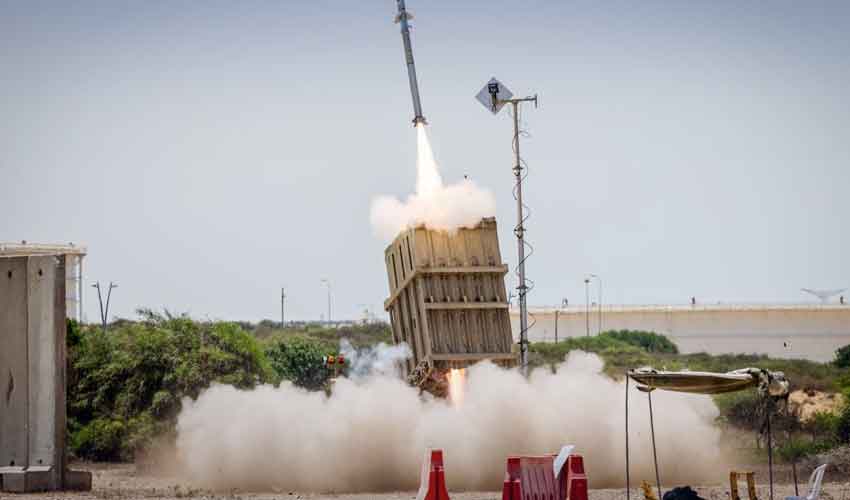
Israel deployed an Iron Dome battery to the United Arab Emirates in the early stages of its recent war with Iran, according to foreign reports cited by Axios.
The system, operated by several dozen Israeli troops, reportedly intercepted dozens of Iranian missiles aimed at the Gulf state.
Israel sent the Iron Dome system to the UAE during Operation Roaring Lion, the recent US-Israel war with Iran, according to Israeli and American officials cited by Axios on Sunday.
The move marked the first known operational deployment of the Iron Dome system outside Israel and the United States. Israeli officials said Prime Minister Benjamin Netanyahu ordered the deployment after a phone call with UAE President Sheikh Mohammed bin Zayed Al Nahyan.
The battery was sent along with several dozen Israeli soldiers to operate it. According to foreign sources, the system successfully intercepted dozens of Iranian missiles fired toward the UAE.
Iran heavily targeted UAE
During the war, Iran launched sustained attacks on the UAE, firing around 550 to 560 ballistic and cruise missiles and more than 2,200 to 2,250 drones, according to Emirati defense estimates cited in the reports.
That made the UAE one of the most heavily targeted countries in the region, including Israel. Analysts at the UK-based International Institute for Strategic Studies said the scale of the attacks appeared to be a direct message from Tehran over Abu Dhabi’s close relationship with Israel.
Iran, which had vowed to strike US bases in the region, targeted several Gulf states with missile fire during the conflict. Tehran also blocked the Strait of Hormuz, disrupting a key global route for oil and natural gas shipments.
UAE seeks help as missiles hit sites
Although most missiles and drones fired at the UAE were intercepted, some projectiles penetrated the country’s air-defense shield.
Reports said Iranian missiles and drones hit a mix of military and civilian targets. Dubai was reportedly among the repeated targets, with strikes affecting the International Financial Centre, the US consulate building and airfields.
The intensity of the attacks prompted Abu Dhabi to seek assistance from allies. Alongside Israel, the US and several European and Western partners helped support the UAE’s defense during the fighting.
Israel, US strike Iranian missile teams
Israeli and Emirati officials said the two countries maintained close military and political coordination throughout the war.
The Israeli Air Force also carried out strikes in southern Iran to neutralize short-range missile threats against Gulf states. Reports said both the US and Israel targeted Iranian ballistic missile teams in southern Iran, though the US conducted most of those strikes, in an effort to reduce the volume of missiles fired at the UAE.
Abraham Accords partnership
Israel and the UAE normalized relations in 2020 under the Abraham Accords, a deal driven in part by their shared concern over Iran.
Since then, military, security and intelligence cooperation between the two countries has steadily grown. Officials from both sides now describe the partnership as unprecedentedly close, especially after the Iran war.
A senior Emirati official quoted by Axios said the UAE was “not going to forget” Israel’s assistance during the conflict. Another Emirati official also praised the US, France, the UK, Italy and Australia for helping defend the UAE, calling it “a real eye-opening moment” that showed who the UAE’s real friends were.
The reported deployment could spark debate inside Israel, where some may question the decision to send an Iron Dome battery abroad while Israel itself was under heavy Iranian fire.
The presence of Israeli troops in the UAE could also be politically sensitive for Abu Dhabi, despite the deepening defense relationship between the two countries.
Still, the reports suggest the war accelerated security coordination between Israel and the UAE to a level not seen since the signing of the Abraham Accords.
Saudi Arabia did not receive Iron Dome
Unlike the UAE, Saudi Arabia did not receive an Israeli Iron Dome system during the conflict, according to the reports.
Israel and Saudi Arabia cooperated under a regional air-defense framework through the United States, but there have been no reports of Israel providing Riyadh with an Iron Dome battery.
Saudi Arabia has expressed interest in normalizing relations with Israel, but only if Israel makes significant concessions toward a two-state solution with the Palestinians.
The UAE is not the only country to seek access to Israel’s missile-defense capabilities.
Ukrainian President Volodymyr Zelensky and other Ukrainian officials have repeatedly asked Israel to provide Iron Dome technology to help defend against Russian attacks. Israel has so far rejected those requests.
Singapore has reportedly purchased and received Iron Dome systems, while Romania is also expected to acquire the technology.
Trump pushes ‘Golden Dome’ missile shield
The report also comes as US President Donald Trump pushes development of a “Golden Dome” missile-defense system inspired by Israel’s Iron Dome.
Unlike Iron Dome, which is land-based, Golden Dome is envisioned as a satellite-driven network designed to detect, track and potentially intercept incoming missiles. The system could involve hundreds of satellites for missile detection and tracking.

.jpg)