The United States has deployed a third aircraft carrier to waters near Iran, sharply increasing the military force available to President Donald Trump as he presses Tehran to surrender its nuclear programme, reopen the Strait of Hormuz and agree to end a weeks-long regional war.
The move comes as Trump says Washington is under no pressure to end the conflict, while warning Iran that “the clock is ticking.”
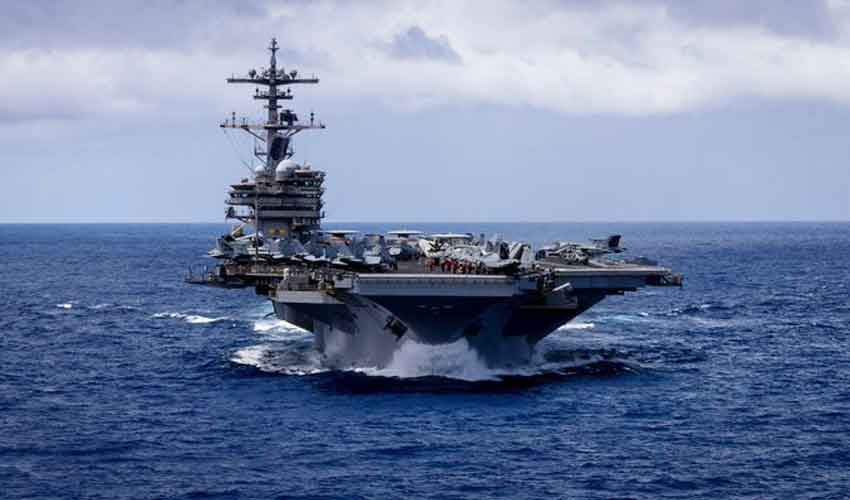
The US military confirmed on Thursday that the USS George H.W. Bush has arrived in the US Central Command area of responsibility. CENTCOM posted a photo on X showing the Nimitz-class supercarrier sailing in the Indian Ocean with its deck packed with warplanes.
The carrier departed Naval Station Norfolk, Virginia, in late March. Instead of taking the usual route through the Mediterranean Sea and the Suez Canal, it sailed around the Cape of Good Hope at the southern tip of Africa.
Nimitz-class aircraft carrier USS George H.W. Bush (CVN 77) sails in the Indian Ocean in the U.S. Central Command area of responsibility, April 23. pic.twitter.com/oDcTM6YMLF
— U.S. Central Command (@CENTCOM) April 23, 2026
That longer route allowed the carrier to avoid the Red Sea and the contested Bab el-Mandeb strait, where Iranian-backed Houthi militants have previously targeted international shipping.
The USS George H.W. Bush joins two other American aircraft carriers already deployed in the theatre.
According to US Central Command posts and the US Naval Institute, the USS Gerald R. Ford is operating in the Red Sea, while the USS Abraham Lincoln is stationed in the northern Arabian Sea.
The USS Gerald R. Ford, the world’s largest aircraft carrier, entered the Red Sea earlier this month after transiting the Suez Canal with the destroyers USS Mahan and USS Winston S. Churchill.
The USS Abraham Lincoln is operating in the northern Arabian Sea, giving the US a three-carrier presence across key waters near the Middle East.
Each carrier travels with a large group of escorting warships. Together, the three strike groups represent roughly 27 US Navy vessels, or around 41% of all American warships currently deployed at sea worldwide.
Also Read: Iran seizes vessel in Strait of Hormuz, defying US Navy
Aircraft carriers of this class usually deploy with nearly 5,000 sailors and aviators, along with air wings made up of multiple squadrons of strike fighters and support aircraft.
The USS George H.W. Bush is being escorted by Arleigh Burke-class destroyers USS Ross, USS Donald Cook and USS Mason.
Trump says Iran has little time left
Trump said on Thursday that the United States has “all the time in the World,” but Iran does not.
“I have all the time in the World, but Iran doesn’t,” Trump wrote on social media. “The clock is ticking!”
He said Iran’s military had been destroyed, its leaders were “no longer with us,” and the US blockade was “airtight and strong.”
According to Trump, the situation for Tehran would only get worse from there. He also said the United States would only make a deal with Iran when it was “appropriate and good” for Washington.
Strait of Hormuz remains effectively blocked
Since Trump indefinitely extended a ceasefire in the Middle East war, the United States and Iran have shifted their focus to the Strait of Hormuz. The waterway normally carries around one-fifth of the world’s oil and liquefied natural gas exports.
However, navigation through the passage remains effectively blocked as the standoff between Washington and Tehran deepens.
Also Read: Iran fast boats threaten shipping near Strait of Hormuz
Iran has vowed to keep the strait closed to all but a small number of approved vessels for as long as the US Navy continues its blockade of Iranian ports.
Tehran has brushed aside US demands to reopen Hormuz and surrender its enriched uranium.
US orders action against Iranian mine-laying boats
Trump said he had ordered the US Navy to destroy any Iranian boat caught laying mines in the Strait of Hormuz. He said he had instructed the Navy to “shoot and kill any boat, small boats though they may be” if it was placing mines in the waterway.
The order came after Iran blockaded the strait following the wider regional war triggered by a major US-Israeli attack. The US has responded to Iran’s actions by imposing its own blockade on Iranian ports.
On Thursday, the Pentagon announced that US forces had carried out a maritime interdiction and right-of-visit boarding of the sanctioned stateless vessel M/T Majestic X in the Indian Ocean. The ship was allegedly transporting oil from Iran.
Earlier, a US fleet had boarded a vessel in the Indian Ocean that was said to be carrying Iranian oil. CENTCOM said US forces have redirected 33 vessels since the start of the blockade against Iran.
Iran claims first Hormuz toll revenue
Iranian Deputy Parliament Speaker Hamidreza Hajibabaei said Tehran had received its first revenue from tolls imposed on ships seeking to cross the Strait of Hormuz.
Also Read: Trump rules out nuclear strike on Iran
Analysts say Iran believes its blockade gives it economic leverage to force Washington to back down from its key demands in any peace talks.
The tolls are part of Tehran’s response to the US naval blockade of Iranian ports.
Blasts over Tehran
Iranian media reported blasts over Tehran on Thursday, the first such reports since a fragile ceasefire came into effect two weeks ago. It was not immediately clear what caused the explosions.
Also Read: Air defences activated in Tehran amid rising tensions
Iran’s state news agency IRNA said the “sound of air defense firing” was heard in western Tehran. Mehr news agency reported that air defence systems were activated in several parts of the capital to counter “hostile targets.”
Israel says ready to resume war
Israel’s Defense Minister Israel Katz said Tel Aviv was prepared to resume the war and was waiting for approval from the United States. He warned that Iran could be pushed “back to the Stone Age” if the conflict restarted.
His remarks came as the regional ceasefire remained fragile and military pressure continued to mount around Iran.
Iranian officials pushed back against Trump’s claim that Iranian leadership was “seriously fractured.” Iran’s president, parliament speaker and chief justice all posted nearly identical messages on social media on Thursday.
“One God, one nation, one leader, and one path; that path being the path to the victory of our dearer-than-life Iran,” they wrote.
Prospective peace talks in Pakistan remain in doubt. On Wednesday, Trump told the New York Post that talks could resume in Pakistan within two to three days. However, no delegations were reported to be heading to Islamabad.
In Islamabad, blanket security remained in place for a fourth straight day in anticipation of possible negotiations. There has been no clear sign of a return to diplomacy to end the standoff over the Strait of Hormuz.
The US formally announced a naval blockade of Iranian ports on April 13. Since the blockade began, CENTCOM has said US forces directed 33 commercial vessels to turn around or return to Iranian ports.
The military buildup comes after a more than two-week ceasefire paused the US-Israeli air campaign against Iran, which was launched in late February.
USS Gerald R. Ford faces demanding deployment
The USS Gerald R. Ford has had one of the most operationally demanding deployments of any US carrier in recent decades. The ship has been at sea for more than 10 months.
Its operations have taken it from the Caribbean, where US forces carried out strikes on alleged drug-smuggling vessels, interdicted sanctioned tankers and seized Venezuelan President Nicolas Maduro, to the current conflict with Iran.
A laundry fire broke out aboard the carrier on March 12, forcing it to seek repairs in Croatia. The vessel later returned to operations and transited back into the Red Sea in time to remain available for US strike planning.
Also Read: US Navy ordered to attack any boats laying mines in Strait of Hormuz
The arrival of the USS George H.W. Bush through the Indian Ocean gives US commanders more operational flexibility. By avoiding the Red Sea route, the carrier entered the region without passing through waters where Houthi militants have targeted ships.
Its deployment significantly amplifies the force Trump can use as he pressures Iran over its nuclear programme, the Hormuz blockade and a possible peace deal.
For now, the combination of military escalation, economic pressure and uncertain diplomacy has left the region on edge.

.jpg)