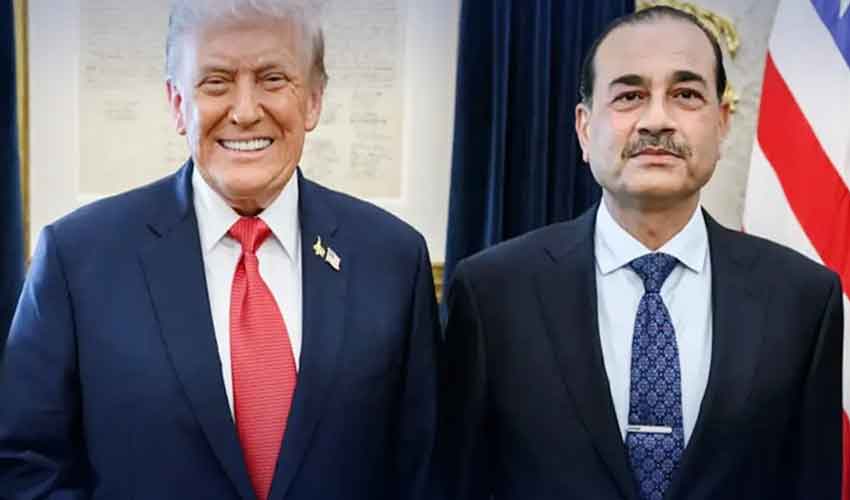
Retired US Army General Mark Kimmitt says the personal relationship between US President Donald Trump and Pakistan’s Chief of Defence Staff, Field Marshal Syed Asim Munir, could help keep diplomacy alive.
In an interview with Al Jazeera, Kimmitt said Pakistan’s push for peace has been significant and may support the chances of a second round of US-Iran talks.
The former assistant secretary of state said there is a close friendship between President Trump and Field Marshal Asim Munir, adding that it was difficult for Trump to say “no” to his friend when Pakistan was pushing strongly for peace.
He said, “the relationship that president Trump has with Field Marshal (Asim) Munir in many ways when the Pakistanis were pushing hard for, he had a hard time saying no to his friend.”
Retired US Army General Mark Kimmitt tells Al Jazeera that an extension of the ceasefire between the US and Iran is expected, as both sides seek to avoid war, but warns that real progress is limited, saying talks could lead to a prolonged “frozen conflict”. pic.twitter.com/srKocsnQE0
— Al Jazeera English (@AJEnglish) April 22, 2026
Pakistan’s peace efforts
Kimmitt described Pakistan’s efforts for peace as commendable, suggesting Islamabad played an important role in encouraging diplomatic space at a sensitive time.
Also Read: Trump announces extension of Iran ceasefire at Pakistan's request
His remarks reinforce the view that Pakistan has been actively trying to reduce tensions and prevent a return to open conflict.
The former US general said he was not surprised by Trump’s decision to announce an extension to the ceasefire with Iran. According to Kimmitt, the move reflected the needs of both sides. “I think both sides wanted it. I think both sides need it,” he said.
Both sides do not want war again
Kimmitt said neither side appears interested in going back to war, which is why the possibility of further diplomatic engagement remains alive.
Also Read: Iran dismisses Trump truce extension as 'meaningless'
He suggested that this shared desire to avoid renewed fighting is one of the strongest reasons a second round of talks remains possible.
Kimmitt said the coming days will likely show whether a second round of talks between the United States and Iran will take place. At the same time, he cautioned that there is also a risk the conflict could become “frozen,” meaning tensions may remain unresolved even if direct escalation is avoided.

.jpg)