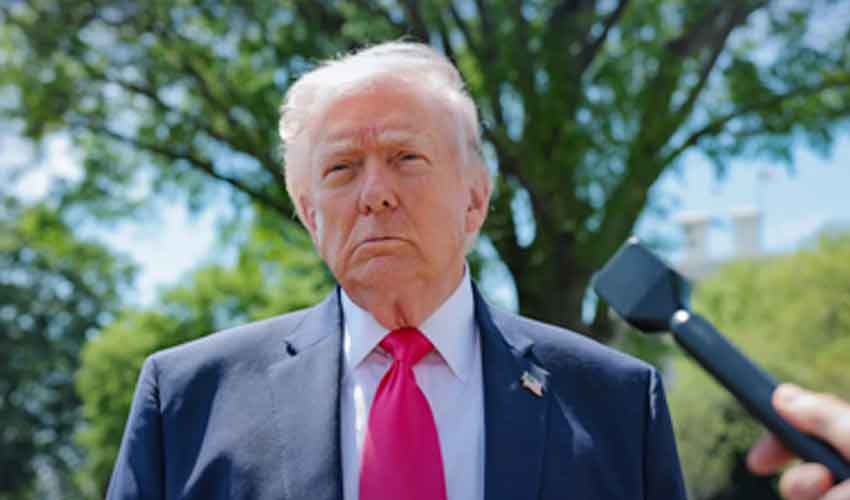
US President Donald Trump has expressed cautious optimism over ongoing negotiations with Iran, saying there is “some pretty good news” regarding efforts to end the Middle East conflict.
However, he warned the current ceasefire may not be extended without a deal by Wednesday.
Speaking to reporters aboard Air Force One while returning to Washington from Phoenix, Arizona, Trump said negotiations with Iran were “going very well.”
“We’re negotiating over the weekend. I expect things to go well,” he said, adding that many issues had already been discussed and agreed upon. However, he declined to provide specific details about the reported progress.
Trump also suggested a possible surprise announcement, revealing that “someone very good, smart and thoughtful” would visit the White House, followed by a news conference.
Ceasefire at risk without deal
Despite the positive tone, Trump issued a clear warning that the ceasefire with Iran could end if no long-term agreement is reached before Wednesday.
He emphasized that a US blockade of Iranian ports would continue regardless of whether the ceasefire is extended. “The main thing is that Iran will not have a nuclear weapon,” Trump said, stressing that this priority outweighs all other considerations.
Strait of Hormuz reopens with uncertainty
Earlier, Iran temporarily reopened the Strait of Hormuz following a separate US-brokered ceasefire agreement between Israel and Lebanon.
However, conflicting statements from both sides created uncertainty over how quickly global shipping would return to normal through the vital oil route, which previously carried about one-fifth of the world’s oil trade.
Vessel tracking data showed around 20 ships heading toward the strait on Friday evening, including container ships, bulk carriers, and tankers. Most later turned back for unclear reasons, though one cruise ship, Celestyal Discovery, successfully crossed into Oman.
Also Read: Trump reacts to Iran announcement on reopening of strait
Iran has now required all vessels to coordinate with the Islamic Revolutionary Guard Corps before passing through the strait, while ships linked to the US and Israel remain restricted.
Shipping companies have raised concerns over safety, particularly the risk of sea mines. The US Navy warned that the threat is not fully understood and advised caution.
Meanwhile, more than a dozen countries have expressed willingness to join an international mission to protect shipping routes once conditions improve, according to Britain.
The war, which began on February 28 following a US-Israeli attack on Iran, has killed thousands and significantly disrupted global energy markets.
Oil prices surged due to the effective closure of the Strait of Hormuz but later fell about 10% on hopes of resumed shipping. Global stock markets also saw gains amid optimism.
Uncertainty over nuclear negotiations
A major sticking point remains Iran’s nuclear program. Trump reiterated that Iran “cannot have a nuclear weapon,” even suggesting the US would remove enriched uranium stockpiles.
“We will go with Iranian drilling equipment, pack the nuclear dust, and bring it to the United States,” he said, adding that if diplomacy fails, the alternative would be “very unfriendly.”
Also Read: Trump hails PM Sharif, CDF Munir as two great personalities
However, Iran has rejected transferring its nuclear material abroad. Foreign Ministry spokesperson Esmaeil Baghaei stated the stockpile would remain in the country.
Possible framework for deal
Sources indicate a potential initial memorandum of understanding could be reached soon, followed by a comprehensive peace agreement within 60 days.
At previous talks, the US proposed a 20-year suspension of Iran’s nuclear activities, while Iran suggested a shorter period of three to five years. Reports suggest a compromise may involve partial reduction of uranium stockpiles.
There are also reports that the US may unfreeze up to $20 billion in Iranian assets, though Trump denied any financial exchange, stating, “There will be no money in the deal.”
Pakistan has played a key mediating role, with Army Chief Field Marshal Asim Munir holding talks in Tehran. While Trump suggested direct talks could take place over the weekend in Islamabad, diplomats expressed doubts due to logistical challenges. No visible preparations were reported in Islamabad.
Also Read: Only few points remain unresolved in US-Iran talks: Dar
Some reports suggest a second round of negotiations could begin soon, possibly in Paris, with an Iranian delegation expected to travel.
Iran’s stance and internal messaging
Iranian officials have maintained a firm stance. Parliamentary speaker Mohammad Baqer Qalibaf warned the Strait of Hormuz could close again if the US blockade continues. Religious leaders also struck a defiant tone. Cleric Ahmad Khatami said, “Our people do not negotiate while being humiliated.”
At the same time, a senior Iranian official expressed hope that a preliminary agreement could be reached in the coming days.
Trump said Chinese President Xi Jinping was “very happy” about the reopening of the Strait of Hormuz and expressed optimism about an upcoming meeting in China. He also thanked regional allies, including Saudi Arabia, Qatar, the UAE, Bahrain, and Kuwait, for their support, while pledging that the US would help “make Lebanon great again.”
Trump described the situation as a “great day for the world,” insisting that most issues have already been resolved and remaining differences are not significant.
He reiterated multiple times that Iran would never be allowed to obtain nuclear weapons and vowed to ensure control over nuclear materials.

.jpg)