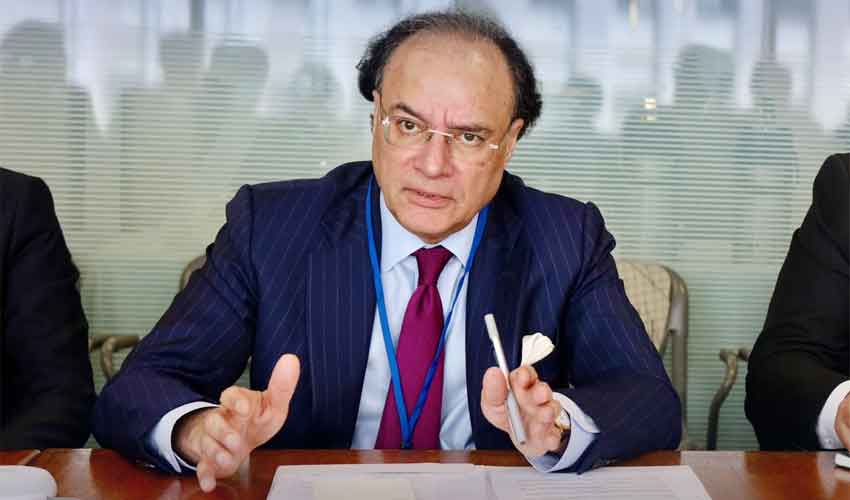
Pakistan is exploring Eurobonds, sukuk, commercial borrowing and support from friendly countries to manage pressure on its foreign exchange reserves after the repayment of a major UAE facility.
At the same time, Finance Minister Muhammad Aurangzeb says the country is staying committed to debt repayments, reform targets and broader economic stability.
Pakistan is considering Eurobonds, loans from other countries and commercial debt to replace a $3.5 billion facility from the United Arab Emirates and protect its foreign reserves, Finance Minister Muhammad Aurangzeb has said.
Speaking in Washington on the sidelines of the IMF and World Bank meetings, Aurangzeb said “all options are on the table” when asked whether the government was in talks with Saudi Arabia for a loan that could replace the UAE facility.
He did not directly comment on reports of possible financial assistance from China and Saudi Arabia, but made clear that Pakistan is examining every available route to maintain stability in its external account.
Reserves under pressure, Pakistan prepares to repay UAE loan
Reuters reported that Pakistan is due to return a $3.5 billion loan to the UAE this month, a development that could put pressure on foreign exchange reserves and increase the risk of breaching International Monetary Fund programme targets.
Bloomberg separately reported that, for the first time in seven years, a rollover from the UAE could not be secured, increasing the urgency for replacement financing. Aurangzeb told international media that Pakistan is considering all options to maintain reserves and manage repayments.
He said the country’s reserves remain at roughly 2.8 months of import cover, while another account put reserves at $16.4 billion, or sufficient for about three months of imports. Maintaining at least that level, he said, will be an important part of Pakistan’s macroeconomic stability going forward.
Eurobonds, sukuk, rupee-linked dollar bonds under review
Aurangzeb said Pakistan is looking at a return to the international bond market this year. He named Eurobonds, Islamic sukuk and dollar-settled rupee-linked bonds among the instruments under active consideration.
“We are looking at Eurobond, we are looking at Islamic sukuk, we are looking at dollar-settled rupee-linked bonds,” he said, adding that the government also remains open to commercial loans.
The finance minister also highlighted Pakistan’s successful repayment of a $1.3 billion Eurobond, presenting it as evidence of the government’s ability and willingness to meet external obligations on time.
First-ever Panda bond to launch next month
Pakistan also expects to launch its first-ever Panda bond next month, a milestone in the country’s effort to diversify external financing sources.
Aurangzeb said the initial issue will be worth $250 million and will form the first part of a planned $1 billion programme. The yuan-denominated bond will be backed by the Asian Development Bank and the Asian Infrastructure Investment Bank.
Officials say the first Panda bond will mark a new chapter in Pakistan’s access to alternative debt markets at a time when the government is trying to ease pressure on traditional reserve channels.
IMF tranche expected soon
The finance minister said there is currently no need to increase or change Pakistan’s $7 billion IMF programme, but he did not rule out approaching the Fund if the economic situation weakens because of the Middle East conflict.
“Depending upon how things pan out over the next few weeks, that’s something which can be discussed,” he said.
Aurangzeb expressed satisfaction with the staff-level agreement and said the IMF Executive Board is expected to approve the next tranche soon, likely by the end of this month or early next month.
That approval would unlock just under $1.3 billion through the Extended Fund Facility and the Resilience and Sustainability Facility. According to the Ministry of Finance, the next tranche will help Pakistan maintain the momentum of its reform programme.
During his visit, Aurangzeb held several high-level meetings on the sidelines of the IMF and World Bank annual spring meetings in Washington.
He met IMF Director Jihad Azour and the IMF mission team for Pakistan, where the two sides discussed reforms, the broader economic situation, fiscal and structural reform progress, and efforts to increase revenues.
Finance Minister Meets IMF Director Jihad Azour to Discuss Reform Progress and Economic Outlook
— Ministry of Finance, Government of Pakistan (@Financegovpk) April 14, 2026
Federal Minister for Finance and Revenue, Senator Muhammad Aurangzeb, held a productive meeting with Mr. Jihad Azour, Director of the Middle East and Central Asia Department at the… pic.twitter.com/LyTh09iHd0
The finance minister also met Jonathan Greenstein, deputy under secretary of the US Treasury. According to the Ministry of Finance, they discussed economic reforms, the IMF staff-level agreement, measures to deal with the direct and indirect impact of Middle East tensions, and efforts to strengthen Pakistan’s foreign exchange reserves.
Both sides also agreed on the importance of further deepening economic cooperation and building a strong, diversified economic partnership based on regional stability and sustainable development.
Pakistan says it can meet all debt obligations
Aurangzeb reiterated that Pakistan remains committed to repaying all bilateral and multilateral obligations on time and maintaining overall financial stability.
He said the government can manage all debt repayments and is determined to protect macroeconomic stability even as external shocks grow more severe.
The Ministry of Finance also emphasized that economic stability remains essential for sustainable and inclusive growth, and that Pakistan’s reform path will continue despite current uncertainty.
Iran war shock forces rethink on fuel security
Aurangzeb said the ongoing war in the Middle East has become one of the biggest recent supply shocks for Pakistan and the wider global economy.
He said the government is not only managing the immediate effects of the crisis, but also dealing with second- and third-order consequences, especially on inflation, growth, remittances and the external sector.
Because of rising energy prices and supply risks, the finance minister said Pakistan now needs to consider establishing strategic petroleum reserves and LPG reserves, rather than relying only on commercial stocks.
“When you go through a supply shock like this... it sends a very clear view that we need to accelerate these journeys,” he said, referring to energy security planning and economic adjustment.
The Middle East crisis has also strengthened the case for a faster transition to renewable energy, Aurangzeb said in Washington.
He argued that Pakistan must move more rapidly toward cleaner and more secure energy sources in order to reduce exposure to imported fuel shocks in the future.
The minister said the war-driven price spike has made it clear that the country should accelerate its renewable energy journey alongside plans for strategic fuel and LPG reserves.
Growth, remittances, social protection seen as buffers
Despite the external shock, Aurangzeb said Pakistan expects GDP growth of close to 4% in the current fiscal year ending June 30.
He also projected remittances of around $41.5 billion, which he suggested would provide important support to the economy at a time of regional uncertainty.
Along with targeted assistance for the poorest citizens, these factors are expected to help Pakistan withstand the impact of the Iran war shock during the current fiscal year.
Pakistan has also been pushed into the international spotlight because of its role in trying to mediate between the United States and Iran amid the war in the Middle East.
That diplomatic role has unfolded at the same time as Islamabad is managing its own financial vulnerabilities, rising oil prices and pressure on reserves.
The finance minister’s remarks reflect the difficult balancing act Pakistan faces: staying current on debt, keeping IMF support on track, and preparing for wider fallout from regional conflict.
Meetings with Saudi Fund, MasterCard, Google and MIGA
Aurangzeb also met Sultan bin Abdul Rahman Al-Murshed, chief executive of the Saudi Fund for Development. During that meeting, he thanked the fund for its support and referred to a recent useful discussion with the Saudi finance minister before leaving for Washington.
Finance Minister Meets CEO of Saudi Fund for Development
— Ministry of Finance, Government of Pakistan (@Financegovpk) April 14, 2026
Federal Minister for Finance and Revenue, Senator Muhammad Aurangzeb, held a meeting with Mr. Sultan bin Abdulrahman Al-Marshad, Chief Executive Officer of the Saudi Fund for Development (SFD), on the sidelines of the… pic.twitter.com/M3FINvKBpb
The two sides discussed the economic consequences of the Middle East conflict, especially for global energy security, and reaffirmed their commitment to strengthening economic and development cooperation between Pakistan and Saudi Arabia.
In another meeting, the finance minister met Tucker Foote, MasterCard’s Chief Global Affairs and Policy officer, to discuss digital payments, financial inclusion, cybersecurity, remittances, cross-border transactions and innovation in Pakistan’s fintech sector. Both sides reaffirmed their commitment to cooperation for a secure and modern digital economy.
Finance Minister Meets Mastercard Official to Discuss Digital Payments and Financial Inclusion
— Ministry of Finance, Government of Pakistan (@Financegovpk) April 14, 2026
Federal Minister for Finance and Revenue, Senator Muhammad Aurangzeb, held a meeting with Mr. Tucker Foote, Chief of Global Affairs and Policy at Mastercard, on the sidelines of the… pic.twitter.com/yYYYrDX6p7
Aurangzeb also met Google Vice President and Global Head of Government Affairs Karan Bhatia. They discussed artificial intelligence, digital transformation, Google’s ongoing initiatives in Pakistan, AI training and capacity building, and the use of artificial intelligence in agriculture and industry.
Finance Minister Meets Google Vice President to Discuss AI Development and Digital Transformation
— Ministry of Finance, Government of Pakistan (@Financegovpk) April 14, 2026
Federal Minister for Finance and Revenue, Senator Muhammad Aurangzeb, held a productive meeting with Ambassador Karan Bhatia, Vice President and Global Head of Government Affairs… pic.twitter.com/qiSN5g7062
He appreciated the start of local manufacturing of Google Chromebooks in Pakistan and welcomed Google’s plan to establish an office in Pakistan in July 2026. The meeting also covered ongoing and proposed joint projects aimed at supporting Pakistan’s digital transformation.
The finance minister also met Tsutomo Yamamoto, Managing Director of the Multilateral Investment Guarantee Agency. Their discussion focused on trade finance and investment facilitation, including MIGA’s proposed short-term trade finance facility of up to $500 million.
According to the Ministry of Finance, that facility would be important for financing critical imports such as food, fertilizer, energy and machinery. Aurangzeb emphasized the need to accelerate work on the facility and also raised ongoing arbitration cases and their financial impact, while stressing the importance of investor confidence and protecting national interests.
Finance Minister Meets Tsutomu Yamamoto, Managing Director MIGA, to Discuss Trade Finance and Investment Facilitation
— Ministry of Finance, Government of Pakistan (@Financegovpk) April 14, 2026
Federal Minister for Finance and Revenue, Senator Muhammad Aurangzeb, held a meeting with Mr. Tsutomu Yamamoto, Managing Director of the Multilateral Investment… pic.twitter.com/rRetyZNQVh
The finance minister’s overall message in Washington was that Pakistan does not currently need to seek changes in its IMF programme, but remains ready to do so if the economic outlook deteriorates.
For now, the government is betting on a mix of reform momentum, timely IMF support, diversified external borrowing, expected remittance inflows and strict debt discipline to navigate a difficult moment.
At the same time, Aurangzeb’s warning about fuel security and the need for faster renewable energy adoption shows that Islamabad sees the Middle East war not just as a temporary shock, but as a strategic wake-up call for Pakistan’s economy.

.jpg)