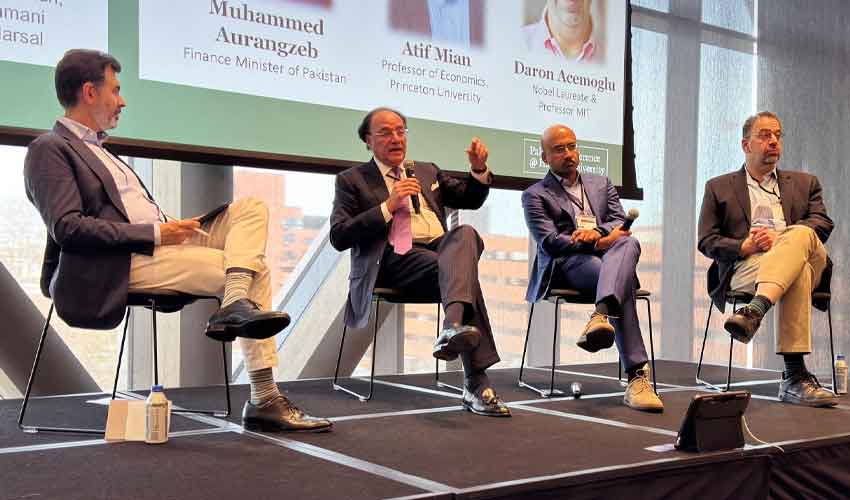
Finance Minister Muhammad Aurangzeb said Pakistan’s external payments position remains satisfactory as the government pushes ahead with reforms aimed at stability, competitiveness and long-term growth.
Speaking at Harvard University, he stressed that the real challenge is not identifying reforms, but implementing them on time. Aurangzeb spoke at a high-level panel discussion at Harvard University during the Pakistan Conference 2026.
The session, titled 'Pakistan’s Economic Agenda: Stability, Reform and What Comes Next', was moderated by former State Bank governor Dr Reza Baqir and included Prof Atif Mian of Princeton University and Nobel laureate Professor Daron Acemoglu of MIT.
The discussion brought together leading economists, policymakers and members of the Pakistani diaspora to examine Pakistan’s economic outlook, reform priorities and long-term growth path.
Pakistan managed recent global supply shock
In his remarks, Aurangzeb described the ongoing Middle East conflict as one of the most significant supply shocks the global economy has seen in recent years.
He said Pakistan’s immediate priority in recent weeks had been to maintain uninterrupted energy supplies across critical sectors despite limited strategic reserves, with ministries and institutions working in close coordination.
Finance Minister Highlights Reform Priorities at Harvard Discussion on Pakistan’s Economic Agenda
— Ministry of Finance, Government of Pakistan (@Financegovpk) April 12, 2026
Federal Minister for Finance and Revenue, Senator Muhammad Aurangzeb, participated in a high-level panel discussion at Harvard University on “Pakistan’s Economic Agenda: Stability,… pic.twitter.com/qd85moDS19
The finance minister said the government initially introduced a blanket subsidy to shield the public from rising energy costs.
He added that the country later moved toward full price transmission, backed by targeted subsidies in line with available fiscal space.
According to Aurangzeb, Pakistan handled the situation better than many other countries, avoiding both severe supply disruptions and law and order problems.
External payments, debt position
Aurangzeb said Pakistan’s external payments capacity is satisfactory, expressing confidence that the country can meet upcoming obligations in a timely manner.
He highlighted the government’s debt management efforts and said the recent Eurobond repayment was effectively a “non-event” for Pakistan.
Pointing to opportunities created even during a difficult period, the finance minister said transit cargo at Karachi Port has increased significantly. He noted that in only a few weeks, the volume had exceeded the entire amount recorded in 2025.
Aurangzeb also said progress is underway to make Gwadar Port fully functional, describing it as an important part of Pakistan’s broader economic and trade strategy.
Record Roshan Digital Account inflows
The minister said there was a record monthly inflow in March under the Roshan Digital Account initiative.
He said the strong inflow reflected renewed confidence among overseas Pakistanis and signaled growing trust in the country’s economic direction.
Aurangzeb said remittances remain important for Pakistan, but made it clear they cannot serve as the country’s sustainable long-term growth model.
He emphasized that dependence on exports and expansion in trade in services are necessary for durable economic resilience and sustainable growth.
Implementation, not reform design
The finance minister said Pakistan has long understood the “what” and “why” of economic reforms. But, he added, the deeper problem lies in the “how”, especially in making timely decisions and ensuring proper execution.
He said delays in taking difficult but necessary steps have repeatedly slowed progress, deepened economic cycles and contributed to the country’s recurring dependence on IMF programmes.
Tax reform and FBR digitisation
Aurangzeb reaffirmed the government’s commitment to structural reforms, particularly in tax administration.
He said steps are underway to improve the tax net system, broaden the tax base and raise the tax-to-GDP ratio, which has improved but still remains below the desired level.
The minister also said transparency is being increased in the FBR through digitalization, automation and data-driven systems.
He explained that the aim is to reduce human discretion, improve efficiency and build a more transparent and effective tax administration system.
Aurangzeb said the government wants to move away from a model based on permanent subsidies for industry. Instead, he said, Pakistan is promoting a competitive economy centered on efficiency, productivity and export-led growth.
In that context, he highlighted recent trade liberalization measures, including tariff rationalization, aimed at improving competitiveness and integrating Pakistan more deeply into global markets.
Solar generation reaches 8,000MW
The finance minister said Pakistan’s solar energy production has reached about 8,000MW.
He noted that this expansion in renewable energy helped cushion the economy during recent external shocks and underlined the government’s ambition to significantly raise the share of renewables in the national energy mix over the coming decade.
Aurangzeb said the agricultural income tax law has now been approved by all four provincial assemblies, describing it as an important reform milestone. He also pointed to progress on privatization and right-sizing of state-owned enterprises.
According to the report, 28 government institutions have been handed over to the Privatization Commission for privatization, while the broader discussion also referenced 27 state-owned enterprises being referred as part of efforts to reduce fiscal burdens and improve governance.
Population growth, climate change
Looking ahead, the finance minister identified rapid population growth and climate change as two of Pakistan’s biggest long-term challenges.
He said sustainable economic progress will not be possible without addressing population pressures, while also warning that Pakistan remains highly vulnerable to climate-related shocks.
Aurangzeb stressed the need for greater attention to climate resilience and adaptation as part of the country’s future policy direction.
The finance minister acknowledged that more work remains to be done in areas such as regulatory reform and the ease of doing business. He said further reforms are essential to improve the business environment and strengthen Pakistan’s investment climate.
Pakistan highlights reform agenda
The Harvard discussion served as an important platform for engagement with international experts, economists and stakeholders.
It also reflected Pakistan’s stated commitment to transparency, reform and constructive dialogue about its economic future.

.jpg)