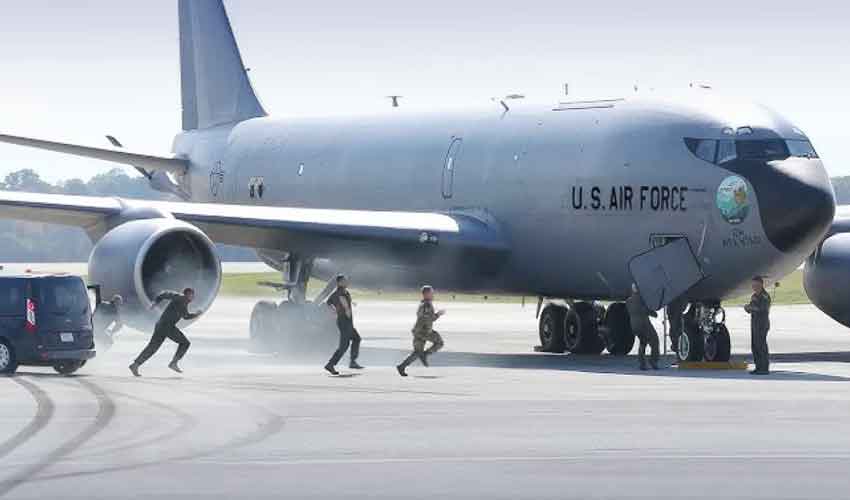
Five US Air Force refueling aircraft were damaged on the ground at Prince Sultan Air Base in Saudi Arabia during an Iranian missile strike, according to US officials cited in reports.
The attack targeted KC-135 tanker aircraft stationed at the base, though officials said the planes were damaged but not destroyed and will be repaired and returned to service.
Two US officials told The Wall Street Journal that five KC-135 refueling aircraft were struck in the Iranian missile attack in recent days while parked at the Saudi base.
The tankers suffered damage but remain repairable and are expected to return to operational service once maintenance work is completed.
Officials also confirmed that no personnel were killed in the strike.
The incident means that at least seven US Air Force refueling aircraft have now been damaged or destroyed during the ongoing conflict, according to reports.
Strategic base repeatedly targeted
Prince Sultan Air Base has been repeatedly targeted by Iranian missiles and drones over the past two weeks, according to open-source intelligence monitoring.
However, official sources have largely remained silent about the full extent of the damage from these attacks. US Central Command (CENTCOM) has not publicly commented on the Wall Street Journal report.
Prince Sultan Air Base has been a critical hub for US military operations in the Middle East since the 1990s. In the early 2000s, most US operations shifted to Al Udeid Air Base in Qatar, reducing activity at Prince Sultan.
Also Read: US deploys more Marines, warships to Middle East
However, amid rising tensions with Iran, US forces returned to the Saudi base in 2019, when the 378th Expeditionary Wing was established there.
In the lead-up to the current conflict, the United States had moved a large number of air assets to the base, beginning as early as last summer.
Pressure on US Air Force refueling fleet
The damage to multiple KC-135 aircraft could place additional strain on the US Air Force’s refueling fleet, which plays a vital role in supporting long-range air strikes and extended aerial patrol missions.
With several tankers reportedly non-operational, military planners may face increased logistical pressure in maintaining air operations across the region.
Separate analysis cited in reports estimates that US military asset losses during the first two weeks of Operation Epic Fury have reached about $3.84 billion.
The conflict has involved widespread strikes and counter-attacks across the region.
Fatal KC-135 crash in Iraq
Meanwhile, a separate tragedy occurred when six US service members were killed in a KC-135 tanker crash in western Iraq on Thursday.
US Central Command said the aircraft was lost while flying over friendly airspace on March 12 during Operation Epic Fury.
“The circumstances of the incident are under investigation,” CENTCOM said in a statement posted on X, adding that the crash was not caused by hostile fire or friendly fire.
Officials confirmed that two aircraft were involved in the incident. One tanker went down in western Iraq while the second aircraft landed safely.
Also Read: US embassy in Iraq's Baghdad hit in missiles attack
According to reports, the crash occurred after a collision between two KC-135 tankers.
Speaking at a press briefing, US Defense Secretary Pete Hegseth described the accident as a tragic reminder of the dangers of military operations.
“War is chaos and as we saw yesterday with the tragic crash of our KC-135 tanker, bad things can happen,” Hegseth said.
General Dan Caine, chairman of the Joint Chiefs of Staff, also addressed the incident, saying the loss of service members deeply affects military families.
“Those are very, very, very tough days when that knock comes on the door,” he said.
US troop fatalities rise
The latest deaths bring the total number of US personnel killed since Operation Epic Fury began on February 28 to 13.
The conflict continues to escalate across the Middle East, with military infrastructure and personnel increasingly exposed to attacks as hostilities persist.


.jpg)