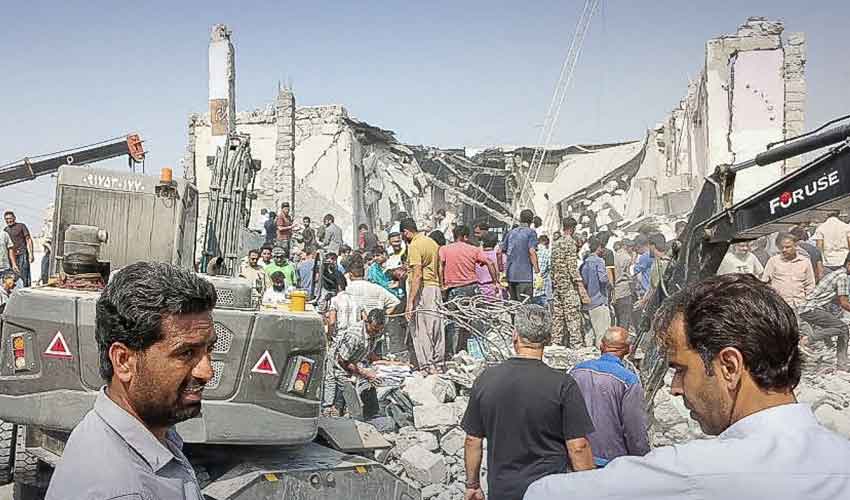
A preliminary US military investigation has found that the United States was responsible for a deadly Tomahawk missile strike on an Iranian elementary school.
The attack occurred on February 28 in Minab, where at least 175 people, mostly children, were killed, according to Iranian officials.
US officials and others familiar with the inquiry say the strike on the Shajarah Tayyebeh elementary school building was the result of a targeting mistake by the US military.
The missile was launched during US strikes on a nearby Iranian military base, which the school building had once been part of. Investigators found that the target coordinates were created using outdated intelligence data.
Outdated intelligence triggered error
According to people briefed on the preliminary findings, officers at US Central Command relied on old targeting information supplied by the Defense Intelligence Agency (DIA).
The outdated data incorrectly identified the school building as a military target when it was passed to Central Command, the command responsible for overseeing the war.
Officials said investigators are still trying to determine why the outdated intelligence was not double-checked before the strike was carried out.
The strike on a building filled with schoolchildren is expected to be remembered as one of the most devastating single military mistakes in recent decades. Iranian authorities have said at least 175 people were killed, with most of the victims being children attending the elementary school.
Although the investigation’s initial conclusion was widely anticipated — because the United States is the only country involved in the conflict known to use Tomahawk missiles — the finding has cast a shadow over the US military campaign in Iran.
School located next to Iranian naval base
The Shajarah Tayyebeh school in Minab sits on the same block as facilities used by Iran’s Islamic Revolutionary Guards Navy, which has been a major target of US military strikes.
Officials involved in the investigation said the building had once been part of the naval base before later being converted into a school. However, it remains unclear exactly when the building officially began operating as an educational institution.
A visual investigation conducted by The New York Times found that the school building had been physically separated from the military base between 2013 and 2016.
Satellite imagery reviewed by the newspaper showed several changes confirming its use as a school. These included the removal of nearby watchtowers, the opening of three public entrances, and the clearing of land for play areas.
Investigators also observed that sports fields were painted on asphalt and the walls were repainted blue and pink, further indicating that the facility had become a civilian school.
Intelligence agencies involved in targeting
The Defense Intelligence Agency plays a key role in developing targeting data used by US military planners.
However, when the agency’s information is outdated, intelligence officers are expected to verify it using updated satellite imagery and other intelligence from the National Geospatial-Intelligence Agency (NGA).
Military targeting is a complex process involving multiple agencies, and several officers are responsible for confirming the accuracy of the data.
The ongoing investigation is examining the roles of several US intelligence and military organizations. These include US Central Command, the Defense Intelligence Agency, and the National Geospatial-Intelligence Agency, which provides satellite imagery for military operations.
Officials from Central Command declined to comment on the investigation, while the DIA referred questions to the Pentagon, which also declined to comment, saying the case remains under investigation. The NGA did not immediately respond to requests for comment.
Possible role of AI
Investigators have also looked into whether artificial intelligence systems or automated data analysis tools could have contributed to the targeting error.
US officials said they reviewed the role of technologies such as Maven Smart System, used by the NGA to help identify potential targets.
Large language models such as Claude, developed by Anthropic, assist in identifying points of interest but do not directly create military targets.
Officials familiar with the investigation believe the mistake was unlikely to have been caused by new technology, suggesting it was more likely the result of human error during wartime operations.
Evidence supporting US responsibility
Independent evidence has increasingly pointed to US responsibility for the strike.
Satellite imagery, social media footage, and verified videos analyzed by The New York Times visual investigations team showed that the school was hit by a precision strike around the same time as attacks on the nearby naval base.
The analysis also showed that the base was struck again roughly two hours later.
A video verified by the newspaper and released by Iran’s semi-official Mehr News Agency shows a Tomahawk cruise missile striking the naval base next to the school in Minab on February 28.
Trump administration responses raise concerns
The investigation has also been complicated by public comments from President Donald Trump, who has at times attempted to shift blame for the strike.
Officials who have reviewed the findings expressed unease after Mr. Trump suggested that Iran might have been responsible.
Speaking to reporters aboard Air Force One, Mr. Trump said: “In my opinion, based on what I’ve seen, that was done by Iran… They’re very inaccurate with their munitions.”
He also incorrectly suggested that Iran might possess Tomahawk missiles, despite the weapon being used exclusively by the United States.
Later, when asked why he was the only official in his administration blaming Iran, Mr. Trump replied: “Because I just don’t know enough about it.”
He added that he would accept the final findings of the investigation.
White House Press Secretary Karoline Leavitt said the inquiry is still underway. “As The New York Times acknowledges in its own reporting, the investigation is still ongoing,” she said in a statement.
Defense Secretary Pete Hegseth and other administration officials have declined to comment further beyond confirming that the incident is under investigation.
Historical parallels with Kosovo war error
The use of outdated intelligence in the strike has drawn comparisons with a major intelligence failure during the Kosovo war in 1999.
At that time, outdated maps and flawed intelligence led the CIA to mistakenly identify the Chinese Embassy in Belgrade as a Yugoslav arms agency, resulting in a NATO airstrike that killed three Chinese citizens.
Former CIA director George J. Tenet later told Congress that the mistake was partly caused by poor database maintenance and overstretched intelligence resources.


.jpg)