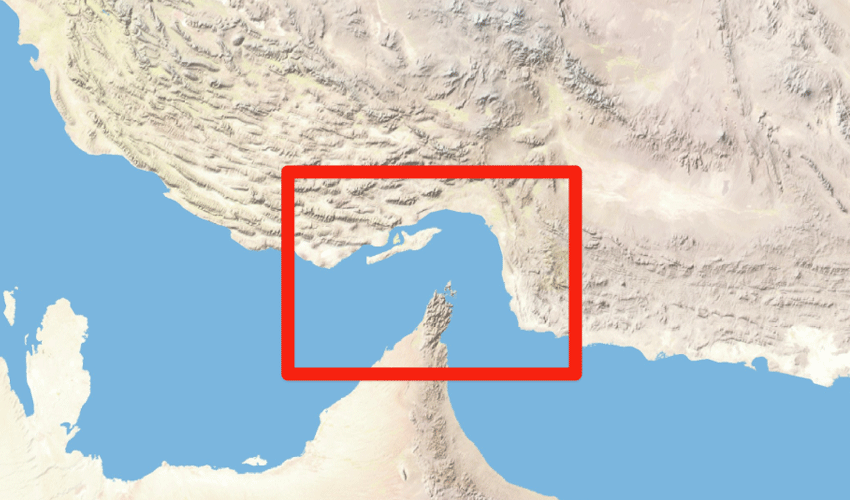
Rising tensions from the Iran–Israel conflict have triggered major disruptions in global energy markets after Iran reportedly closed the strategic Strait of Hormuz, one of the world’s most vital oil shipping routes.
The development has raised serious concerns for Pakistan, which relies heavily on oil and LNG imports passing through the strait. Experts warn the situation could impact fuel availability, increase energy prices, and widen the country’s trade deficit.
The ongoing conflict between Iran, Israel, and the United States has created deep uncertainty in the global energy market.
Iran’s closure of the 22-kilometer-wide Strait of Hormuz has put global oil supplies at risk. The passage is one of the world’s most critical energy corridors, carrying 21% of global crude oil and around 30% of global LNG shipments.
Every day, 30 to 40 oil tankers pass through the strait. Major Gulf exporters such as Saudi Arabia, the United Arab Emirates, and Qatar rely heavily on this route for their energy exports.
Pakistan heavily dependent on Strait of Hormuz route
Pakistan is particularly vulnerable to any disruption in this corridor. The country imports about 80% of its oil requirements, and around 90% of that supply arrives through the Strait of Hormuz.
On average, Pakistan imports about 200,000 barrels of crude oil daily, along with 145,000 barrels of refined gasoline and significant volumes of other petroleum products.
In addition, 10 RLNG cargoes reach Pakistan each month via the same route, making the strait a critical component of the country’s energy supply chain.
Limited fuel reserves
Energy experts warn that Pakistan’s current petroleum reserves may not be enough to withstand a prolonged disruption. The country reportedly holds only about 28 days of petroleum product storage, which analysts describe as dangerously low under the present circumstances.
Economist Dr. Shakeel said policymakers have mainly focused on price management rather than preparing for a potential supply blockage.
“Our focus has been on prices, perhaps how we can manage their impact, but we may not have fully considered the possibility of a complete supply blockage,” he said.
He emphasized that Pakistan should have at least three months of operational fuel storage capacity to deal with crises of this nature.
Pakistan’s trade deficit could worsen
The closure of the Strait of Hormuz has already pushed global oil prices upward.
Crude oil prices have risen by $10 to $13 per barrel within just a few days, and analysts fear further increases as ships may be forced to adopt longer alternative sea routes.
Dr. Shakeel warned that if global oil prices climb to $100 per barrel, Pakistan’s trade deficit could increase by $5 to $7 billion, putting additional pressure on the national economy and currency.
Energy expert Dr. Khalid Waleed explained that two major fuel categories could directly affect Pakistan’s economy.
“One is petroleum products, which impact the transportation sector, and the other is RLNG, which is directly connected to the country’s energy system,” he said.
He stressed that Pakistan must gradually shift from import-based fuels to indigenous energy sources. One possible solution, he noted, is the storage of hydrocarbons in depleted gas and oil fields, which can serve as strategic energy reserves during crises.
Impact of war could last months
Even if the conflict ends soon, experts believe the economic and energy consequences may continue for months. Former petroleum secretary G.A. Sabri warned that disruptions in energy supply chains take time to recover.
“Even if the war ends immediately, its negative effects will remain for several months,” he said, explaining that industrial facilities and supply systems cannot resume normal operations instantly once they shut down.
He described the current situation as extremely challenging and potentially disastrous if not handled carefully.
The emerging energy crisis presents one of the biggest challenges for Pakistan’s policymakers.
Experts say the country must accelerate efforts toward energy self-reliance, including activating local oil and gas reserves and investing in alternative energy solutions.
Strengthening domestic energy resources and building strategic reserves is increasingly seen as an unavoidable necessity rather than a policy option.


.jpg)