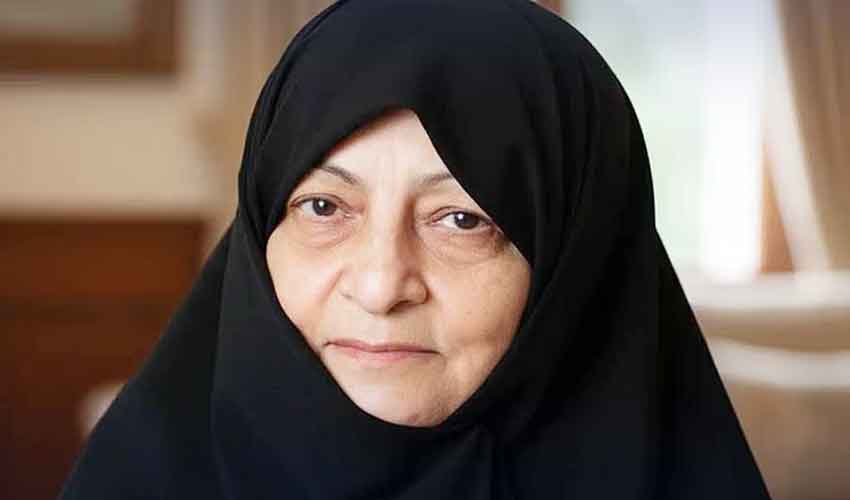
Mansoureh Khojasteh Bagherzadeh, the wife of Iran’s slain Supreme Leader Ayatollah Ali Khamenei, has died after succumbing to injuries sustained in a US-Israeli airstrike.
Iranian state media confirmed her death on Monday, two days after the strike that killed her husband and several family members at their residence in central Tehran.
Iranian media outlets, including the Tasnim news agency, reported that Mansoureh Khojasteh Bagherzadeh had been in a coma since Saturday’s strikes.
She was critically wounded in the same attack that killed her husband during what US officials described as Operation Epic Fury.
Tasnim announced on Telegram: “The martyrdom of the wife of the martyred leader of the revolution was confirmed.”
Al Jazeera also reported that she died two days after Ayatollah Ali Khamenei was killed in the strike.
Strike on Tehran residence decapitates leadership
Iran officially confirmed that Ayatollah Ali Khamenei was killed in the airstrike on his compound in central Tehran. The attack also claimed the lives of his daughter, son-in-law, daughter-in-law, grandchild and other family members who were present at the site, according to Iranian state media and international reports.
The large-scale air assault has been described as a devastating blow that virtually decapitated Iran’s leadership.
Khamenei, 86, had served as Iran’s Supreme Leader since 1989. As head of state and commander-in-chief of the military, he was the country’s most powerful figure and oversaw the Islamic Revolutionary Guard Corps (IRGC).
Private figure who avoided public life
Mansoureh Khojasteh Bagherzadeh, believed to have been 78 or 79 at the time of her death, was Khamenei’s only wife. The couple married in 1964 or 1965 and had four sons and two daughters together.
Despite decades of political turbulence under Khamenei’s rule, Bagherzadeh maintained a low public profile. She held no official position and largely avoided media attention.
In a rare 2011 interview with Iranian state media, she described her primary role as maintaining calm at home so her husband could focus on his political work.
“I think my biggest role was to preserve a calm atmosphere in our home so that he could do his work in peace,” she said at the time.
She recalled visiting him in prison during the Shah’s rule without sharing family hardships, distributing pamphlets, carrying messages, and hiding documents during revolutionary activities.
When asked whether Khamenei helped with household responsibilities, she responded: “He neither currently has time [to help] nor do I expect him to do so.”
She also noted that even when exhausted, he tried to keep work-related issues away from home.
National mourning
Following confirmation of the deaths, Iranian authorities declared a 40-day period of national mourning. A seven-day nationwide holiday was also announced to allow for funeral ceremonies and public condolences.
The deaths come as military operations continue for the third consecutive day, deepening political and security turmoil across Iran.
The war is spreading across the Middle East. Israel launched attacks on Hezbollah targets in Lebanon on March 2, with Lebanon’s health ministry reporting at least 31 people killed and many others injured.
Meanwhile, a senior US official, speaking anonymously, said Iran had been rebuilding infrastructure for its nuclear programme that was damaged in strikes last year.
The killing of Khamenei and his family marks a dramatic turning point in the conflict, with regional tensions at their highest level in years.




.jpg)