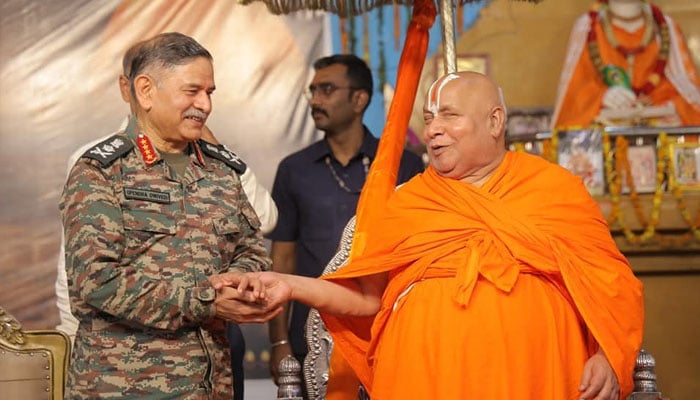
Indian Army Chief General Upendra Dwivedi has come under sharp criticism after he visited a Hindu ashram in uniform, sparking a debate over the role of religion in the country's armed forces.
General Dwivedi visited the ashram of Hindu spiritual leader Jagadguru Rambhadracharya, drawing condemnation from various quarters, including senior journalists, who called the move a departure from the secular and apolitical character traditionally maintained by the Indian military.
During this meeting, the spiritual leader requested the return of Azad Jammu and Kashmir as “dakshina”, which the army chief allegedly accepted.
This incident highlights a troubling trend of intertwining religion with state affairs, particularly within the military. Even prior to this, there has been a noticeable rise in the inclusion of religious rituals in government and military ceremonies -- signaling a gradual shift away from the secular foundations of the Indian armed forces.
This development not only undermines the secular character of India’s military but also poses significant risks to regional stability. The fusion of religious nationalism with military affairs has the potential to heighten tensions with neighboring countries, especially Pakistan, and further complicate the already sensitive situation in Kashmir.
Noted Indian journalist and former army officer Sushant Singh, in a post on X (formerly Twitter), said: “Civil-military relations are strained when military leaders align with partisan religious agendas, undermining the apolitical ethos of India’s secular armed forces.”
The timing of the visit is particularly sensitive as it came just days after a brief but intense military confrontation between India and Pakistan.
The four-day conflict erupted following an attack on Indian tourists in Pahalgam, located in Indian Illegally Occupied Jammu and Kashmir (IIOJK), which left 26 civilians dead. India swiftly blamed Pakistan for the incident, though it has yet to present concrete evidence.
The military escalation was halted on May 10 after the United States mediated a ceasefire between the two nuclear-armed neighbours. During the hostilities, Pakistan launched “Operation Bunyan-um-Marsoos,” targeting multiple Indian military installations and downing six Indian Air Force jets, including three Rafales, alongside dozens of drones.
Indian Air Marshal AK Bharti, when asked about the aerial losses, downplayed the situation, stating that "losses are a part of combat," without offering further clarification.
The Indian Army has previously taken steps to ensure that military personnel maintain religious neutrality while in uniform.
A directive was issued last year cautioning military officials against wearing religious trinkets, symbols, or accessories while in uniform. The advisory came after some officers were seen donning religious markers in widely circulated social media posts.
General Dwivedi's recent appearance at a religious institution has therefore raised eyebrows, with critics warning that such acts risk politicising the armed forces and eroding public confidence in their neutrality.