A wave of unverified earthquake predictions — stemming from a Japanese manga, psychic forecasts, and feng shui warnings — has sparked anxiety among East Asian travellers, leading to a notable dip in tourist bookings to Japan, particularly from Hong Kong and mainland China.
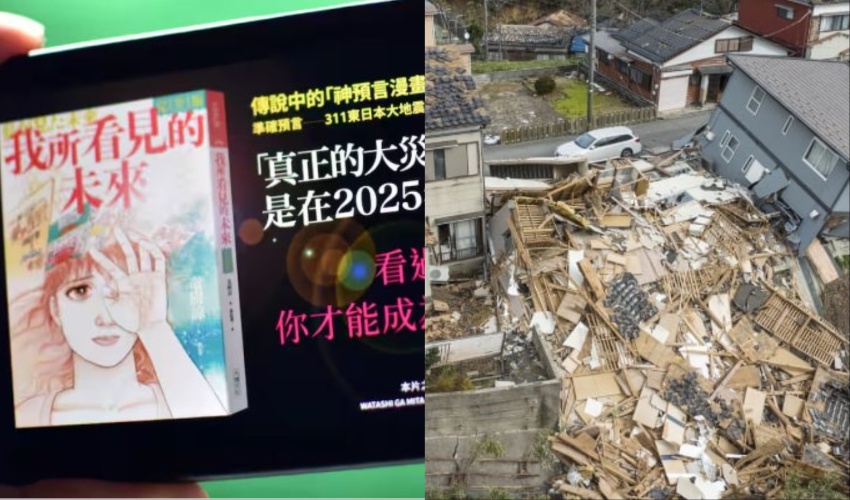
The unease centres around “The Future I Saw,” a 1999 comic book by manga artist Ryo Tatsuki, which gained notoriety for allegedly predicting the catastrophic Tohoku earthquake and tsunami in March 2011. In its 2021 “complete version,” Tatsuki suggested another major seismic event would occur in July 2025, describing a seabed fissure between Japan and the Philippines that would send waves even larger than those in 2011.
Although Tatsuki has cautioned readers against taking her dream-based visions literally, her cult following across Asia has helped rekindle earthquake fears. Social media platforms in Hong Kong, Thailand, Vietnam, and China have been flooded with content echoing dire predictions and urging people to avoid travel to Japan during the summer.
Several travel agencies report growing hesitancy among clients. CN Yuen, managing director of WWPKG in Hong Kong, confirmed a nearly 50% drop in Easter holiday bookings to Japan and forecast a further decline in the coming months.
“People just say they want to hold off their trip for now,” Yuen told local media, adding that such anxieties have become “ingrained” among travellers.
Adding fuel to the speculation were predictions by a self-styled psychic, who warned of an earthquake in the Tokyo Bay Area on April 26 — which did not materialise — and popular Hong Kong feng shui expert Master Seven, who advised against travel to Japan starting in April.
Japan’s Cabinet Office has since taken to X (formerly Twitter) to reiterate that no technology currently exists to reliably predict earthquakes, a position echoed by seismologists who argue that fear-mongering undermines public trust and preparation efforts.
Miyagi Governor Yoshihiro Murai, whose prefecture was heavily damaged in 2011, also voiced concern, saying: “It is a serious issue when the spread of highly unscientific rumours on social media has an effect on tourism.”
Japan, located along the volatile Ring of Fire, routinely faces seismic activity. While authorities have warned of an 80% chance of a major earthquake hitting the Nankai Trough region within the next 30 years, such projections are long-term assessments, not specific forecasts.
Impact on Tourism
Despite the swirl of online rumours and speculation, Japan continues to attract tourists in record numbers. Data from the Japan National Tourism Organization (JNTO) shows that 10.5 million foreign tourists visited the country in the first three months of 2025, a historic high.
This includes 2.36 million visitors from mainland China — a 78% increase from the same period last year — and 647,600 travellers from Hong Kong, marking a 3.9% year-on-year rise. Tourists from the United States, Canada, and Australia also contributed to the surge, with 343,000 Americans visiting Japan in March alone.
However, individual cases of trip cancellations reflect a growing “prophecy effect.” Samantha Tang, a 34-year-old yoga instructor from Hong Kong, called off her August vacation to Wakayama due to mounting fear stoked by online chatter.
“Everyone says so much about an earthquake coming,” said Tang, who has vacationed in Japan annually since the end of the pandemic.
Similarly, frequent visitor Oscar Chu, 36, opted to cancel his travel plans this year, citing concerns over possible flight disruptions and travel chaos in the event of a quake.
Still, many travellers remain undeterred. Among them is Vic Shing, who is travelling to Tokyo and Osaka in June.
“Earthquake predictions have never been accurate,” said Shing. “Japan has encountered many massive earthquakes before. It shouldn’t be too bad when it comes to disaster management.”
A Test of Resilience
Tatsuki’s manga has sold nearly 900,000 copies and continues to exert influence across the region. Yet the artist herself has asked readers not to be “overly swayed” by her dream-inspired visions, urging them to act based on expert guidance.
While Japan’s disaster readiness remains among the best in the world, the current bout of superstition-driven caution underscores the powerful role of media and social networks in shaping public sentiment — and the delicate balance tourism authorities must strike between public safety and economic stability.







.jpg)