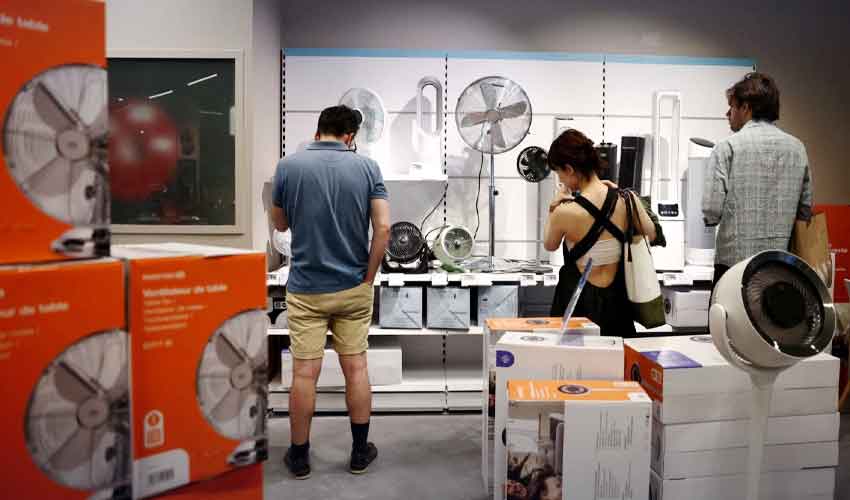
Hundreds of shoppers crowded Lidl supermarkets across Paris and surrounding suburbs on Thursday in a desperate bid to buy low-cost air-conditioning units, with police called to several stores after scuffles, long queues and frustration over limited stock.
The rush comes as France recovers from a record-breaking heatwave that caused excess deaths, overwhelmed hospitals, forced school closures and led to the cancellation of music festivals, while forecasters warn another spell of extreme heat is expected this weekend.
Large crowds formed outside Lidl branches in Paris and nearby suburbs as customers rushed to buy portable air conditioners being sold for as little as €179.
With similar units costing more than €1,200 elsewhere, the supermarket's promotion drew hundreds of shoppers, prompting police to respond to at least two stores as tensions rose.
Videos shared on social media showed customers crowding store entrances before opening hours and rushing inside once doors opened as demand for cooling appliances surged.
Long queues, disappointment over limited stock
At a small Lidl store in a northern Paris neighborhood, Mousa Traore said he had waited for more than an hour alongside around 200 other customers.
He said shoppers were initially told only two air conditioners were available.
"But then the police came and we were told there were none. The police officers took them, I think," he joked.
French lawmaker Karl Olive said similar scenes unfolded across several Lidl branches, with some customers queuing from as early as 6am before stores opened at 8:30am.
According to Olive, Lidl had advertised a nationwide campaign involving nearly 200,000 cooling devices, including portable air conditioners.
However, he said some branches, including one in Chambourcy, had no air conditioners available when customers entered.
"The disappointment was total: no air conditioners available, only fans," Olive wrote on X.
He added that while products can become victims of their own popularity, customers deserved accurate information about available stock.
Olive also cited French consumer law, arguing businesses should not mislead consumers regarding product availability.
Police intervene as disputes break out
Although many shoppers remained patient, arguments broke out as some people attempted to cut in line. One Lidl manager warned customers she would not open the store unless the crowd moved back.
Another employee told AFP that only two air conditioners had been delivered to the branch, but declined to confirm whether they had already been sold.
At a supermarket in Sevran, hundreds more shoppers gathered, with traffic backing up through the suburb as vehicles queued outside the store.
Similar scenes were reported in Livry-Gargan. One resident, identified only as Lolo, eventually abandoned the search.
"I give up, it's madness. I abandoned my car several streets away to get there on foot, but there is already a huge queue. It's impossible," Lolo said.
French media also reported chaotic scenes nationwide.
According to Le Parisien, police intervened after customers argued over the last remaining fans at a store in Saint-Germain-en-Laye.
Witnesses in Aubervilliers said some shoppers forced open store doors before opening time and pushed others in an attempt to reach cooling appliances first.
Heatwave fuels unprecedented demand
France has experienced several consecutive days of extreme heat, with temperatures exceeding 35 degrees Celsius (95°F) in many regions.
Meteorologists are forecasting another round of high temperatures over the coming weekend, increasing demand for air conditioners and cooling equipment.
Because France has historically experienced relatively mild summers, most homes and schools are not equipped with air conditioning, leaving many residents vulnerable during increasingly frequent heatwaves linked by scientists to global warming.
Air conditioning becomes political issue
The growing demand for air conditioning has also intensified political debate in France. The country's main far-right opposition party has criticized the government for failing to prepare the country for rising temperatures.
Environmental groups, meanwhile, have warned that widespread use of air conditioners significantly increases electricity consumption and greenhouse gas emissions while also raising temperatures in densely populated urban areas.
Instead, many left-leaning policymakers advocate broader climate adaptation measures, including expanding cooling centers, improving urban planning and introducing flexible working hours.
Europe rethinks cooling as temperatures rise
Air conditioning has long been standard in much of the United States, where homes, offices and businesses routinely rely on cooling systems during summer.
Europe, however, developed with milder summers, making air conditioning far less common.
That pattern is changing rapidly as Europe has become the world's fastest-warming continent.
According to the World Health Organization, around 200,000 people have died from heat-related causes across Europe in the past four years, with many of those deaths considered preventable.
Research consistently shows air conditioning is the most effective tool for preventing heat-related deaths, particularly among elderly people and children.
As climate change drives more frequent and intense heatwaves, France and other European countries are increasingly confronting difficult questions about balancing public health, energy consumption and climate goals.



.jpg)