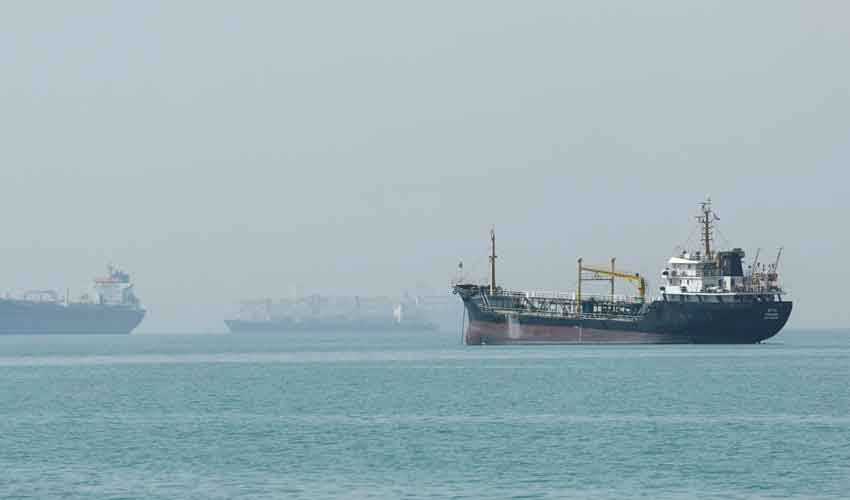
Iran reasserted its right to control shipping in the Strait of Hormuz on Friday and warned Gulf states against siding with the United States, a day after a ship attack near Oman exposed the fragility of a preliminary deal to end the Iran war.
The warning came as oil prices fell further despite continued uncertainty over the future of shipping through the vital waterway, where a fifth of global oil and liquefied natural gas supplies usually passes.
Tehran was responding to what it called an “interventionist, irresponsible and provocative” joint statement by the United States and six Gulf states.
The statement rejected Iran’s insistence that it could charge tolls on vessels passing through the Strait of Hormuz.
Iran’s Deputy Foreign Minister Kazem Gharibabadi said safe passage could not be guaranteed through unclear arrangements or routes that ignore Iran’s role as a coastal state.
“Safe passage through the Strait of Hormuz cannot be guaranteed under ambiguous arrangements, parallel routes or decision-making that does not take Iran’s role as a coastal state into account,” he said on X.
Rubio warns Iran over shipping threats
US Secretary of State Marco Rubio, who was wrapping up a Gulf tour to reassure regional allies about the interim US-Iran pact, warned that any Iranian threat to shipping would create a serious problem.
“If Iran threatens or blocks ships in the strait, we’re going to have a problem,” Rubio told reporters on Thursday.
In a joint statement, Rubio and the Gulf Cooperation Council called for “free, unconditional, and unrestricted navigation” through the Strait of Hormuz without tolls or attempts to assert control.
The statement also said any lasting peace must address Iran’s ballistic missiles, drones and support for proxy groups.
Tehran warns against ‘hostile policies’
Iran’s Foreign Ministry responded on Friday by saying the US military presence in the Gulf was the source of regional insecurity and division. The ministry said the Strait of Hormuz should be governed by Tehran and Oman in line with the terms of the interim deal.
Also Read: Strait of Hormuz attack halts UN ship escort operation
“We warn against the continuation of hostile and interventionist policies in the region,” it said.
Iran took effective control of the waterway after US-Israeli strikes on February 28 triggered the war, disrupting oil flows and rattling global energy markets.
Ever Lovely hit near Oman
Taiwan’s Evergreen Marine said on Friday that its Singapore-flagged ship Ever Lovely was hit close to Oman on Thursday by an “unknown object.”
The company said the vessel had been traveling on a route recommended by the British navy agency UKMTO. No one was injured in the incident, and the ship later resumed its journey out of the Strait of Hormuz.
Two US officials told Reuters that Iran had fired on the ship.
Iran’s Persian Gulf Strait Authority, which was established by Tehran to manage requests for vessels traveling through the strait, said passage through unauthorized routes would be the responsibility of the owner, operator and vessel commander.
There was no immediate comment from the US government.
US President Donald Trump had earlier warned that if Iran did not honor the interim deal, including reopening the strait, the United States would probably resume bombing the country.
IMO pauses ship escort operation
The International Maritime Organization, a UN agency, temporarily paused its operation to escort ships through the Strait of Hormuz after the Oman incident.
The IMO and Oman had earlier announced a new southern route through the strait to evacuate hundreds of ships stranded by the war, a move that angered Tehran.
Also Read: Cargo vessel struck near Strait of Hormuz, reports UKMTO
Jakob Larsen, chief safety and security officer at shipping association BIMCO, said the attack was a setback for efforts to evacuate ships and resume regular transit.
“The situation underscores the importance of clear and unambiguous agreements between the US and Iran regarding a resumption of maritime traffic through the strait,” he said.
Shipping traffic slows after attack
Fewer vessels transited the Strait of Hormuz on Friday than earlier in the week, according to ship-tracking data.
Tanker traffic, including crude oil, oil product and chemical tankers, fell to 13 transits in both directions on Friday, compared with 24 on Thursday and 27 on Wednesday, according to Kpler analysis.
Wednesday’s figure was the highest level since before the conflict began with US-Israeli strikes on Iran on February 28.
For overall sailings in both directions, including dry bulk ships, AXSMarine data showed 62 transits on June 24, the highest single-day count since the conflict began.
However, AXSMarine said that represented only 53% of the traffic recorded on the same day last year, adding that traffic has not yet fully normalized. Before the conflict, average daily sailings through the strait stood at around 125 ships.
Tankers continue to move despite risks
Despite the slowdown, at least four tankers, including three Very Large Crude Carriers, entered the Gulf on Friday to load oil, according to ship-tracking data from LSEG and MarineTraffic.
Each Very Large Crude Carrier can carry up to 2 million barrels of oil.
Also Read: Iran plans billion-dollar revenue from Strait of Hormuz fees, says report
Two separate supertankers entered the strait to load Iranian oil, while another tanker exited the strait via the Omani side carrying 2 million barrels of oil, according to Kpler analysis.
Oil buyers have been seeking to secure supplies after months of disruption caused by the Iran war and the subsequent ceasefire deal between Washington and Tehran.
Saudi Aramco resumes Ras Tanura loadings
Saudi Aramco resumed crude loadings on Friday at its Ras Tanura terminal in the Gulf, the world’s biggest oil port, after a nearly four-month halt.
Shipping data showed two Very Large Crude Carriers controlled by Saudi Arabia’s shipping arm Bahri loading crude at Ras Tanura, while another waited nearby.
Ras Tanura sits on Saudi Arabia’s eastern coast on the Gulf, west of the Strait of Hormuz. Before the conflict, the terminal used to export more than 5 million barrels per day of crude.
Crude prices dropped by more than 3% on Friday and were on course for steep weekly losses as easing supply concerns outweighed renewed security fears. The decline came as top exporter Saudi Arabia resumed loadings in the Gulf and more tankers moved through the strait.
Oil prices had previously been under pressure from months of disruption after Iran blocked the waterway during the war.
South Korean ships to exit Hormuz
South Korean President Lee Jae Myung said on Friday that three South Korean ships would leave the Strait of Hormuz over the weekend.
The announcement came after South Korea’s Oceans Ministry reported that eight more South Korean vessels had already exited the strait.
The dispute over the Strait of Hormuz is one of several unresolved issues in the framework ceasefire deal between the United States and Iran.
Disagreements also persist over financial incentives for Iran, nuclear inspections and Israel’s parallel war in Lebanon. The interim deal has opened a 60-day negotiation window to tackle more difficult issues, including Iran’s nuclear program.
In the United States, the war is weighing heavily on President Trump ahead of November midterm elections that will determine control of Congress.





.jpeg)